AQA · A-Level · History
Course version: 7042 · Version from Sept 2017
The USSR and the Soviet Empire, 1953–2000 (A-level only) – Years of…
Full specification wording
2T The Crisis of Communism: The USSR and the Soviet Empire, 1953–2000 (A-level only) – Years of Stagnation, 1964–1985: Economic and social policies and problems under Brezhnev: attempted reforms of Kosygin; the 10th Five Year Plan; agriculture; defence spending; consumer goods, living standards and life-styles for the elite and the workers
Under Brezhnev, the USSR experienced an 'Era of Stagnation' characterised by deep economic and social problems.
Checked against the AQA 7042 specification (opens in a new tab) on .
- Point 2 of 4
- 2 key terms
Study notes
From the checked teaching notes for this specification point.
The idea
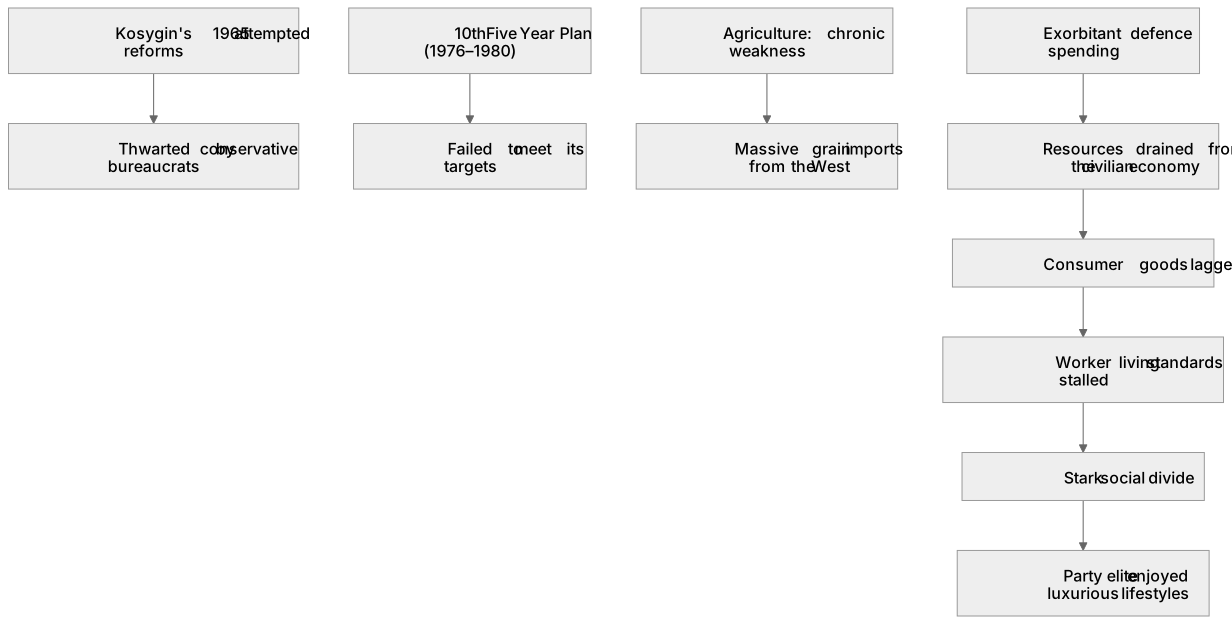
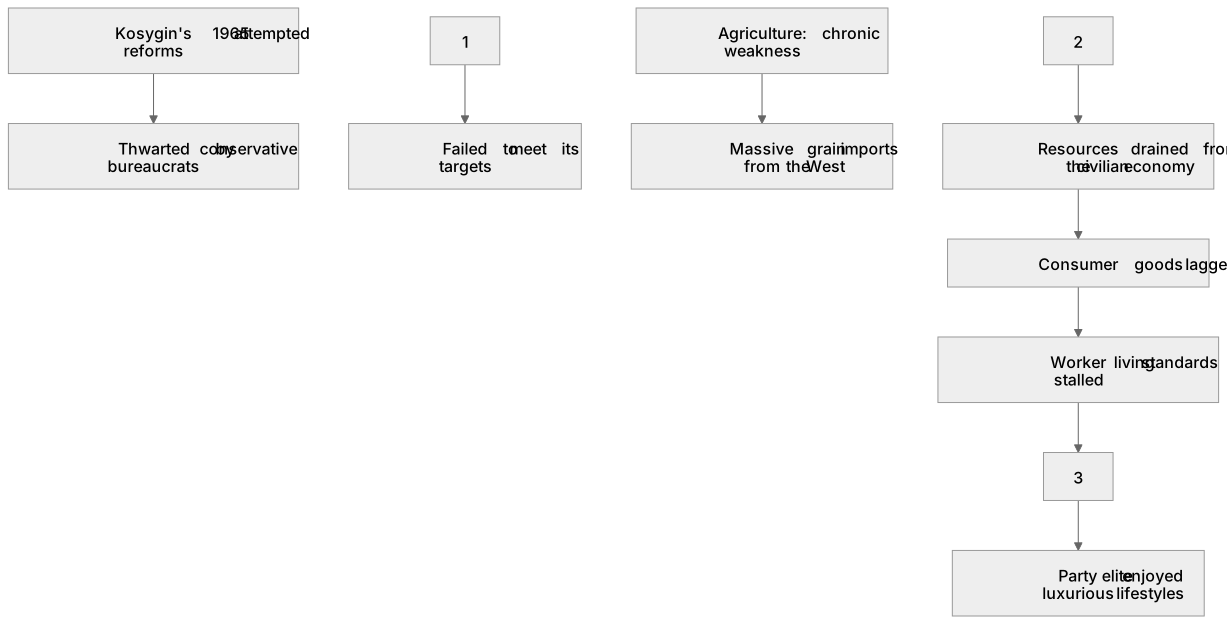
Under Brezhnev, the USSR experienced an 'Era of Stagnation' characterised by deep economic and social problems. Alexei Kosygin’s 1965 attempted reforms aimed to increase enterprise autonomy and incentivise production, but were thwarted by conservative bureaucrats. The 10th Five Year Plan (1976–1980) failed to meet its targets, highlighting systemic inefficiencies. Agriculture remained a chronic weakness, requiring massive grain imports from the West despite heavy investment. Meanwhile, exorbitant defence spending to achieve nuclear parity drained resources from the civilian economy. Consequently, the production of consumer goods lagged, stalling worker living standards. A stark social divide emerged: while ordinary workers faced shortages and queues, the party elite enjoyed luxurious lifestyles.
What earns the marks
- Evaluate the failure of Kosygin's 1965 reforms due to resistance from orthodox central planners who feared losing political control.
- Analyse the shortcomings of the 10th Five Year Plan, specifically the failure to transition from extensive to intensive economic growth.
- Assess the impact of the military-industrial complex, noting that defence spending consumed a disproportionate and unsustainable share of the Soviet GDP.
- Contrast the stagnant living standards and consumer goods shortages for ordinary workers with the privileged lifestyles of the nomenklatura.
- Explain the chronic agricultural failures that forced the USSR to rely on capitalist nations for grain imports despite massive state subsidies.
Common mistakes and how to put them right
Claiming Kosygin's reforms were fully implemented and successful.
Put it right: Acknowledge that Kosygin's reforms were watered down and ultimately abandoned due to conservative opposition.
Assuming living standards fell dramatically for everyone under Brezhnev.
Put it right: Note that while consumer goods were scarce, basic living standards for workers were stable, though they contrasted sharply with elite privileges.
Ignoring the role of defence spending in economic stagnation.
Put it right: Explicitly link the massive financial drain of the arms race to the lack of investment in consumer goods and agriculture.
Exam tips
- Use the term 'nomenklatura' when discussing the elite to demonstrate precise historical vocabulary.
- Link the failure of the 10th Five Year Plan directly to the systemic flaws of a command economy rather than just bad weather or bad luck.
- When evaluating Brezhnev's domestic record, weigh the short-term stability he provided against the long-term damage caused by economic stagnation.
Try the lesson
The start of the 2T The Crisis of Communism: The USSR and the Soviet Empire, 1953–2000 (A-level only) – Years of Stagnation, 1964–1985: Economic and social policies and problems under Brezhnev: attempted reforms of Kosygin; the 10th Five Year Plan; agriculture; defence spending; consumer goods, living standards and life-styles for the elite and the workers lesson, made from checked teaching notes for this specification point.
Have a go first
What was the primary objective of the economic reforms introduced by Alexei Kosygin in 1965?
Listen
Under Brezhnev, the USSR experienced an 'Era of Stagnation' characterised by deep economic and social problems. Alexei Kosygin’s 1965 attempted reforms aimed to increase enterprise autonomy and incentivise production, but were thwarted by conservative bureaucrats. The 10th Five Year Plan (1976–1980) failed to meet its targets, highlighting systemic inefficiencies. Agriculture remained a chronic weakness, requiring massive grain imports from the West despite heavy investment. Meanwhile, exorbitant defence spending to achieve nuclear parity drained resources from the civilian economy. Consequently, the production of consumer goods lagged, stalling worker living standards. A stark social divide emerged: while ordinary workers faced shortages and queues, the party elite enjoyed luxurious lifestyles. A strong answer earns marks for these points. Evaluate the failure of Kosygin's 1965 reforms due to resistance from orthodox central planners who feared losing political control. Analyse the shortcomings of the 10th Five Year Plan, specifically the failure to transition from extensive to intensive economic growth. Assess the impact of the military-industrial complex, noting that defence spending consumed a disproportionate and unsustainable share of the Soviet GDP. Contrast the stagnant living standards and consumer goods shortages for ordinary workers with the privileged lifestyles of the nomenklatura. A common slip: Claiming Kosygin's reforms were fully implemented and successful. Instead, Acknowledge that Kosygin's reforms were watered down and ultimately abandoned due to conservative opposition. Exam tip: Use the term 'nomenklatura' when discussing the elite to demonstrate precise historical vocabulary.
See it
Key words
Say what each word means before you turn the card.
Economic stagnation
Try answering aloud or in your head before turning the card.
Social inequality
Try answering aloud or in your head before turning the card.
See every definition
- Economic stagnation
- An 'Era of Stagnation' under Brezhnev characterised by deep economic and social problems, with the 10th Five Year Plan failing to meet its targets and highlighting systemic inefficiencies.
- Social inequality
- A stark social divide in which ordinary workers faced shortages and queues while the party elite enjoyed luxurious lifestyles.
Label the diagram
Some boxes have lost their names. Pick the right name for each number.
1Box 1
2Box 2
3Box 3
There is more to this lesson
The full lesson goes on to check your understanding and help you earn the marks. Create a free account to carry on, with your progress saved.
A week of Premium from your first lesson · Then the free plan continues · No card, no charge
Test your understanding of 2T The Crisis of Communism: The USSR and the Soviet Empire, 1953–2000 (A-level only) – Years of Stagnation, 1964–1985: Economic and social policies and problems under Brezhnev: attempted reforms of Kosygin; the 10th Five Year Plan; agriculture; defence spending; consumer goods, living standards and life-styles for the elite and the workers
Active recall beats re-reading. Take an instant quiz now to test what you’ve learned and lock it into long-term memory.
A week of Premium from your first lesson · Then the free plan continues · No card, no charge