OCR · GCSE · History
Course version: J410 · Version from Mar 2026
The changing international order 1918–1975 - The Cold War in Europe…
Full specification wording
International Relations: the changing international order 1918–1975 - The Cold War in Europe 1945–1961: Rising Tensions: The building of the Berlin Wall 1961 and its effects on international relations.
This topic asks you to know why the Berlin Wall was built in 1961 and to explain its consequences for relations between the superpowers.
Checked against the OCR J410 specification (opens in a new tab) on .
- Point 5 of 5
- 4 key terms
Study notes
From the checked teaching notes for this specification point.
The idea
This topic asks you to know why the Berlin Wall was built in 1961 and to explain its consequences for relations between the superpowers. Learn the background: after 1945 Germany was divided, and Berlin lay deep inside the Soviet zone but was itself split into sectors. By 1961 around three million East Germans had left for the West, many through Berlin, which weakened the East German state. In August 1961 the East German authorities, with Soviet backing, sealed the border and built the Wall. Study the effects: it stopped the refugee flow, it became a symbol of a divided Europe, and it reduced direct confrontation over Berlin while hardening the division between East and West. Link each cause and effect with clear agents and dates.
What earns the marks
- Identifies that the Wall was built in August 1961 by the East German authorities with Soviet support.
- Explains that a major cause was the large-scale emigration of East Germans to the West through Berlin.
- Describes an effect on international relations, such as the Wall becoming a symbol of the division of Europe.
- Explains that the Wall reduced the immediate risk of direct superpower confrontation over Berlin while hardening the East–West split.
Common mistakes and how to put them right
States that the Wall was built by the Western Allies.
Put it right by naming the East German authorities acting with Soviet backing.
Confuses the Berlin Wall with the earlier Berlin Blockade of 1948–1949.
Put it right: Keep the two events and their dates separate.
Claims the Wall ended the Cold War.
Put it right by explaining that it symbolised and hardened division rather than ending it.
Exam tips
- Learn the key date, August 1961, and the main cause, the refugee flow to the West.
- Practise linking each cause and effect with a clear agent, such as the East German government.
- Use the Wall as a symbol of division when explaining effects on international relations.
Try the lesson
The start of the International Relations: the changing international order 1918–1975 - The Cold War in Europe 1945–1961: Rising Tensions: The building of the Berlin Wall 1961 and its effects on international relations. lesson, made from checked teaching notes for this specification point.
Have a go first
In which year did the East German authorities begin building the Berlin Wall?
Listen
This topic asks you to know why the Berlin Wall was built in 1961 and to explain its consequences for relations between the superpowers. Learn the background: after 1945 Germany was divided, and Berlin lay deep inside the Soviet zone but was itself split into sectors. By 1961 around three million East Germans had left for the West, many through Berlin, which weakened the East German state. In August 1961 the East German authorities, with Soviet backing, sealed the border and built the Wall. Study the effects: it stopped the refugee flow, it became a symbol of a divided Europe, and it reduced direct confrontation over Berlin while hardening the division between East and West. Link each cause and effect with clear agents and dates. A strong answer earns marks for these points. Identifies that the Wall was built in August 1961 by the East German authorities with Soviet support. Explains that a major cause was the large-scale emigration of East Germans to the West through Berlin. Describes an effect on international relations, such as the Wall becoming a symbol of the division of Europe. Explains that the Wall reduced the immediate risk of direct superpower confrontation over Berlin while hardening the East–West split. A common slip: States that the Wall was built by the Western Allies. Instead, naming the East German authorities acting with Soviet backing. Exam tip: Learn the key date, August 1961, and the main cause, the refugee flow to the West.
See it
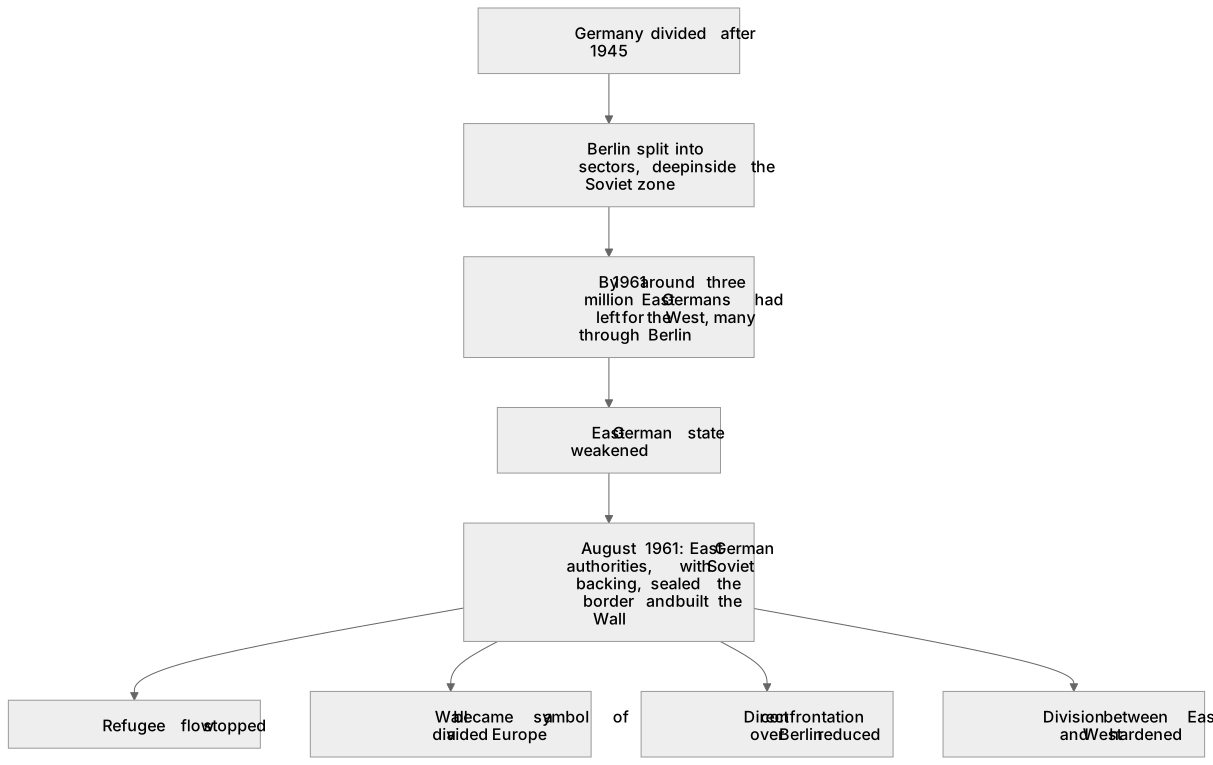
Key words
Say what each word means before you turn the card.
Causes of the building of the Berlin Wall
Try answering aloud or in your head before turning the card.
The refugee crisis and East German weakness
Try answering aloud or in your head before turning the card.
Effects on superpower relations
Try answering aloud or in your head before turning the card.
The Wall as a symbol of a divided Europe
Try answering aloud or in your head before turning the card.
See every definition
- Causes of the building of the Berlin Wall
- A major cause was the large-scale emigration of East Germans to the West through Berlin, which weakened the East German state.
- The refugee crisis and East German weakness
- By 1961 around three million East Germans had left for the West, many through Berlin, which weakened the East German state.
- Effects on superpower relations
- It reduced direct confrontation over Berlin while hardening the division between East and West.
- The Wall as a symbol of a divided Europe
- It became a symbol of a divided Europe, symbolising and hardening division rather than ending the Cold War.
Label the diagram
Some boxes have lost their names. Pick the right name for each number.
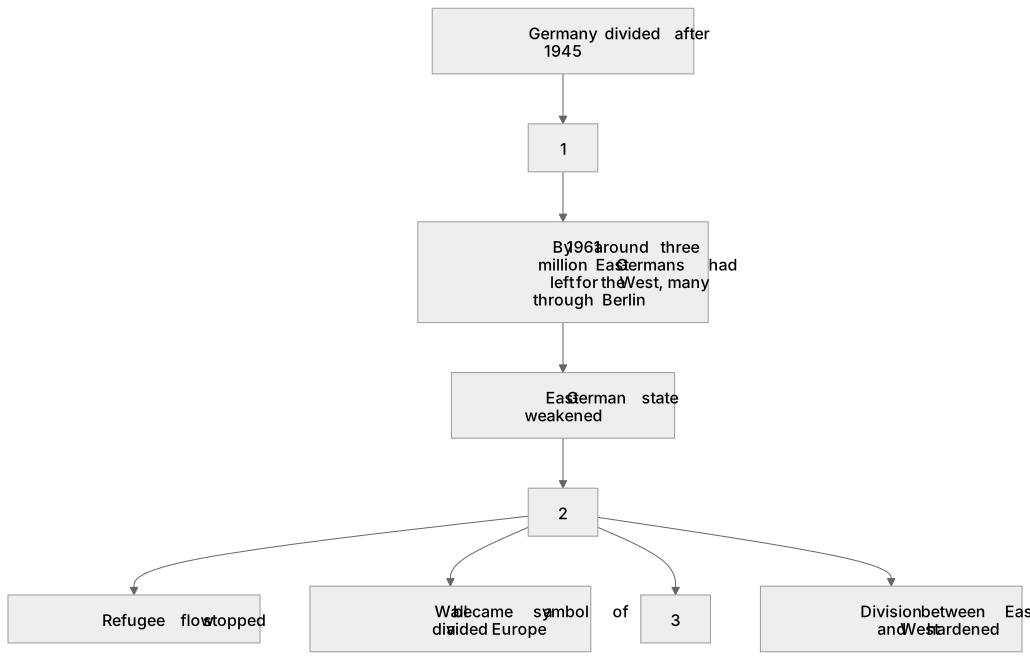
1Box 1
2Box 2
3Box 3
There is more to this lesson
The full lesson goes on to check your understanding and help you earn the marks. Create a free account to carry on, with your progress saved.
A week of Premium from your first lesson · Then the free plan continues · No card, no charge
Test your understanding of International Relations: the changing international order 1918–1975 - The Cold War in Europe 1945–1961: Rising Tensions: The building of the Berlin Wall 1961 and its effects on international relations.
Active recall beats re-reading. Take an instant quiz now to test what you’ve learned and lock it into long-term memory.
A week of Premium from your first lesson · Then the free plan continues · No card, no charge