OCR · GCSE · History
Local Site Study
This guide provides a comprehensive, exam-focused breakdown of the OCR GCSE History 'History Around Us' local site study. It equips candidates with the specific analytical skills, architectural vocabulary, and historical context needed to transform site observations into high-mark answers.
- 6 min read
- 3 worked examples
- 5 practice questions
- 6 key terms
Study Notes
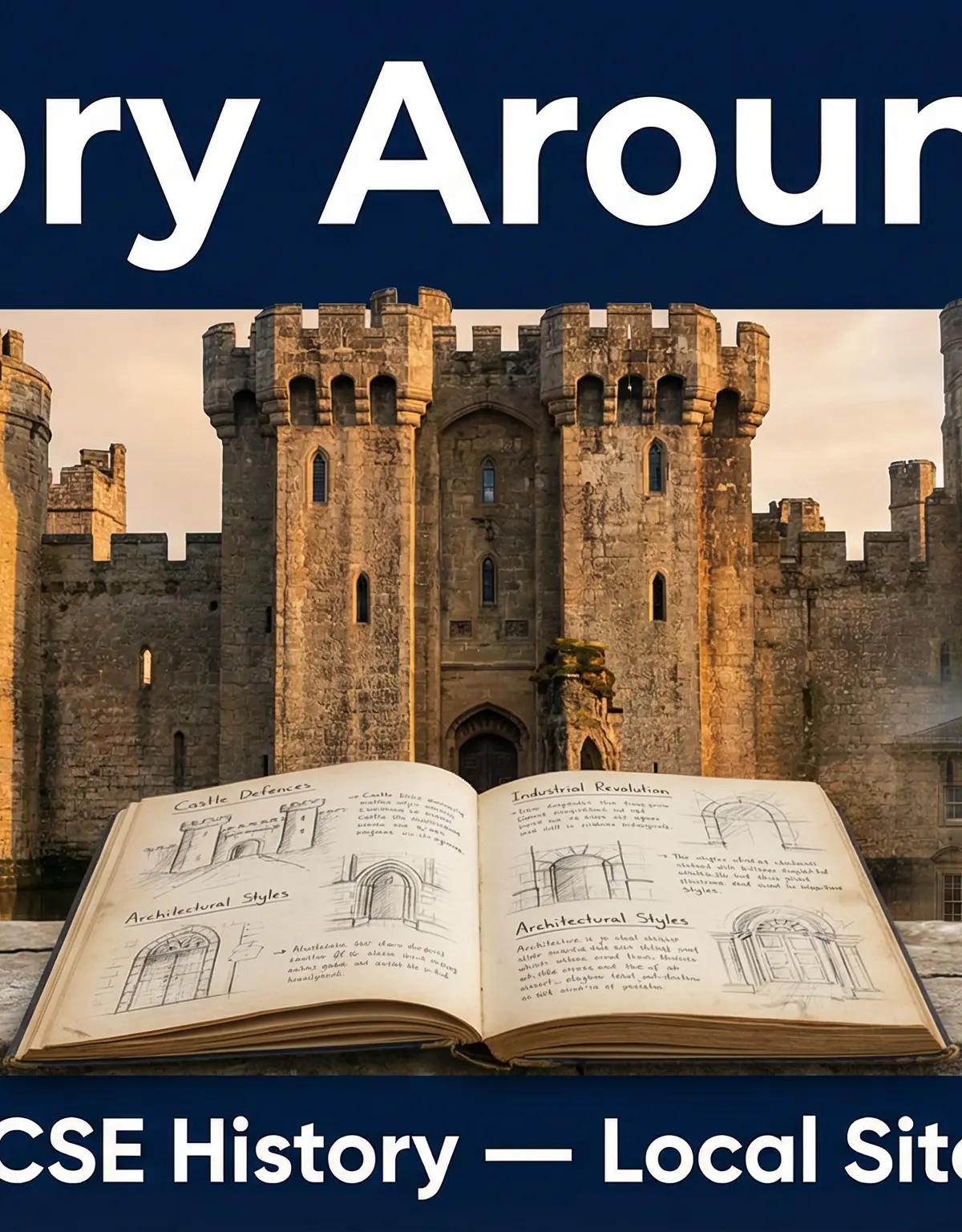
Overview
The OCR 'History Around Us' component requires candidates to conduct a rigorous historical enquiry into a specific, designated site. This is not a descriptive task; it is an analytical one. Examiners expect you to use the site's physical features—its architecture, layout, materials, and modifications over time—as primary evidence to answer historical questions. You must connect the tangible remains you can see and touch to broader historical contexts, such as national events, social changes, and technological developments. High-level responses will demonstrate a clear understanding of the site's chronological evolution, evaluate its changing functions, and analyse its significance. Credit is awarded for moving beyond a simple narrative or 'guidebook' description to construct a well-supported argument grounded in the physical evidence of the site itself. This study is worth a significant portion of the GCSE, and mastering the technique of reading a site as a historical document is the key to success.
Key Concepts for Site Analysis
This section breaks down the core analytical frameworks examiners want to see you apply. Use these as a mental checklist for any question.
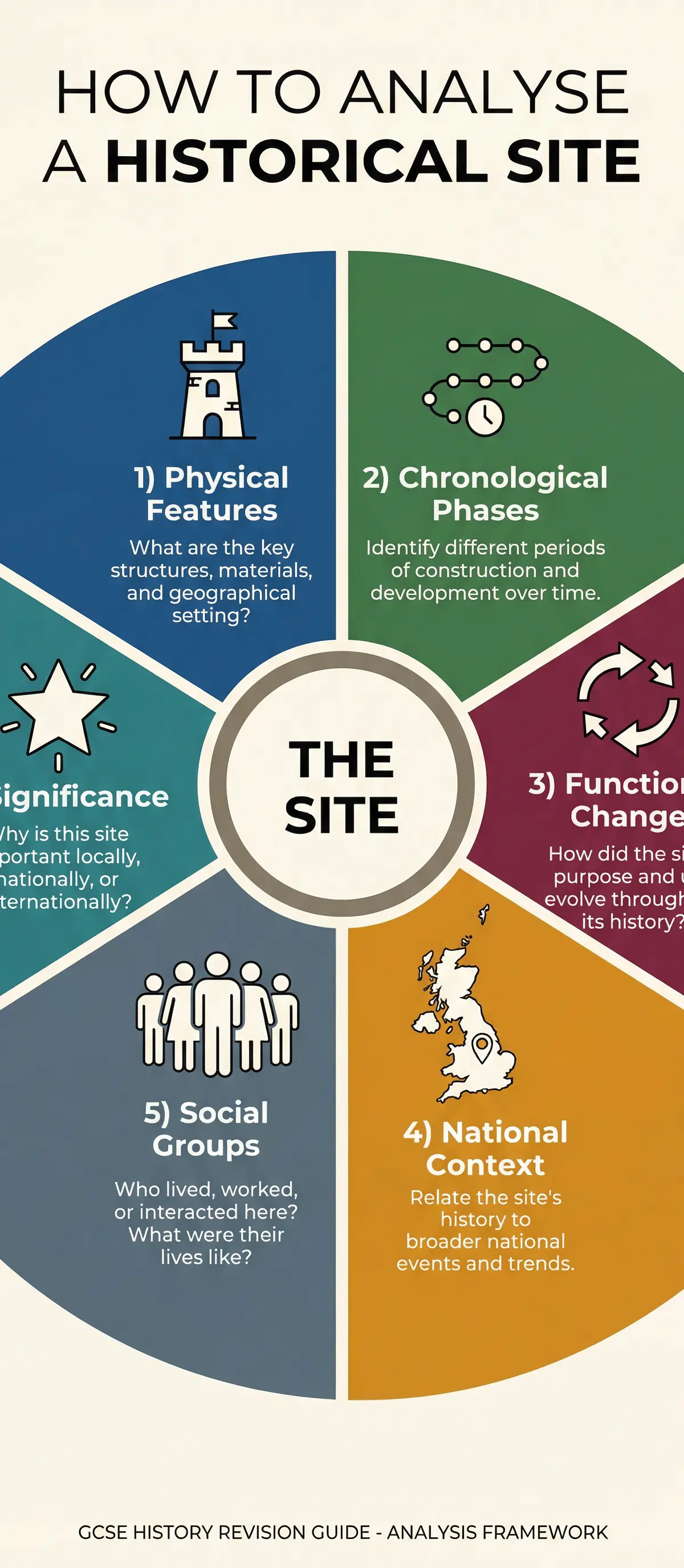
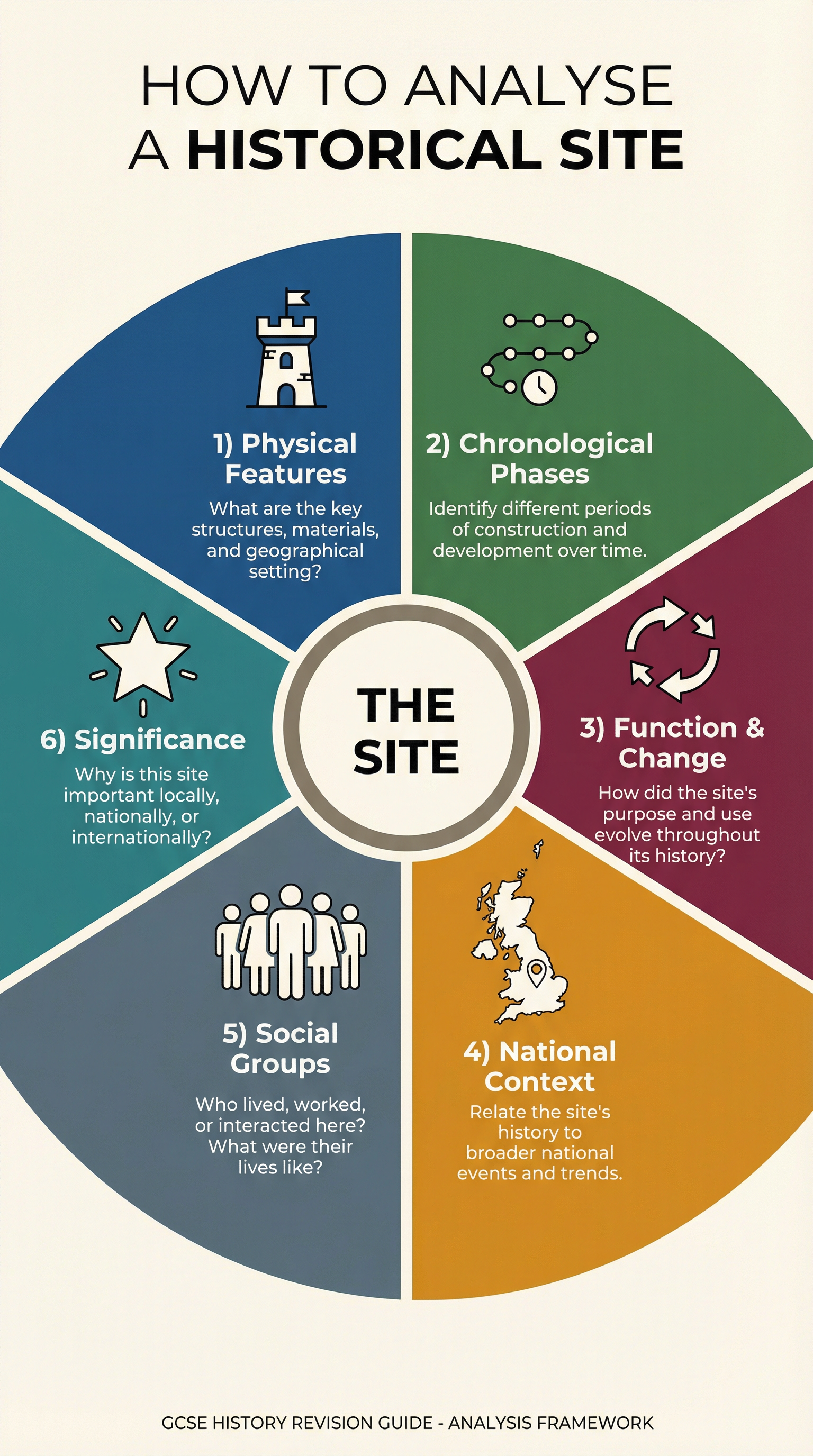
1. Physical Features as Evidence
What it is: Identifying specific, tangible parts of the site and using them to support a point. This is the absolute foundation of the study.
Why it matters: This is the primary way to earn AO1 (knowledge) and AO2 (analysis) marks. Vague descriptions like 'old walls' receive no credit. Precise, named features are essential.
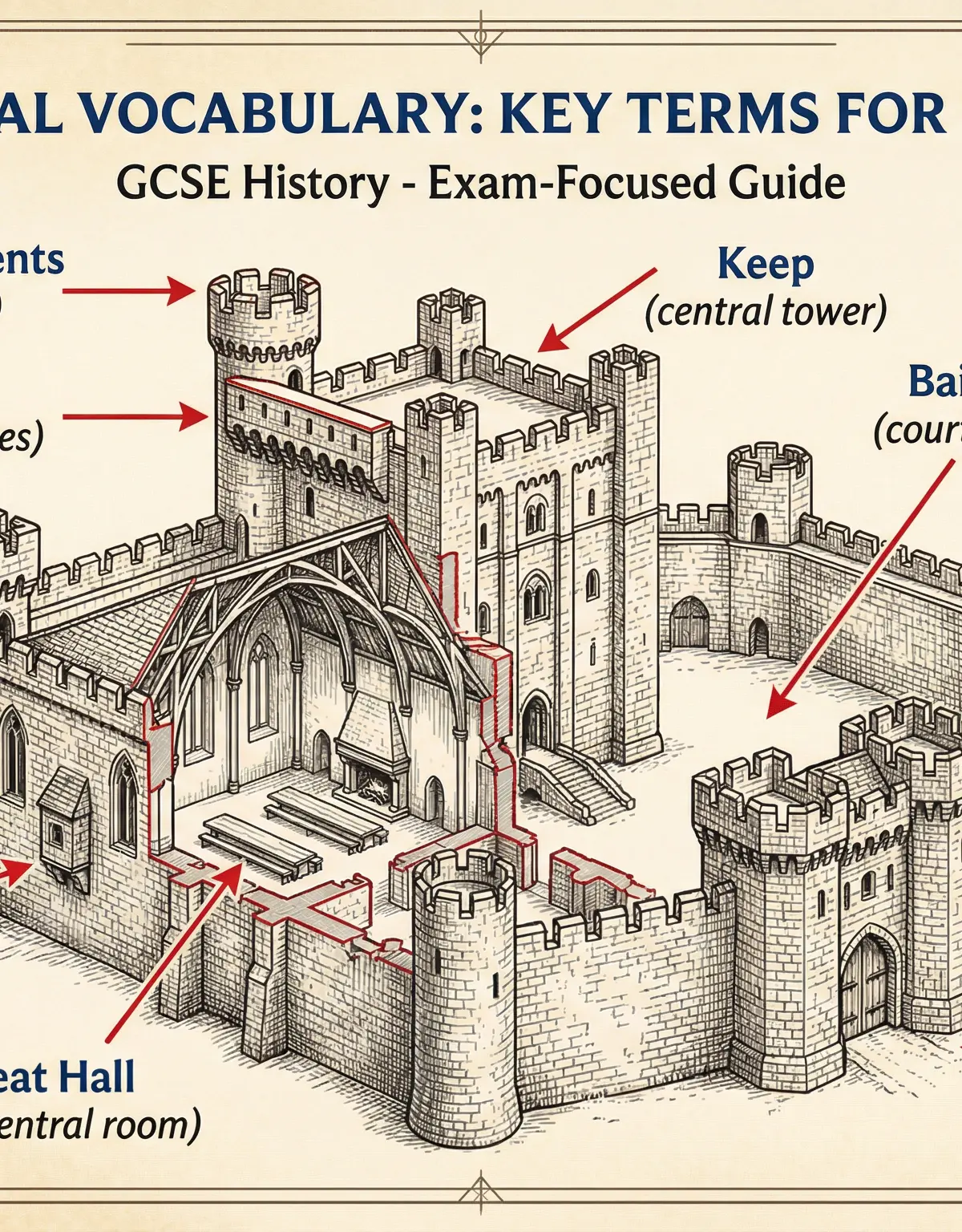
Specific Knowledge: You must use correct architectural vocabulary. For example, instead of 'pointy windows', you should write 'lancet windows, characteristic of the Early English Gothic style (c. 1180-1280)'. Instead of 'holes for dropping things', you must use 'machicolations'.
2. Chronological Understanding
What it is: Recognising that your site was not built in a single day. It is a product of different phases of construction, alteration, and sometimes, destruction.
Why it matters: Marks are awarded for showing how the site developed over time. This demonstrates an understanding of change and continuity, a key historical concept.
Specific Knowledge: Be able to identify different periods in your site's history (e.g., Norman foundation, Tudor extension, Victorian restoration). Link these phases to specific dates and national events. For example, 'The original Norman motte and bailey, constructed after 1066 to subdue the local population, was later superseded by a stone keep in the 12th century, reflecting a move towards more permanent control.'
3. Function and Purpose
What it is: Analysing what the site was used for at different points in its history.
Why it matters: A site's function dictates its form. A castle built for defence will look very different from a monastery built for worship or a country house built for displaying status. Explaining why a site has certain features by linking them to its purpose is a high-level analytical skill.
Specific Knowledge: Consider how function changed. A classic example is a monastery dissolved during the Reformation (1536-41). Its function changed from religious to domestic. Evidence for this might include the blocking up of a cloister walk to create internal rooms, or the insertion of large new windows in a former chapel.
4. National Context
What it is: Linking the specific, local story of your site to the bigger picture of national English and British history.
Why it matters: This is a major requirement for top-level marks. Examiners want to see that you can explain why changes happened at your site by connecting them to wider events.
Specific Knowledge: You should have a bank of key national events ready to deploy. Examples include: The Norman Conquest (1066), The Reformation (1530s), The English Civil War (1642-51), The Industrial Revolution (c. 1760-1840), and the Victorian Era (1837-1901). For instance, 'The addition of a large, unfortified wing with extensive glass windows in the 1590s reflects the increased political stability of the Elizabethan period, where defensive features were less important than demonstrating wealth and status.'
Second-Order Concepts
Causation
Your analysis must explain the causes of change at the site. For example, the cause of a castle falling into ruin might be the development of gunpowder artillery in the 15th and 16th centuries (long-term technological cause), combined with its owner backing the losing side in the English Civil War and the castle being deliberately 'slighted' or destroyed by Parliamentarian forces (short-term political cause).
Change & Continuity
Identify what changed and what stayed the same. A castle's curtain walls might remain (continuity), but a new, comfortable domestic range might be built inside them, replacing military barracks (change). This shows a shift in priorities from defence to domestic comfort.
Significance
Why does this site matter? Consider its significance at different levels: local (e.g., it was the centre of the local economy), national (e.g., a king stayed there, a key battle was fought nearby), and historical (e.g., it is a rare surviving example of a particular architectural style).
Source Skills
For this paper, you will be given sources related to your site. These could be maps, photographs, written descriptions, or archaeological reports. You must evaluate their utility (usefulness) for a specific enquiry.
Approach: Use the 'Content-Provenance-Limitations' framework.
- Content: What does the source show or say that is relevant to the enquiry? Quote from it or describe specific details.
- Provenance: Who made this source, when, and why? How does its origin affect its usefulness? An estate map from 1850 is useful for showing land use at that time, but its purpose was to record the owner's property, not to be an objective historical record.
- Limitations: What does the source not tell you? What are its weaknesses? A photograph only shows a single moment in time. A written account might be biased. Always offer a balanced judgement.
Visual Resources
3 diagrams and illustrations
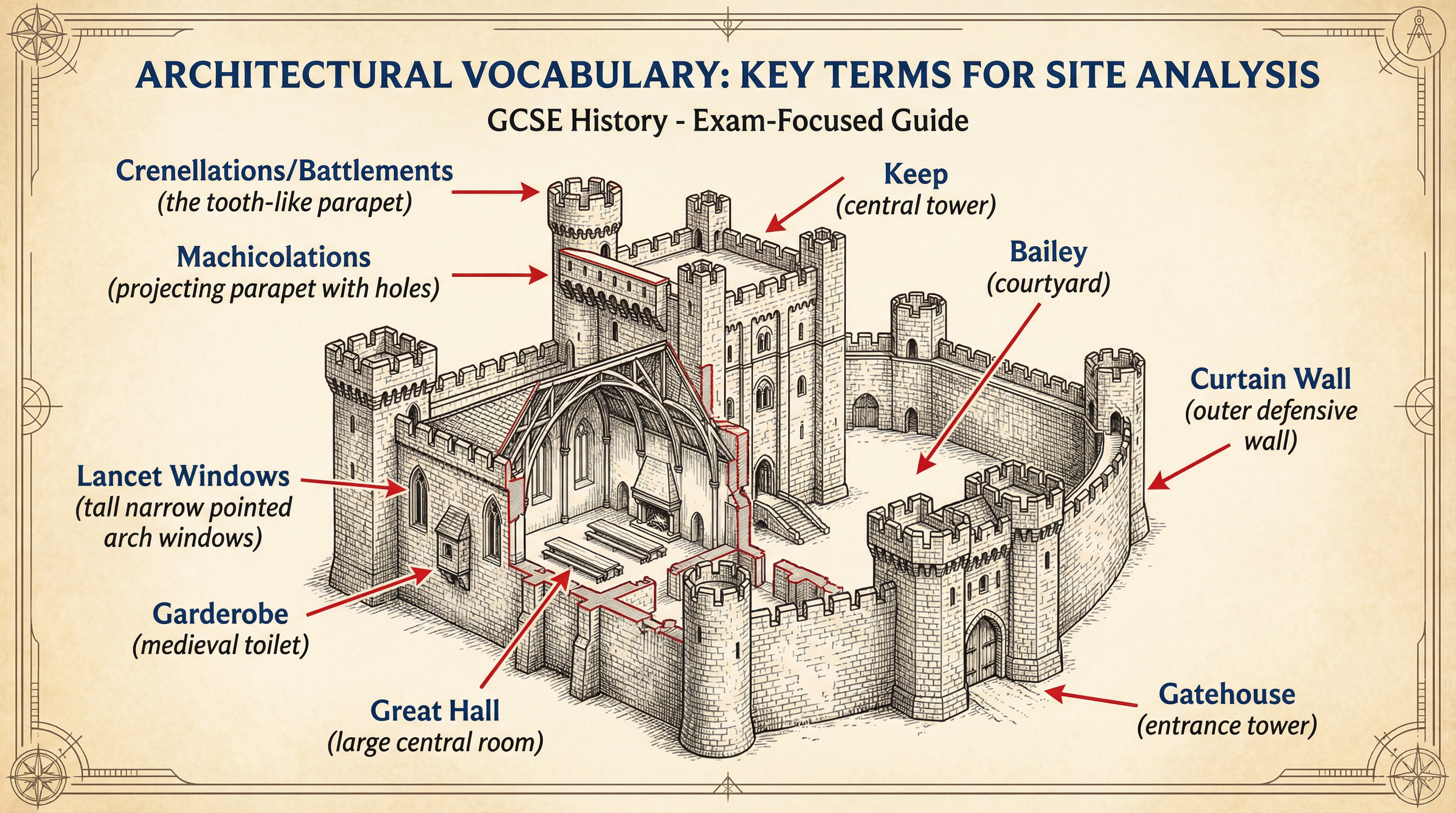
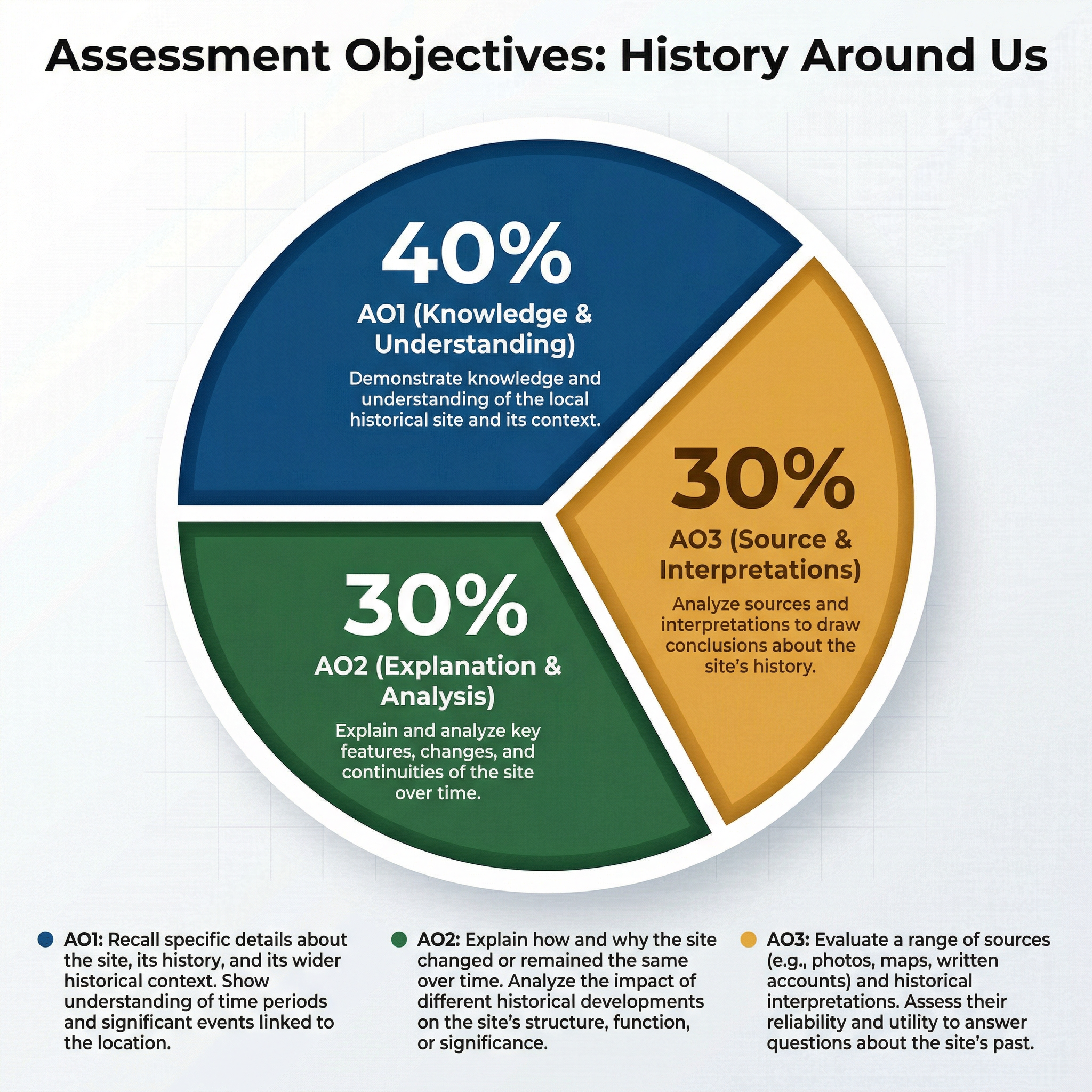
Interactive Diagrams
1 interactive diagram to visualise key concepts
Diagram could not be rendered
A timeline showing how national periods influenced the development of local sites.
Worked Examples
3 worked examples — open one to explore the question and available guidance.
Practice Questions
Test your understanding — click to reveal model answers
Describe two features of [Your Site Name] that show it was designed for defence. (4 marks)
Hint: Identify a feature and give a supporting detail for each one. Think 'Point + Evidence'.
Explain how the function of [Your Site Name] changed after the Dissolution of the Monasteries. (12 marks)
Hint: This is a causation question. Focus on the consequences of the Dissolution for your specific site. Use the PEEL structure.
How significant was the coming of the railway to the development of [Your Site Name] in the 19th century? (8 marks)
Hint: Explain the impact of the railway. Did it bring tourists? Did it bring industry? Did it save the site or ruin it?
Study Source A. How useful is this source to an historian studying the living conditions of servants at [Your Site Name] in the Victorian period? (8 marks)
Hint: Use the PCL framework: Provenance, Content, Limitations. What does it show, who made it, and what are its weaknesses?
‘The history of [Your Site Name] is one of constant change.’ How far do you agree? (16 marks)
Hint: This is a change and continuity question. You must argue both sides. Where was there massive change? Where was there surprising continuity?
Test your understanding of Local Site Study
Active recall beats re-reading. Take an instant quiz now to test what you’ve learned and lock it into long-term memory.
7 days Premium · Then free forever · No card, no charge