OCR · GCSE · History
Course version: J410 · Version from Mar 2026
Commonwealth migration after the Second World War: the varied reasons for…
Full specification wording
Migration to Britain c.1000 to c.2010 (J410/08) - 1900–c.2010: Commonwealth migration after the Second World War: the varied reasons for this immigration; the impact of immigrants; the experiences of immigrants; the resulting debate over immigration – political racism and antiracism; the impact of race relations legislation and immigration controls including the 1962 Commonwealth Immigrants Act and the 1981 British Nationality Act.
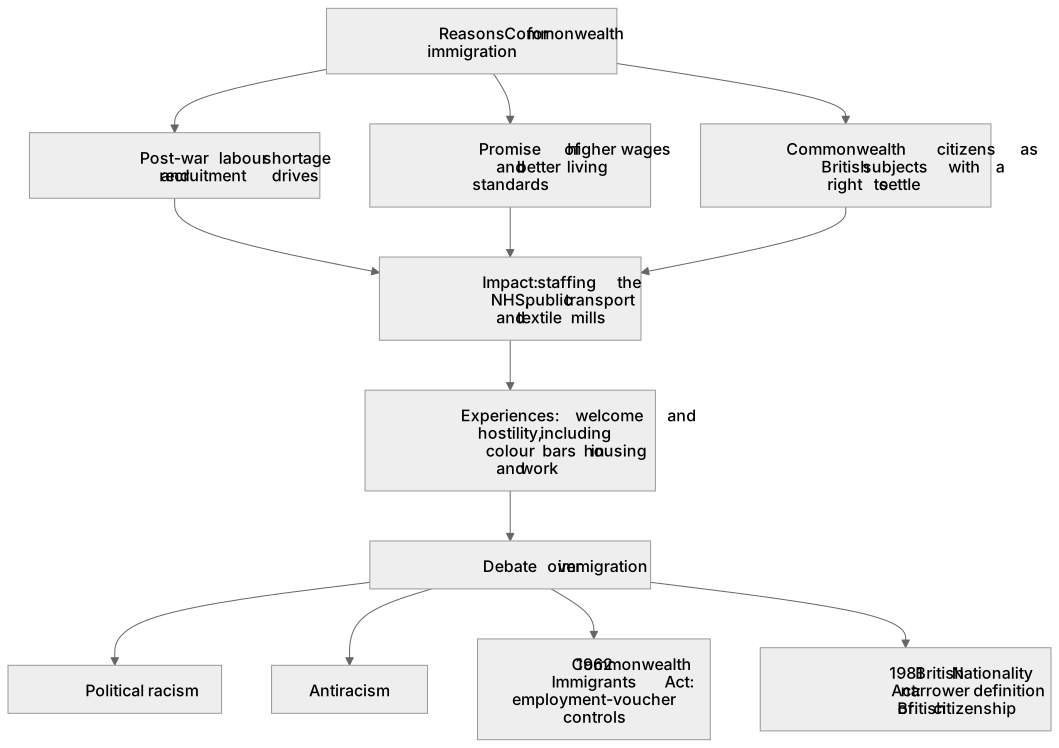
After 1945 people from the Commonwealth came to Britain for several linked reasons: Britain's post-war labour shortage and recruitment drives in the Caribbean and South Asia; the promise of higher…
Checked against the OCR J410 specification (opens in a new tab) on .
- Point 3 of 4
- 4 key terms
Study notes
From the checked teaching notes for this specification point.
The idea
After 1945 people from the Commonwealth came to Britain for several linked reasons: Britain's post-war labour shortage and recruitment drives in the Caribbean and South Asia; the promise of higher wages and better living standards; and the status of Commonwealth citizens as British subjects with a right to settle. Their impact included staffing the new National Health Service, public transport and textile mills. Their experiences mixed welcome with hostility: many met colour bars in housing and work, while communities built churches, temples, mosques and shops. The resulting debate produced political racism, seen in some politicians' hostility to non-white immigration, and antiracism, seen in campaigns and organisations opposing discrimination.
What earns the marks
- Identifies the post-war labour shortage and recruitment drives as a reason for Commonwealth immigration.
- Explains that Commonwealth citizens held British subject status with a right to settle before controls tightened.
- Describes the impact of immigrants in staffing services such as the NHS and public transport.
- Contrasts welcoming experiences with hostility such as colour bars in housing and employment.
- Distinguishes political racism from antiracist campaigning as two sides of the immigration debate.
- Links the 1962 Commonwealth Immigrants Act to the introduction of employment-voucher controls.
- Links the 1981 British Nationality Act to a narrower definition of British citizenship.
Common mistakes and how to put them right
Treats all Commonwealth migrants as arriving for one single reason.
Put it right: Recognise the mix of labour demand, wages and citizenship rights.
Assumes migrants met only hostility or only welcome.
Put it right: Note that experiences varied by place and sector.
Confuses the 1962 Commonwealth Immigrants Act with the 1981 British Nationality Act.
Put it right: Keep their different purposes distinct.
Describes race relations legislation as stopping all discrimination.
Put it right: Treat it as a step that faced limits in enforcement.
Exam tips
- Read the question stem to see whether it asks for a reason, an impact, an experience or a legal change before choosing.
- Eliminate options that merge two different Acts or two different causes into one statement.
- Check that a chosen option matches the post-1945 to c.2010 period rather than earlier migration.
- Use the wording of the option to test whether it describes cause, experience or legislation.
Try the lesson
The start of the Migration to Britain c.1000 to c.2010 (J410/08) - 1900–c.2010: Commonwealth migration after the Second World War: the varied reasons for this immigration; the impact of immigrants; the experiences of immigrants; the resulting debate over immigration – political racism and antiracism; the impact of race relations legislation and immigration controls including the 1962 Commonwealth Immigrants Act and the 1981 British Nationality Act. lesson, made from checked teaching notes for this specification point.
Have a go first
Which of these was a common reason for Commonwealth migrants coming to Britain after 1945?
Listen
After 1945 people from the Commonwealth came to Britain for several linked reasons: Britain's post-war labour shortage and recruitment drives in the Caribbean and South Asia; the promise of higher wages and better living standards; and the status of Commonwealth citizens as British subjects with a right to settle. Their impact included staffing the new National Health Service, public transport and textile mills. Their experiences mixed welcome with hostility: many met colour bars in housing and work, while communities built churches, temples, mosques and shops. The resulting debate produced political racism, seen in some politicians' hostility to non-white immigration, and antiracism, seen in campaigns and organisations opposing discrimination. A strong answer earns marks for these points. Identifies the post-war labour shortage and recruitment drives as a reason for Commonwealth immigration. Explains that Commonwealth citizens held British subject status with a right to settle before controls tightened. Describes the impact of immigrants in staffing services such as the NHS and public transport. Contrasts welcoming experiences with hostility such as colour bars in housing and employment. Exam tip: Read the question stem to see whether it asks for a reason, an impact, an experience or a legal change before choosing.
See it
Key words
Say what each word means before you turn the card.
Commonwealth citizenship and right to settle
Try answering aloud or in your head before turning the card.
Impact on public services and communities
Try answering aloud or in your head before turning the card.
Hostility and colour bars
Try answering aloud or in your head before turning the card.
Political racism and antiracism
Try answering aloud or in your head before turning the card.
See every definition
- Commonwealth citizenship and right to settle
- Commonwealth citizens held British subject status with a right to settle before controls tightened.
- Impact on public services and communities
- Immigrants staffed the new National Health Service, public transport and textile mills, and built churches, temples, mosques and shops.
- Hostility and colour bars
- Many met colour bars in housing and work, so experiences mixed welcome with hostility.
- Political racism and antiracism
- Some politicians showed hostility to non-white immigration, while campaigns and organisations opposed discrimination.
Label the diagram
Some boxes have lost their names. Pick the right name for each number.
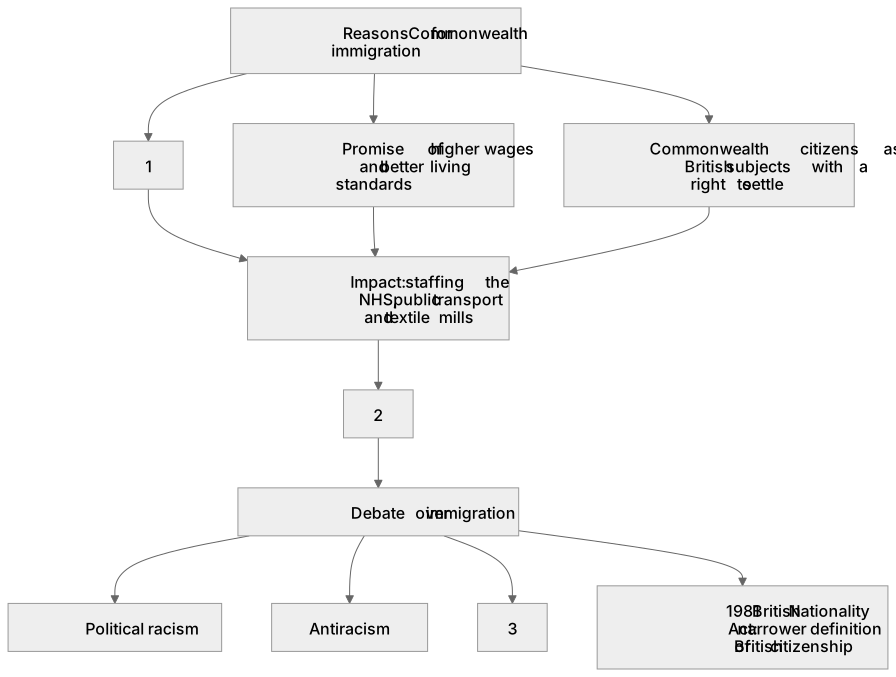
1Box 1
2Box 2
3Box 3
There is more to this lesson
The full lesson goes on to check your understanding and help you earn the marks. Create a free account to carry on, with your progress saved.
A week of Premium from your first lesson · Then the free plan continues · No card, no charge
Test your understanding of Migration to Britain c.1000 to c.2010 (J410/08) - 1900–c.2010: Commonwealth migration after the Second World War: the varied reasons for this immigration; the impact of immigrants; the experiences of immigrants; the resulting debate over immigration – political racism and antiracism; the impact of race relations legislation and immigration controls including the 1962 Commonwealth Immigrants Act and the 1981 British Nationality Act.
Active recall beats re-reading. Take an instant quiz now to test what you’ve learned and lock it into long-term memory.
A week of Premium from your first lesson · Then the free plan continues · No card, no charge