OCR · GCSE · History
Course version: J410 · Version from Mar 2026
Immigration as a political issue c.1990–c.2010: the debate over a…
Full specification wording
Migration to Britain c.1000 to c.2010 (J410/08) - 1900–c.2010: Immigration as a political issue c.1990–c.2010: the debate over a ‘multi-cultural society’; attitudes towards, and treatment of, political refugees and asylum seekers; the issues raised by EU ‘open borders’.
Between about 1990 and 2010 immigration became a prominent political issue.
Checked against the OCR J410 specification (opens in a new tab) on .
- Point 4 of 4
- 4 key terms
Study notes
From the checked teaching notes for this specification point.
The idea
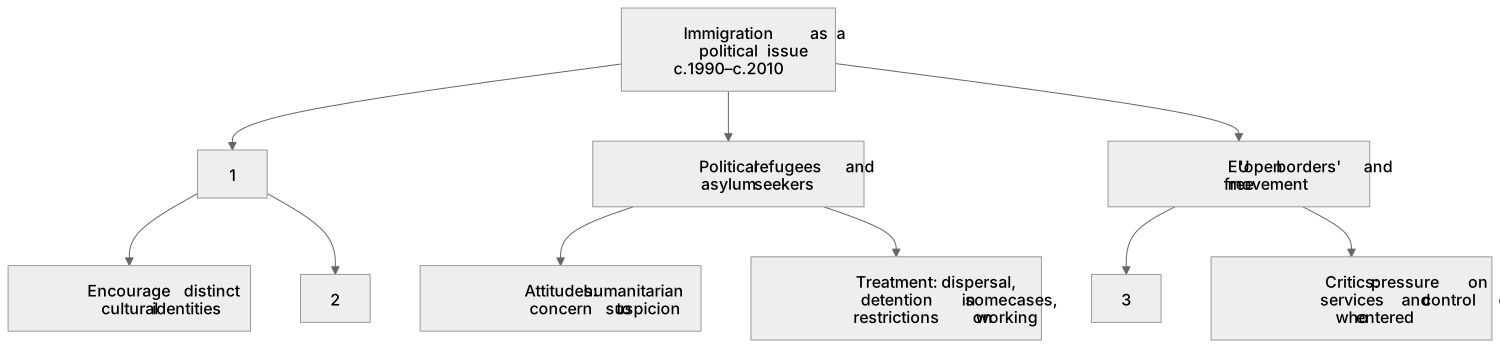
Between about 1990 and 2010 immigration became a prominent political issue. The debate over a 'multi-cultural society' asked whether Britain should encourage distinct cultural identities or expect greater integration, and politicians, media and communities argued both ways. Attitudes towards political refugees and asylum seekers ranged from humanitarian concern to suspicion, and treatment included dispersal of asylum seekers around the country, detention in some cases and restrictions on working while claims were decided. The issues raised by EU 'open borders' concerned free movement of people within the European Union: supporters stressed labour mobility and rights, while critics raised concerns about pressure on services and control of who entered. Together these debates shaped party politics and public argument in the period.
What earns the marks
- Explains the debate over a 'multi-cultural society' as a disagreement about cultural diversity and integration.
- Describes differing attitudes towards political refugees and asylum seekers, from humanitarian concern to suspicion.
- Identifies treatment of asylum seekers such as dispersal and restrictions while claims were decided.
- Explains that EU 'open borders' concerned free movement of people within the European Union.
- Contrasts arguments for free movement, such as labour mobility, with concerns about pressure on services.
- Places these debates within the c.1990–c.2010 political context rather than earlier periods.
Common mistakes and how to put them right
Treats the 'multi-cultural society' debate as settled.
Put it right: Recognise that it remained contested across the period.
Assumes all asylum seekers were treated identically.
Put it right: Note variation in attitudes and in treatment such as dispersal.
Confuses EU free movement with Commonwealth immigration controls.
Put it right: Keep the two frameworks separate.
Places these debates in the 1950s or 1960s.
Put it right: Keep examples inside c.1990–c.2010.
Exam tips
- Check the date range in the stem and reject options set outside c.1990–c.2010.
- Separate the three strands: multiculturalism, asylum, and EU free movement, and match the option to the right strand.
- Eliminate options that present one side of a debate as the only view.
- Read carefully for words such as 'all' or 'never' that overstate a contested position.
Try the lesson
The start of the Migration to Britain c.1000 to c.2010 (J410/08) - 1900–c.2010: Immigration as a political issue c.1990–c.2010: the debate over a ‘multi-cultural society’; attitudes towards, and treatment of, political refugees and asylum seekers; the issues raised by EU ‘open borders’. lesson, made from checked teaching notes for this specification point.
Have a go first
In the 2000s, which right did citizens of most EU member states gain that allowed them to live and work in Britain?
Listen
Between about 1990 and 2010 immigration became a prominent political issue. The debate over a 'multi-cultural society' asked whether Britain should encourage distinct cultural identities or expect greater integration, and politicians, media and communities argued both ways. Attitudes towards political refugees and asylum seekers ranged from humanitarian concern to suspicion, and treatment included dispersal of asylum seekers around the country, detention in some cases and restrictions on working while claims were decided. The issues raised by EU 'open borders' concerned free movement of people within the European Union: supporters stressed labour mobility and rights, while critics raised concerns about pressure on services and control of who entered. Together these debates shaped party politics and public argument in the period. A strong answer earns marks for these points. Explains the debate over a 'multi-cultural society' as a disagreement about cultural diversity and integration. Describes differing attitudes towards political refugees and asylum seekers, from humanitarian concern to suspicion. Identifies treatment of asylum seekers such as dispersal and restrictions while claims were decided. Explains that EU 'open borders' concerned free movement of people within the European Union. Exam tip: Check the date range in the stem and reject options set outside c.1990–c.2010.
See it

Key words
Say what each word means before you turn the card.
The 'multi-cultural society' debate
Try answering aloud or in your head before turning the card.
Attitudes to refugees and asylum seekers
Try answering aloud or in your head before turning the card.
Treatment of asylum seekers
Try answering aloud or in your head before turning the card.
EU free movement and 'open borders'
Try answering aloud or in your head before turning the card.
See every definition
- The 'multi-cultural society' debate
- A disagreement about whether Britain should encourage distinct cultural identities or expect greater integration, argued both ways by politicians, media and communities.
- Attitudes to refugees and asylum seekers
- Views on political refugees and asylum seekers that ranged from humanitarian concern to suspicion.
- Treatment of asylum seekers
- Measures including dispersal around the country, detention in some cases and restrictions on working while claims were decided.
- EU free movement and 'open borders'
- Issues concerning free movement of people within the European Union, with supporters stressing labour mobility and rights and critics raising concerns about pressure on services and control of who entered.
Label the diagram
Some boxes have lost their names. Pick the right name for each number.
1Box 1
2Box 2
3Box 3
There is more to this lesson
The full lesson goes on to check your understanding and help you earn the marks. Create a free account to carry on, with your progress saved.
A week of Premium from your first lesson · Then the free plan continues · No card, no charge
Test your understanding of Migration to Britain c.1000 to c.2010 (J410/08) - 1900–c.2010: Immigration as a political issue c.1990–c.2010: the debate over a ‘multi-cultural society’; attitudes towards, and treatment of, political refugees and asylum seekers; the issues raised by EU ‘open borders’.
Active recall beats re-reading. Take an instant quiz now to test what you’ve learned and lock it into long-term memory.
A week of Premium from your first lesson · Then the free plan continues · No card, no charge