OCR · GCSE · History
Course version: J410 · Version from Mar 2026
The foundation of the East India Company and arrivals from the Indian…
Full specification wording
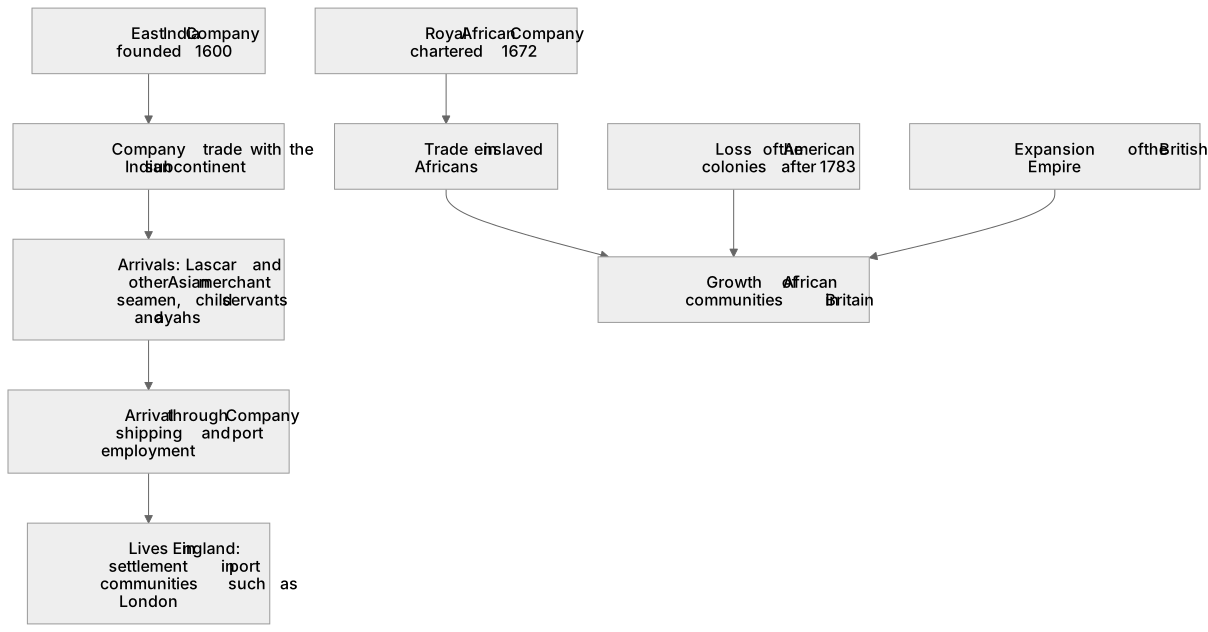
Migration to Britain c.1000 to c.2010 (J410/08) - c.1500–1900: The foundation of the East India Company and arrivals from the Indian subcontinent – Lascar and other Asian merchant seamen, child servants and ayahs, including how they arrived and their lives in England. The growth of African communities in Britain: reasons including the Royal African Company and the trade in enslaved Africans, loss of the American colonies and the expansion of the British Empire.
This topic covers two linked strands of migration between c.1500 and c.1900.
Checked against the OCR J410 specification (opens in a new tab) on .
- Point 2 of 5
- 4 key terms
Study notes
From the checked teaching notes for this specification point.
The idea
This topic covers two linked strands of migration between c.1500 and c.1900. First, the East India Company was founded in 1600 and its trade brought people from the Indian subcontinent to Britain: Lascar and other Asian merchant seamen, child servants and ayahs. Learn how each group arrived, often through Company shipping and port employment, and how they lived in England, frequently in port cities such as London. Second, African communities grew in Britain. Explain the reasons: the Royal African Company, chartered in 1672, organised the trade in enslaved Africans; the loss of the American colonies after 1783 redirected trade and settlement; and the expansion of the British Empire drew more people to Britain. Link causes to consequences rather than listing dates.
What earns the marks
- Identifies the East India Company as founded in 1600 and links its trade to the arrival of people from the Indian subcontinent.
- Names Lascar and other Asian merchant seamen, child servants and ayahs as groups arriving from the Indian subcontinent.
- Explains how these groups arrived, for example through Company shipping and work in port cities.
- Describes the lives of these arrivals in England, such as settlement in port communities.
- Explains that the Royal African Company, chartered in 1672, organised the trade in enslaved Africans.
- Links the loss of the American colonies to changes in trade and the growth of African communities in Britain.
- Connects the expansion of the British Empire to increased migration to Britain.
Common mistakes and how to put them right
Treats the East India Company as founded in a later century.
Put it right: Place its foundation in 1600.
Lists the migrant groups without explaining how they arrived.
Put it right: Add the shipping and port-employment routes.
Omits the African strand entirely.
Put it right: Include the Royal African Company, the trade in enslaved Africans, the loss of the American colonies and imperial expansion.
Gives reasons for African settlement without linking them to consequences.
Put it right: Connect each cause to the growth of communities.
Exam tips
- Read the question stem carefully to see whether it asks about the Indian subcontinent strand, the African strand or both.
- Match each option to a specific cause or group named in the specification rather than a general statement about migration.
- Eliminate options that give a wrong date, such as placing the East India Company outside 1600.
- Check that an option explains a reason for migration, not just a consequence of it.
Try the lesson
The start of the Migration to Britain c.1000 to c.2010 (J410/08) - c.1500–1900: The foundation of the East India Company and arrivals from the Indian subcontinent – Lascar and other Asian merchant seamen, child servants and ayahs, including how they arrived and their lives in England. The growth of African communities in Britain: reasons including the Royal African Company and the trade in enslaved Africans, loss of the American colonies and the expansion of the British Empire. lesson, made from checked teaching notes for this specification point.
Have a go first
In which year was the East India Company founded?
Listen
This topic covers two linked strands of migration between c.1500 and c.1900. First, the East India Company was founded in 1600 and its trade brought people from the Indian subcontinent to Britain: Lascar and other Asian merchant seamen, child servants and ayahs. Learn how each group arrived, often through Company shipping and port employment, and how they lived in England, frequently in port cities such as London. Second, African communities grew in Britain. Explain the reasons: the Royal African Company, chartered in 1672, organised the trade in enslaved Africans; the loss of the American colonies after 1783 redirected trade and settlement; and the expansion of the British Empire drew more people to Britain. Link causes to consequences rather than listing dates. A strong answer earns marks for these points. Identifies the East India Company as founded in 1600 and links its trade to the arrival of people from the Indian subcontinent. Names Lascar and other Asian merchant seamen, child servants and ayahs as groups arriving from the Indian subcontinent. Explains how these groups arrived, for example through Company shipping and work in port cities. Describes the lives of these arrivals in England, such as settlement in port communities. Exam tip: Read the question stem carefully to see whether it asks about the Indian subcontinent strand, the African strand or both.
See it
Put the events in order
Put these events in the order they happened, earliest first.
- 1. The East India Company is founded
- 2. The loss of the American colonies redirects trade and settlement
- 3. The Royal African Company is chartered and organises the trade in enslaved Africans
Key words
Say what each word means before you turn the card.
East India Company
Try answering aloud or in your head before turning the card.
Lascar and other Asian merchant seamen
Try answering aloud or in your head before turning the card.
Royal African Company
Try answering aloud or in your head before turning the card.
Loss of the American colonies
Try answering aloud or in your head before turning the card.
See every definition
- East India Company
- Founded in 1600, its trade brought people from the Indian subcontinent to Britain.
- Lascar and other Asian merchant seamen
- Groups arriving from the Indian subcontinent, often through Company shipping and port employment.
- Royal African Company
- Chartered in 1672, it organised the trade in enslaved Africans.
- Loss of the American colonies
- After 1783 this redirected trade and settlement and is linked to the growth of African communities in Britain.
Label the diagram
Some boxes have lost their names. Pick the right name for each number.
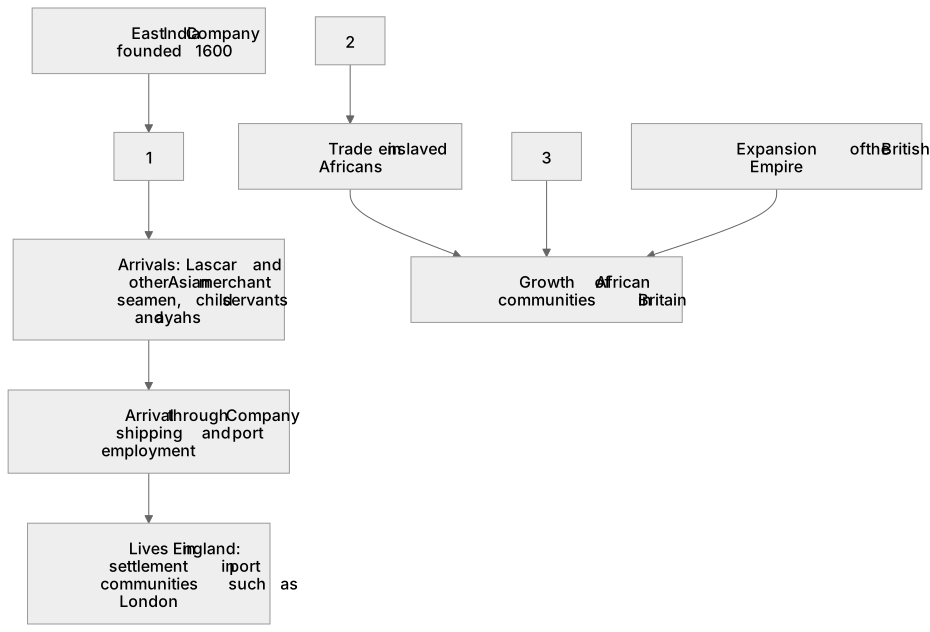
1Box 1
2Box 2
3Box 3
There is more to this lesson
The full lesson goes on to check your understanding and help you earn the marks. Create a free account to carry on, with your progress saved.
A week of Premium from your first lesson · Then the free plan continues · No card, no charge
Test your understanding of Migration to Britain c.1000 to c.2010 (J410/08) - c.1500–1900: The foundation of the East India Company and arrivals from the Indian subcontinent – Lascar and other Asian merchant seamen, child servants and ayahs, including how they arrived and their lives in England. The growth of African communities in Britain: reasons including the Royal African Company and the trade in enslaved Africans, loss of the American colonies and the expansion of the British Empire.
Active recall beats re-reading. Take an instant quiz now to test what you’ve learned and lock it into long-term memory.
A week of Premium from your first lesson · Then the free plan continues · No card, no charge