OCR · GCSE · History
Course version: J410 · Version from Mar 2026
The readmission of Jews in 1656 and their experiences; religious refugees…
Full specification wording
Migration to Britain c.1000 to c.2010 (J410/08) - c.1500–1900: The readmission of Jews in 1656 and their experiences; religious refugees – the arrival of Protestant refugees from the 1670s including the Huguenots and the Palatines: their reasons for emigrating, their reception, their impact, and the extent of their assimilation.
This topic covers two related movements of people into Britain.
Checked against the OCR J410 specification (opens in a new tab) on .
- Point 3 of 5
- 4 key terms
Study notes
From the checked teaching notes for this specification point.
The idea
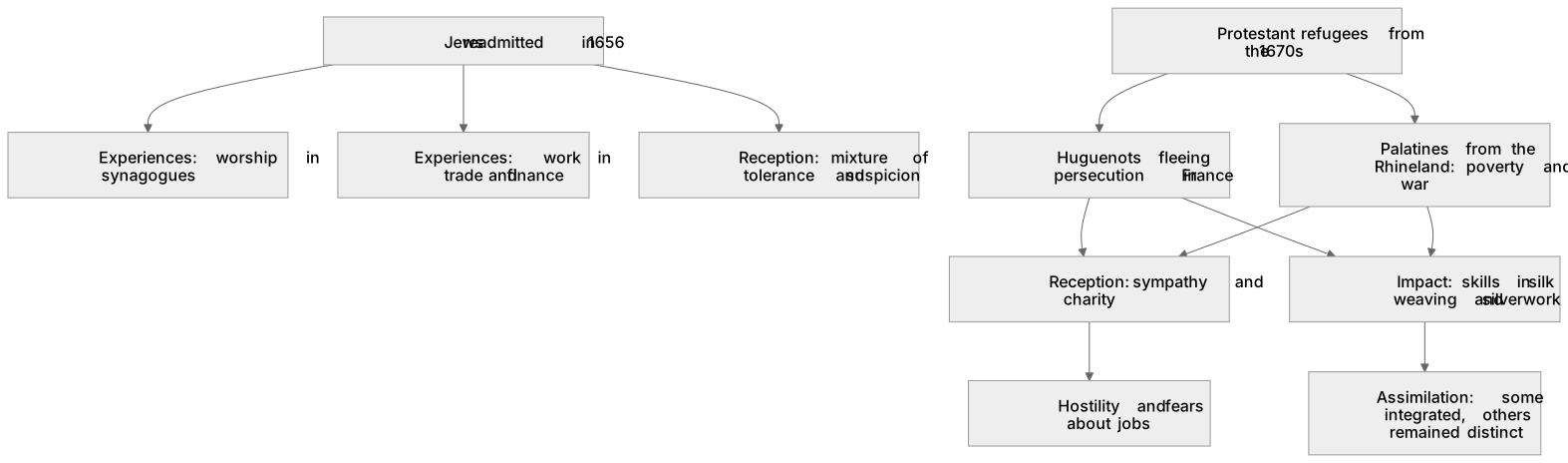
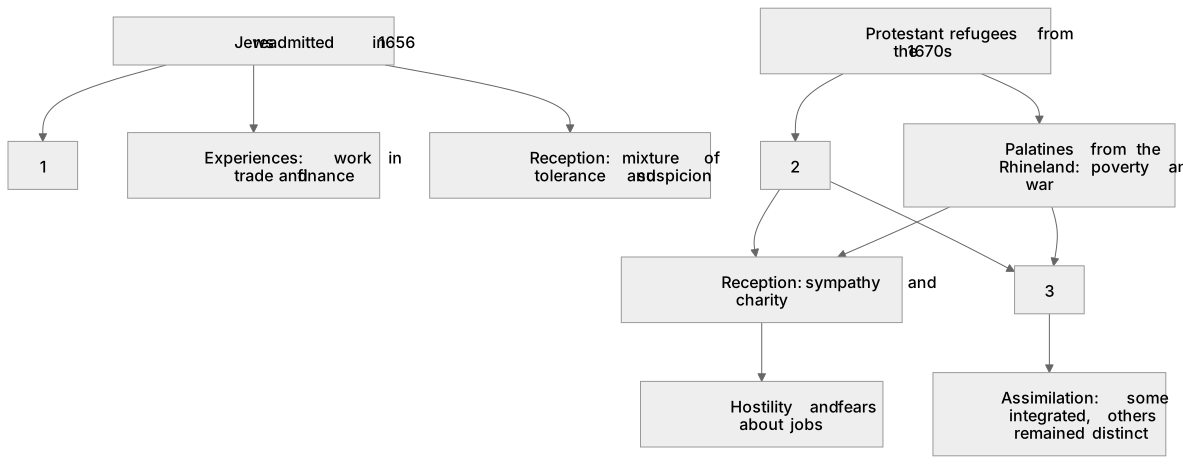
This topic covers two related movements of people into Britain. First, the readmission of Jews in 1656, when Jews were permitted to return and settle openly after their medieval expulsion; learn about their experiences, including worship in synagogues, work in trade and finance, and the mixture of tolerance and suspicion they faced. Second, Protestant refugees arriving from the 1670s, notably the Huguenots fleeing persecution in France and the Palatines from the Rhineland. For each group, learn the reasons for emigrating (religious persecution, war, poverty), their reception in Britain (sympathy, charity, but also hostility and fears about jobs), their impact (skills in silk weaving, silverwork, brewing and other trades) and the extent of their assimilation into local communities over time. A strong answer compares reasons, reception, impact and assimilation rather than listing facts.
What earns the marks
- Places the readmission of Jews in 1656 and describes their experiences, including worship and work in trade and finance.
- Identifies Huguenots and Palatines as Protestant refugees arriving from the 1670s and gives their reasons for emigrating, such as religious persecution and poverty.
- Describes the reception of these refugees, including both sympathy and charity and hostility or fears about competition for work.
- Explains the impact of Huguenot and Palatine settlers through skills in trades such as silk weaving and silverwork.
- Assesses the extent of assimilation, recognising that some refugees integrated into local communities while others remained distinct.
Common mistakes and how to put them right
Dates the readmission of Jews to the wrong century.
Put it right: Place it in 1656 within the c.1500–1900 period.
Treats Huguenots and Palatines as a single group with identical reasons.
Put it right: Distinguish French Protestant persecution from Palatine poverty and war.
Describes reception as wholly welcoming or wholly hostile.
Put it right: Show both sympathy and hostility.
Claims assimilation was complete or absent.
Put it right: Assess the extent using evidence of integration and of continuing distinct communities.
Exam tips
- Check the question asks about reasons, reception, impact or assimilation before choosing.
- Reject options that place events outside the c.1500–1900 period.
- Link each refugee group to a specific trade or skill when judging impact.
Try the lesson
The start of the Migration to Britain c.1000 to c.2010 (J410/08) - c.1500–1900: The readmission of Jews in 1656 and their experiences; religious refugees – the arrival of Protestant refugees from the 1670s including the Huguenots and the Palatines: their reasons for emigrating, their reception, their impact, and the extent of their assimilation. lesson, made from checked teaching notes for this specification point.
Have a go first
In 1656 a small group of Jews was permitted to remain and worship in London. Which ruler allowed this readmission?
Listen
This topic covers two related movements of people into Britain. First, the readmission of Jews in 1656, when Jews were permitted to return and settle openly after their medieval expulsion; learn about their experiences, including worship in synagogues, work in trade and finance, and the mixture of tolerance and suspicion they faced. Second, Protestant refugees arriving from the 1670s, notably the Huguenots fleeing persecution in France and the Palatines from the Rhineland. For each group, learn the reasons for emigrating (religious persecution, war, poverty), their reception in Britain (sympathy, charity, but also hostility and fears about jobs), their impact (skills in silk weaving, silverwork, brewing and other trades) and the extent of their assimilation into local communities over time. A strong answer compares reasons, reception, impact and assimilation rather than listing facts. A strong answer earns marks for these points. Places the readmission of Jews in 1656 and describes their experiences, including worship and work in trade and finance. Identifies Huguenots and Palatines as Protestant refugees arriving from the 1670s and gives their reasons for emigrating, such as religious persecution and poverty. Describes the reception of these refugees, including both sympathy and charity and hostility or fears about competition for work. Explains the impact of Huguenot and Palatine settlers through skills in trades such as silk weaving and silverwork. Exam tip: Check the question asks about reasons, reception, impact or assimilation before choosing.
See it
Key words
Say what each word means before you turn the card.
Readmission of Jews in 1656
Try answering aloud or in your head before turning the card.
Huguenots
Try answering aloud or in your head before turning the card.
Palatines
Try answering aloud or in your head before turning the card.
Assimilation
Try answering aloud or in your head before turning the card.
See every definition
- Readmission of Jews in 1656
- Jews were permitted to return and settle openly after their medieval expulsion, and their experiences included worship in synagogues and work in trade and finance.
- Huguenots
- Protestant refugees fleeing persecution in France who arrived from the 1670s.
- Palatines
- Protestant refugees from the Rhineland who arrived from the 1670s, with reasons for emigrating including poverty and war.
- Assimilation
- The extent to which refugees integrated into local communities over time, while others remained distinct.
Label the diagram
Some boxes have lost their names. Pick the right name for each number.
1Box 1
2Box 2
3Box 3
There is more to this lesson
The full lesson goes on to check your understanding and help you earn the marks. Create a free account to carry on, with your progress saved.
A week of Premium from your first lesson · Then the free plan continues · No card, no charge
Test your understanding of Migration to Britain c.1000 to c.2010 (J410/08) - c.1500–1900: The readmission of Jews in 1656 and their experiences; religious refugees – the arrival of Protestant refugees from the 1670s including the Huguenots and the Palatines: their reasons for emigrating, their reception, their impact, and the extent of their assimilation.
Active recall beats re-reading. Take an instant quiz now to test what you’ve learned and lock it into long-term memory.
A week of Premium from your first lesson · Then the free plan continues · No card, no charge