OCR · GCSE · History
Course version: J410 · Version from Mar 2026
Monarchy and Democracy in Britain c.1000 to 2014 (J410/09) -…
Full specification wording
Power: Monarchy and Democracy in Britain c.1000 to 2014 (J410/09) - c.1000–c.1485: Different claims to the throne in 1066: the Norman invasion, including the establishment of the Norman monarchy and the transfer of power from Saxons to Normans at all levels of society; the extent of the power of the monarch and the barons by 1087.
In 1066 several claimants competed for the English throne: Harold Godwinson was crowned but faced rivals including Harald Hardrada of Norway and William, Duke of Normandy, who invaded and won at…
Checked against the OCR J410 specification (opens in a new tab) on .
- Point 2 of 3
- 4 key terms
Study notes
From the checked teaching notes for this specification point.
The idea
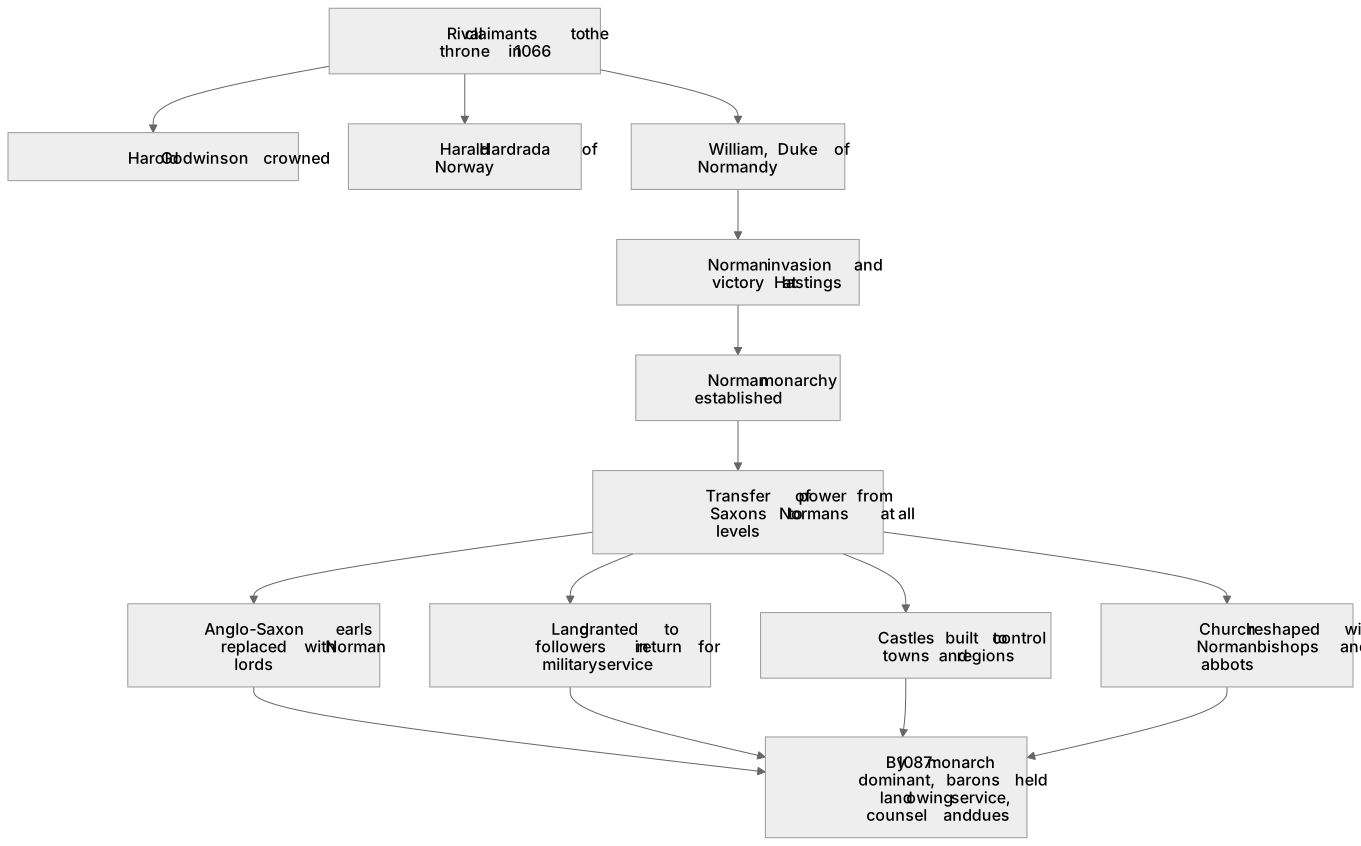
In 1066 several claimants competed for the English throne: Harold Godwinson was crowned but faced rivals including Harald Hardrada of Norway and William, Duke of Normandy, who invaded and won at Hastings. William's victory established a Norman monarchy, and over the following years he transferred power from Saxon to Norman hands at every level: he replaced Anglo-Saxon earls with Norman lords, granted land to his followers in return for military service, built castles to control towns and regions, and reshaped the Church with Norman bishops and abbots. By William's death in 1087 the monarch held extensive royal land and authority, while the barons held large estates but owed the king military service, counsel and financial dues, so royal power remained dominant over theirs.
What earns the marks
- Identifies the rival claimants to the throne in 1066, including Harold Godwinson, Harald Hardrada and William of Normandy.
- Explains that the Norman victory at Hastings established a Norman monarchy in England.
- Describes how power transferred from Saxons to Normans through the replacement of earls, land grants and castle building.
- Explains that by 1087 the monarch retained dominant power while the barons held land in return for service and loyalty.
Common mistakes and how to put them right
Assumes only one claimant existed in 1066.
Put it right: Recognise that several rivals competed for the throne.
Treats the Norman takeover as a single event.
Put it right: Recognise that power transferred gradually at all levels of society.
Assumes the barons were more powerful than the king by 1087.
Put it right: Recognise that royal authority remained dominant.
Exam tips
- Check whether the question asks about the claims to the throne, the invasion, the transfer of power or the balance of power by 1087.
- Reject options that place events outside 1066–1087.
- Distinguish between the monarch's power and the barons' power when both appear in options.
Try the lesson
The start of the Power: Monarchy and Democracy in Britain c.1000 to 2014 (J410/09) - c.1000–c.1485: Different claims to the throne in 1066: the Norman invasion, including the establishment of the Norman monarchy and the transfer of power from Saxons to Normans at all levels of society; the extent of the power of the monarch and the barons by 1087. lesson, made from checked teaching notes for this specification point.
Have a go first
At which battle in October 1066 did William of Normandy defeat Harold Godwinson?
Listen
In 1066 several claimants competed for the English throne: Harold Godwinson was crowned but faced rivals including Harald Hardrada of Norway and William, Duke of Normandy, who invaded and won at Hastings. William's victory established a Norman monarchy, and over the following years he transferred power from Saxon to Norman hands at every level: he replaced Anglo-Saxon earls with Norman lords, granted land to his followers in return for military service, built castles to control towns and regions, and reshaped the Church with Norman bishops and abbots. By William's death in 1087 the monarch held extensive royal land and authority, while the barons held large estates but owed the king military service, counsel and financial dues, so royal power remained dominant over theirs. A strong answer earns marks for these points. Identifies the rival claimants to the throne in 1066, including Harold Godwinson, Harald Hardrada and William of Normandy. Explains that the Norman victory at Hastings established a Norman monarchy in England. Describes how power transferred from Saxons to Normans through the replacement of earls, land grants and castle building. Explains that by 1087 the monarch retained dominant power while the barons held land in return for service and loyalty. Exam tip: Check whether the question asks about the claims to the throne, the invasion, the transfer of power or the balance of power by 1087.
See it
Key words
Say what each word means before you turn the card.
Claims to the throne in 1066
Try answering aloud or in your head before turning the card.
The Norman invasion
Try answering aloud or in your head before turning the card.
Transfer of power from Saxons to Normans
Try answering aloud or in your head before turning the card.
Power of monarch and barons by 1087
Try answering aloud or in your head before turning the card.
See every definition
- Claims to the throne in 1066
- Several claimants competed for the English throne, including Harold Godwinson, Harald Hardrada of Norway and William, Duke of Normandy.
- The Norman invasion
- William, Duke of Normandy, invaded and won at Hastings, establishing a Norman monarchy.
- Transfer of power from Saxons to Normans
- Power transferred gradually at all levels of society, with Norman lords replacing Anglo-Saxon earls, land granted to followers for military service, castles built and the Church reshaped.
- Power of monarch and barons by 1087
- The monarch held extensive royal land and authority, while barons held large estates but owed military service, counsel and financial dues, so royal power remained dominant.
Label the diagram
Some boxes have lost their names. Pick the right name for each number.
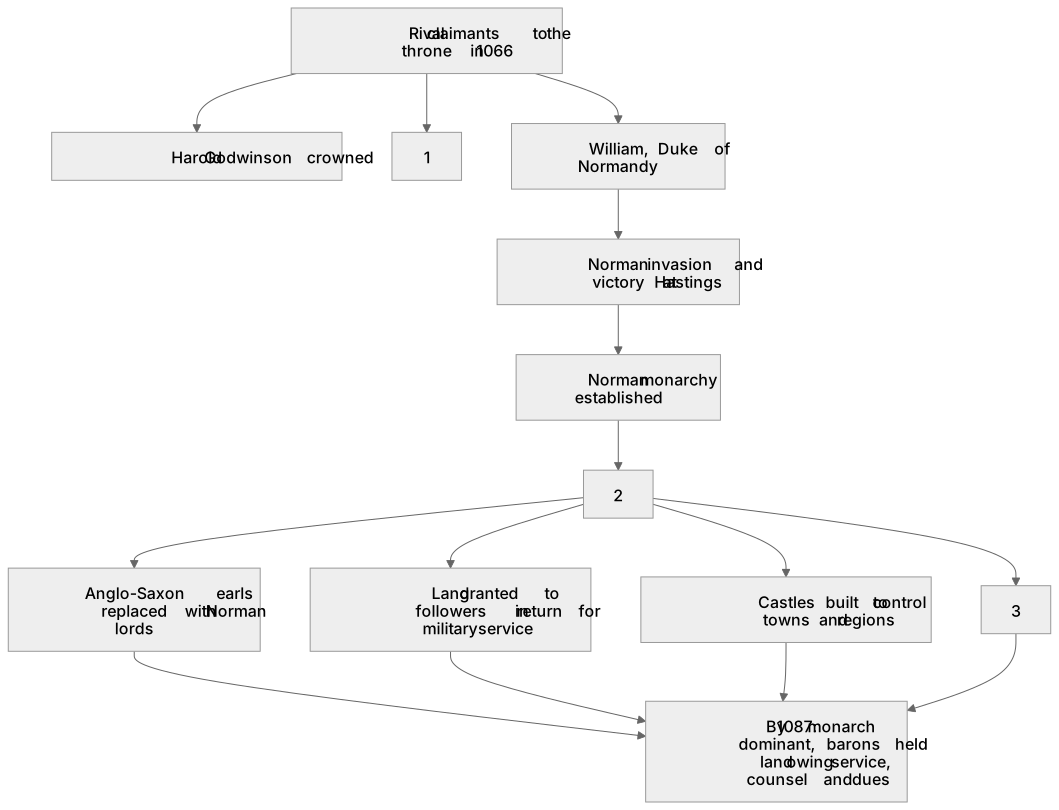
1Box 1
2Box 2
3Box 3
There is more to this lesson
The full lesson goes on to check your understanding and help you earn the marks. Create a free account to carry on, with your progress saved.
A week of Premium from your first lesson · Then the free plan continues · No card, no charge
Test your understanding of Power: Monarchy and Democracy in Britain c.1000 to 2014 (J410/09) - c.1000–c.1485: Different claims to the throne in 1066: the Norman invasion, including the establishment of the Norman monarchy and the transfer of power from Saxons to Normans at all levels of society; the extent of the power of the monarch and the barons by 1087.
Active recall beats re-reading. Take an instant quiz now to test what you’ve learned and lock it into long-term memory.
A week of Premium from your first lesson · Then the free plan continues · No card, no charge