OCR · GCSE · History
Course version: J410 · Version from Mar 2026
Monarchy and Democracy in Britain c.1000 to 2014 (J410/09) -…
Full specification wording
Power: Monarchy and Democracy in Britain c.1000 to 2014 (J410/09) - c.1000–c.1485: Struggles over power: John’s ascension and early revolts against his rule; John and Magna Carta; emergence of Parliament in the reigns of Henry III and Edward I, including the role and importance of Simon de Montfort; deposition of Richard II in 1399; Wars of the Roses.
This topic traces how barons, kings and parliaments competed for power between 1199 and 1485.
Checked against the OCR J410 specification (opens in a new tab) on .
- Point 3 of 3
- 4 key terms
Study notes
From the checked teaching notes for this specification point.
The idea
This topic traces how barons, kings and parliaments competed for power between 1199 and 1485. John became king in 1199 and faced early baronial revolts; his heavy taxation and quarrels with the Church and barons led to Magna Carta in 1215, a charter that limited royal power and was reissued afterwards. Under Henry III and Edward I, meetings of nobles and clergy grew into an early Parliament, and Simon de Montfort's role in calling wider representation in 1265 matters because it widened who could be consulted. In 1399 Richard II was deposed by Henry Bolingbroke, showing that Parliament and nobles could remove a king. The Wars of the Roses (1455–1485) were dynastic conflicts between the houses of Lancaster and York over the crown. Learn each struggle by asking who gained power, who lost it, and what mechanism (revolt, charter, parliament, deposition, war) was used.
What earns the marks
- Identifies John's accession in 1199 and the early baronial revolts against his rule as a struggle over royal power.
- Explains that Magna Carta (1215) limited John's power and was reissued by later kings.
- Describes how Parliament emerged under Henry III and Edward I as a body of nobles, clergy and eventually wider representatives.
- Explains Simon de Montfort's role in widening representation and its importance for the growth of Parliament.
- Identifies the deposition of Richard II in 1399 as an example of nobles and Parliament removing a king.
- Describes the Wars of the Roses as dynastic conflict between Lancaster and York over the crown.
Common mistakes and how to put them right
Places Magna Carta under a king other than John.
Put it right: It was sealed by John in 1215.
Treats Parliament as fully formed from the start.
Put it right: Recognise it emerged gradually under Henry III and Edward I.
Confuses the Wars of the Roses with a war against France.
Put it right: Keep it as a dynastic struggle between Lancaster and York.
Assumes Richard II was killed in battle.
Put it right: He was deposed in 1399.
Exam tips
- Match each event to the mechanism of struggle: revolt, charter, parliament, deposition or war.
- Use dates as anchors (1215, 1265, 1399, 1455–1485) to keep the sequence clear.
- For each example, state who gained power and who lost it rather than just naming the event.
Try the lesson
The start of the Power: Monarchy and Democracy in Britain c.1000 to 2014 (J410/09) - c.1000–c.1485: Struggles over power: John’s ascension and early revolts against his rule; John and Magna Carta; emergence of Parliament in the reigns of Henry III and Edward I, including the role and importance of Simon de Montfort; deposition of Richard II in 1399; Wars of the Roses. lesson, made from checked teaching notes for this specification point.
Have a go first
In which year did King John set his seal on Magna Carta at Runnymede?
Listen
This topic traces how barons, kings and parliaments competed for power between 1199 and 1485. John became king in 1199 and faced early baronial revolts; his heavy taxation and quarrels with the Church and barons led to Magna Carta in 1215, a charter that limited royal power and was reissued afterwards. Under Henry III and Edward I, meetings of nobles and clergy grew into an early Parliament, and Simon de Montfort's role in calling wider representation in 1265 matters because it widened who could be consulted. In 1399 Richard II was deposed by Henry Bolingbroke, showing that Parliament and nobles could remove a king. The Wars of the Roses (1455–1485) were dynastic conflicts between the houses of Lancaster and York over the crown. Learn each struggle by asking who gained power, who lost it, and what mechanism (revolt, charter, parliament, deposition, war) was used. A strong answer earns marks for these points. Identifies John's accession in 1199 and the early baronial revolts against his rule as a struggle over royal power. Explains that Magna Carta (1215) limited John's power and was reissued by later kings. Describes how Parliament emerged under Henry III and Edward I as a body of nobles, clergy and eventually wider representatives. Explains Simon de Montfort's role in widening representation and its importance for the growth of Parliament. Exam tip: Match each event to the mechanism of struggle: revolt, charter, parliament, deposition or war.
See it
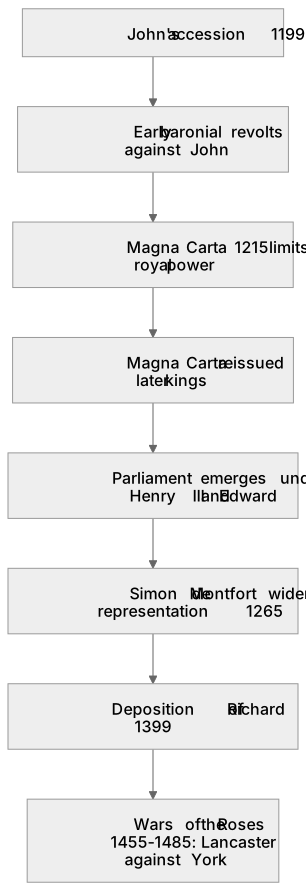
Put it in order
Put these steps in the order they happen.
- 1. Parliament emerges under Henry III and Edward I
- 2. Wars of the Roses 1455-1485: Lancaster against York
- 3. Simon de Montfort widens representation 1265
- 4. John's accession 1199
- 5. Early baronial revolts against John
- 6. Deposition of Richard II 1399
- 7. Magna Carta 1215 limits royal power
- 8. Magna Carta reissued by later kings
Put the events in order
Put these events in the order they happened, earliest first.
- 1. Magna Carta limits royal power and is reissued afterwards
- 2. John becomes king and faces early baronial revolts
- 3. Wars of the Roses begin as dynastic conflict
- 4. Simon de Montfort widens representation in Parliament
- 5. Richard II is deposed by Henry Bolingbroke
Key words
Say what each word means before you turn the card.
Magna Carta
Try answering aloud or in your head before turning the card.
Parliament
Try answering aloud or in your head before turning the card.
Deposition
Try answering aloud or in your head before turning the card.
Wars of the Roses
Try answering aloud or in your head before turning the card.
See every definition
- Magna Carta
- A charter in 1215 that limited royal power and was reissued afterwards, following John's heavy taxation and quarrels with the Church and barons.
- Parliament
- A body of nobles, clergy and eventually wider representatives that emerged gradually under Henry III and Edward I from meetings of nobles and clergy.
- Deposition
- The removal of a king, shown when Richard II was deposed by Henry Bolingbroke in 1399, showing that Parliament and nobles could remove a king.
- Wars of the Roses
- Dynastic conflicts between the houses of Lancaster and York over the crown between 1455 and 1485.
Label the diagram
Some boxes have lost their names. Pick the right name for each number.
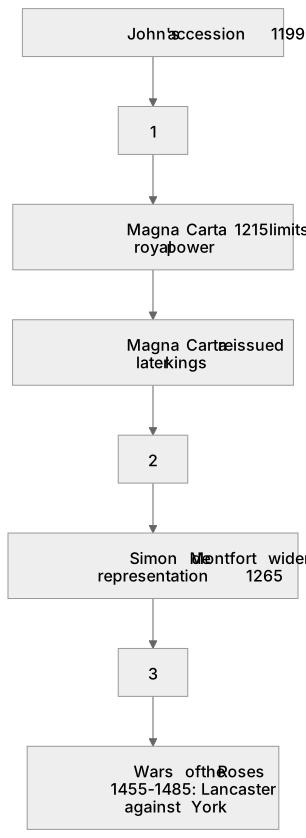
1Box 1
2Box 2
3Box 3
There is more to this lesson
The full lesson goes on to check your understanding and help you earn the marks. Create a free account to carry on, with your progress saved.
A week of Premium from your first lesson · Then the free plan continues · No card, no charge
Test your understanding of Power: Monarchy and Democracy in Britain c.1000 to 2014 (J410/09) - c.1000–c.1485: Struggles over power: John’s ascension and early revolts against his rule; John and Magna Carta; emergence of Parliament in the reigns of Henry III and Edward I, including the role and importance of Simon de Montfort; deposition of Richard II in 1399; Wars of the Roses.
Active recall beats re-reading. Take an instant quiz now to test what you’ve learned and lock it into long-term memory.
A week of Premium from your first lesson · Then the free plan continues · No card, no charge