OCR · GCSE · History
Course version: J410 · Version from Mar 2026
Monarchy and Democracy in Britain c.1000 to 2014 (J410/09) -…
Full specification wording
Power: Monarchy and Democracy in Britain c.1000 to 2014 (J410/09) - c.1485–c.1800: Defeat and return of monarchy: Charles I’s personal rule 1629–1640; the Civil Wars and the abolition of the monarchy; the Restoration of the monarchy in 1660.
This topic traces how royal power collapsed and returned between 1629 and 1660.
Checked against the OCR J410 specification (opens in a new tab) on .
- Point 2 of 3
- 4 key terms
Study notes
From the checked teaching notes for this specification point.
The idea
This topic traces how royal power collapsed and returned between 1629 and 1660. Charles I ruled without calling Parliament from 1629 to 1640, raising money through levies such as ship money, which many saw as unlawful. Conflict over religion and taxation led to the Civil Wars, and Charles was executed in 1649. Parliament then abolished the monarchy and England became a republic, governed first by the Rump and then by Cromwell as Lord Protector. After Cromwell's death in 1658 the republic faltered, and in 1660 Charles II was restored. Learn the sequence, the causes of each change and the difference between personal rule, abolition and restoration.
What earns the marks
- Identifies 1629–1640 as the period of Charles I's personal rule, when he governed without Parliament.
- Explains that Charles raised revenue through disputed levies such as ship money, which contributed to conflict.
- Places the Civil Wars before the execution of Charles I in 1649 and the subsequent abolition of the monarchy.
- Distinguishes the republic under Cromwell's Protectorate from the Restoration of Charles II in 1660.
- Links the failure of the republic after Cromwell's death in 1658 to the decision to restore the monarchy.
Common mistakes and how to put them right
Confuses the personal rule with the Restoration.
Put it right: Keep 1629–1640 as the years without Parliament and 1660 as the return of the king.
Places the abolition of the monarchy before the Civil Wars.
Put it right: Order the events as war, execution, abolition, then restoration.
Assumes the monarchy ended permanently in 1649.
Put it right: Charles II was restored in 1660.
Treats Cromwell as a king.
Put it right: Describe him as Lord Protector of a republic.
Exam tips
- Learn the key dates 1629, 1640, 1649, 1658 and 1660 as anchors for the sequence.
- For each event, note one cause and one consequence so you can explain change rather than just list it.
- Read the whole question before choosing, because options often swap the order of events.
Try the lesson
The start of the Power: Monarchy and Democracy in Britain c.1000 to 2014 (J410/09) - c.1485–c.1800: Defeat and return of monarchy: Charles I’s personal rule 1629–1640; the Civil Wars and the abolition of the monarchy; the Restoration of the monarchy in 1660. lesson, made from checked teaching notes for this specification point.
Have a go first
For roughly how long did Charles I rule without calling Parliament during his Personal Rule?
Listen
This topic traces how royal power collapsed and returned between 1629 and 1660. Charles I ruled without calling Parliament from 1629 to 1640, raising money through levies such as ship money, which many saw as unlawful. Conflict over religion and taxation led to the Civil Wars, and Charles was executed in 1649. Parliament then abolished the monarchy and England became a republic, governed first by the Rump and then by Cromwell as Lord Protector. After Cromwell's death in 1658 the republic faltered, and in 1660 Charles II was restored. Learn the sequence, the causes of each change and the difference between personal rule, abolition and restoration. A strong answer earns marks for these points. Identifies 1629–1640 as the period of Charles I's personal rule, when he governed without Parliament. Explains that Charles raised revenue through disputed levies such as ship money, which contributed to conflict. Places the Civil Wars before the execution of Charles I in 1649 and the subsequent abolition of the monarchy. Distinguishes the republic under Cromwell's Protectorate from the Restoration of Charles II in 1660. Exam tip: Learn the key dates 1629, 1640, 1649, 1658 and 1660 as anchors for the sequence.
See it
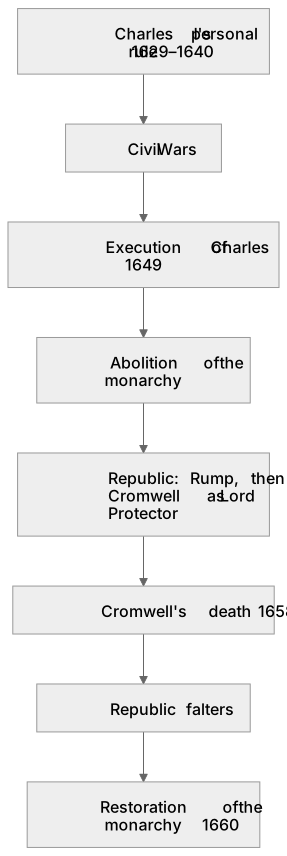
Put it in order
Put these steps in the order they happen.
- 1. Republic: Rump, then Cromwell as Lord Protector
- 2. Restoration of the monarchy 1660
- 3. Cromwell's death 1658
- 4. Charles I's personal rule 1629–1640
- 5. Civil Wars
- 6. Republic falters
- 7. Execution of Charles I 1649
- 8. Abolition of the monarchy
Put the events in order
Put these events in the order they happened, earliest first.
- 1. Charles II is restored to the monarchy
- 2. Charles I begins personal rule without Parliament
- 3. Cromwell dies and the republic falters
- 4. Charles I is executed and the monarchy abolished
Key words
Say what each word means before you turn the card.
Personal rule
Try answering aloud or in your head before turning the card.
Ship money
Try answering aloud or in your head before turning the card.
Abolition of the monarchy
Try answering aloud or in your head before turning the card.
Restoration
Try answering aloud or in your head before turning the card.
See every definition
- Personal rule
- The period from 1629 to 1640 when Charles I governed without Parliament.
- Ship money
- A disputed levy through which Charles raised revenue, which many saw as unlawful.
- Abolition of the monarchy
- The ending of the monarchy by Parliament after the execution of Charles I in 1649.
- Restoration
- The return of the monarchy in 1660, when Charles II was restored after the republic faltered.
Label the diagram
Some boxes have lost their names. Pick the right name for each number.
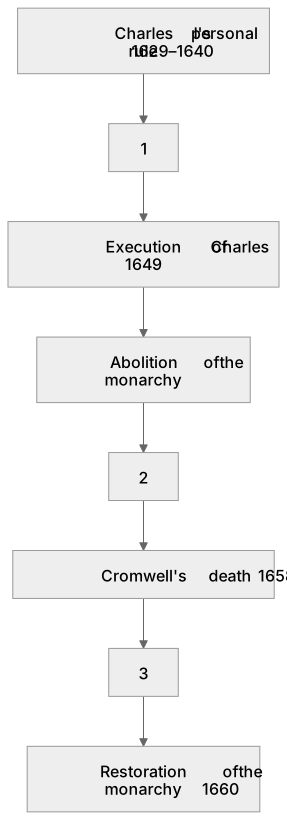
1Box 1
2Box 2
3Box 3
There is more to this lesson
The full lesson goes on to check your understanding and help you earn the marks. Create a free account to carry on, with your progress saved.
A week of Premium from your first lesson · Then the free plan continues · No card, no charge
Test your understanding of Power: Monarchy and Democracy in Britain c.1000 to 2014 (J410/09) - c.1485–c.1800: Defeat and return of monarchy: Charles I’s personal rule 1629–1640; the Civil Wars and the abolition of the monarchy; the Restoration of the monarchy in 1660.
Active recall beats re-reading. Take an instant quiz now to test what you’ve learned and lock it into long-term memory.
A week of Premium from your first lesson · Then the free plan continues · No card, no charge