OCR · GCSE · History
Course version: J410 · Version from Mar 2026
Monarchy and Democracy in Britain c.1000 to 2014 (J410/09) -…
Full specification wording
Power: Monarchy and Democracy in Britain c.1000 to 2014 (J410/09) - c.1485–c.1800: James II’s rule and the reasons for the 1688 Revolution (The Glorious Revolution); the legacy of the Glorious Revolution including the Bill of Rights; the development of Parliament under William III and Anne; the emergence of political parties and the development of a Parliamentary monarchy in the course of the 1700s.
This topic follows the shift from royal to parliamentary power.
Checked against the OCR J410 specification (opens in a new tab) on .
- Point 3 of 3
- 4 key terms
Study notes
From the checked teaching notes for this specification point.
The idea
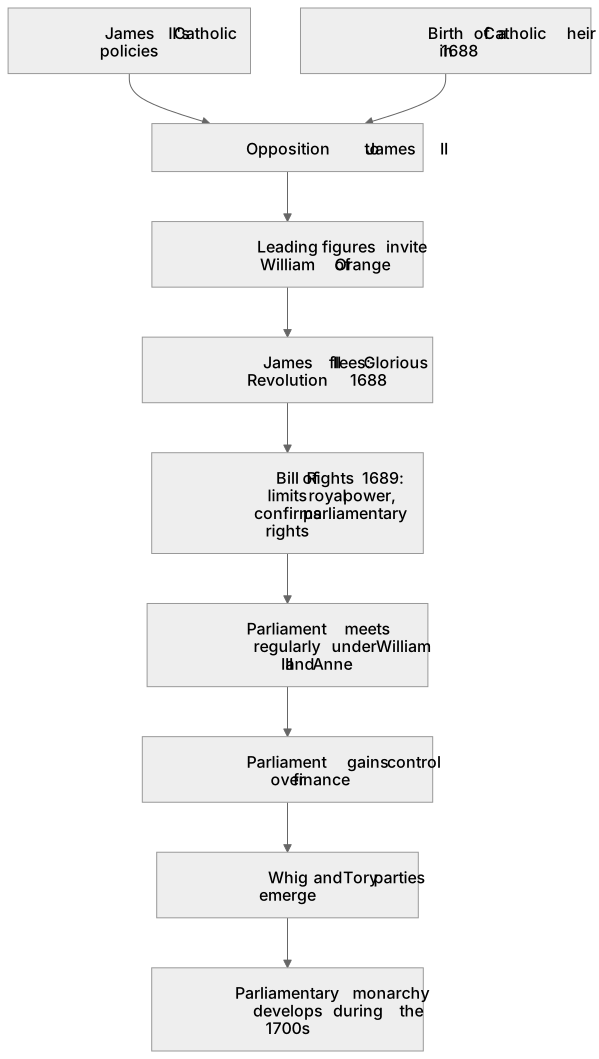
This topic follows the shift from royal to parliamentary power. James II's Catholic policies and his son's birth in 1688 prompted leading figures to invite William of Orange, and James fled, an event known as the Glorious Revolution. The Bill of Rights of 1689 limited royal power and confirmed parliamentary rights. Under William III and Anne, Parliament met regularly and controlled finance. Political parties, Whig and Tory, emerged and organised support. Across the 1700s a parliamentary monarchy developed in which the monarch governed through ministers and Parliament, though the franchise remained narrow. Learn the reasons for 1688, the legacy of the settlement and the growth of parties.
What earns the marks
- Explains that James II's Catholic policies and the birth of a Catholic heir in 1688 prompted opposition.
- Identifies the Glorious Revolution of 1688 as the replacement of James II by William and Mary.
- Describes the Bill of Rights of 1689 as limiting royal power and confirming parliamentary rights.
- Explains that Parliament met regularly under William III and Anne and gained control over finance.
- Identifies the emergence of Whig and Tory parties and the growth of a parliamentary monarchy during the 1700s.
Common mistakes and how to put them right
Dates the Glorious Revolution to 1689.
Put it right: Keep 1688 as the year of the revolution and 1689 as the year of the Bill of Rights.
Treats the Bill of Rights as creating full democracy.
Put it right: Describe it as limiting royal power while the franchise stayed narrow.
Assumes political parties appeared only in the 1800s.
Put it right: Place their emergence in the late 1600s and 1700s.
Confuses James II with Charles II.
Put it right: Keep James II as the monarch removed in 1688.
Exam tips
- Anchor the sequence with 1688, 1689 and the course of the 1700s.
- For each change, ask whether it increased the power of Parliament or limited the monarch.
- Check options that swap 1688 and 1689 or confuse the two Stuart kings.
Try the lesson
The start of the Power: Monarchy and Democracy in Britain c.1000 to 2014 (J410/09) - c.1485–c.1800: James II’s rule and the reasons for the 1688 Revolution (The Glorious Revolution); the legacy of the Glorious Revolution including the Bill of Rights; the development of Parliament under William III and Anne; the emergence of political parties and the development of a Parliamentary monarchy in the course of the 1700s. lesson, made from checked teaching notes for this specification point.
Have a go first
The Bill of Rights of 1689 limited the monarch's power. Which of these did it state?
Listen
This topic follows the shift from royal to parliamentary power. James II's Catholic policies and his son's birth in 1688 prompted leading figures to invite William of Orange, and James fled, an event known as the Glorious Revolution. The Bill of Rights of 1689 limited royal power and confirmed parliamentary rights. Under William III and Anne, Parliament met regularly and controlled finance. Political parties, Whig and Tory, emerged and organised support. Across the 1700s a parliamentary monarchy developed in which the monarch governed through ministers and Parliament, though the franchise remained narrow. Learn the reasons for 1688, the legacy of the settlement and the growth of parties. A strong answer earns marks for these points. Explains that James II's Catholic policies and the birth of a Catholic heir in 1688 prompted opposition. Identifies the Glorious Revolution of 1688 as the replacement of James II by William and Mary. Describes the Bill of Rights of 1689 as limiting royal power and confirming parliamentary rights. Explains that Parliament met regularly under William III and Anne and gained control over finance. Exam tip: Anchor the sequence with 1688, 1689 and the course of the 1700s.
See it
Key words
Say what each word means before you turn the card.
Reasons for the 1688 Revolution
Try answering aloud or in your head before turning the card.
The Bill of Rights and its legacy
Try answering aloud or in your head before turning the card.
Parliament under William III and Anne
Try answering aloud or in your head before turning the card.
Political parties and parliamentary monarchy in the 1700s
Try answering aloud or in your head before turning the card.
See every definition
- Reasons for the 1688 Revolution
- James II's Catholic policies and the birth of a Catholic heir in 1688 prompted leading figures to invite William of Orange.
- The Bill of Rights and its legacy
- The Bill of Rights of 1689 limited royal power and confirmed parliamentary rights.
- Parliament under William III and Anne
- Under William III and Anne, Parliament met regularly and controlled finance.
- Political parties and parliamentary monarchy in the 1700s
- Whig and Tory parties emerged and organised support, and across the 1700s a parliamentary monarchy developed in which the monarch governed through ministers and Parliament.
Label the diagram
Some boxes have lost their names. Pick the right name for each number.
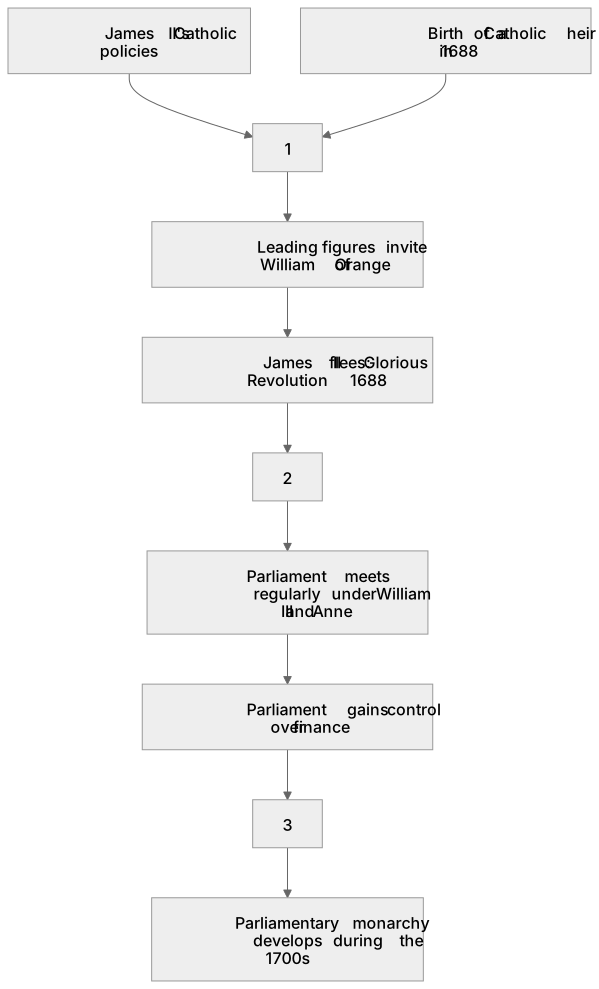
1Box 1
2Box 2
3Box 3
There is more to this lesson
The full lesson goes on to check your understanding and help you earn the marks. Create a free account to carry on, with your progress saved.
A week of Premium from your first lesson · Then the free plan continues · No card, no charge
Test your understanding of Power: Monarchy and Democracy in Britain c.1000 to 2014 (J410/09) - c.1485–c.1800: James II’s rule and the reasons for the 1688 Revolution (The Glorious Revolution); the legacy of the Glorious Revolution including the Bill of Rights; the development of Parliament under William III and Anne; the emergence of political parties and the development of a Parliamentary monarchy in the course of the 1700s.
Active recall beats re-reading. Take an instant quiz now to test what you’ve learned and lock it into long-term memory.
A week of Premium from your first lesson · Then the free plan continues · No card, no charge