OCR · GCSE · History
Course version: J410 · Version from Mar 2026
Monarchy and Democracy in Britain c.1000 to 2014 (J410/09) - c.1800–2014:…
Full specification wording
Power: Monarchy and Democracy in Britain c.1000 to 2014 (J410/09) - c.1800–2014: The changing relationship between Parliament and people c.1800 to c.1918: dissatisfaction with electoral system by early 1800s; reasons for and impacts of the Parliamentary Reform Acts of 1832, 1867 and 1884; the rise and effectiveness of mass Trade Unions and the Labour Party 1880s–1914; the struggle for the vote for women and the reasons why it was won for some women in 1918.
This topic traces how the link between Parliament and the people shifted between c.1800 and c.1918.
Checked against the OCR J410 specification (opens in a new tab) on .
- Point 1 of 3
- 4 key terms
Study notes
From the checked teaching notes for this specification point.
The idea
This topic traces how the link between Parliament and the people shifted between c.1800 and c.1918. Start with early-1800s dissatisfaction: tiny, uneven electorates, rotten and pocket boroughs, and growing industrial towns with no separate representation. Then explain why each Reform Act happened and what it changed: 1832 redistributed seats and extended the vote to sections of the middle class; 1867 enfranchised many urban working men; 1884 extended the franchise in the counties. Next, cover the rise of mass trade unions and the Labour Party from the 1880s to 1914, judging how effective they were in pressing working people's interests. Finally, examine the women's suffrage struggle and the reasons some women gained the vote in 1918, weighing campaign pressure, wartime roles and political calculation.
What earns the marks
- Identifies specific features of the early-1800s electoral system, such as unequal constituencies and limited franchise, that caused dissatisfaction.
- Explains a reason for the 1832 Reform Act and one impact it had on representation.
- Distinguishes the 1867 and 1884 Reform Acts by the groups and areas whose franchise each extended.
- Assesses the effectiveness of mass trade unions and the Labour Party in advancing working people's interests between the 1880s and 1914.
- Explains a reason why the vote was won for some women in 1918, linking campaign pressure or wartime contribution to the outcome.
Common mistakes and how to put them right
Treats the 1918 franchise as giving all women the vote.
Put it right: Note that it enfranchised only some women, with age and property qualifications.
Assumes the 1832 Act gave the vote to working-class men.
Put it right: Recognise that it mainly benefited sections of the middle class.
Describes trade unions and the Labour Party as having no political effect before 1914.
Put it right: Weigh their real but limited effectiveness.
Confuses the 1867 and 1884 Acts.
Put it right: Keep the urban and county extensions distinct.
Exam tips
- Learn one clear reason and one clear impact for each Reform Act so you can match them to the right date.
- Use precise terms such as rotten borough, pocket borough and franchise rather than vague wording.
- When a question asks about effectiveness, give a judgement supported by evidence rather than just describing events.
Try the lesson
The start of the Power: Monarchy and Democracy in Britain c.1000 to 2014 (J410/09) - c.1800–2014: The changing relationship between Parliament and people c.1800 to c.1918: dissatisfaction with electoral system by early 1800s; reasons for and impacts of the Parliamentary Reform Acts of 1832, 1867 and 1884; the rise and effectiveness of mass Trade Unions and the Labour Party 1880s–1914; the struggle for the vote for women and the reasons why it was won for some women in 1918. lesson, made from checked teaching notes for this specification point.
Have a go first
In the early 1800s, which group of people was most dissatisfied with the way parliamentary seats were distributed?
Listen
This topic traces how the link between Parliament and the people shifted between c.1800 and c.1918. Start with early-1800s dissatisfaction: tiny, uneven electorates, rotten and pocket boroughs, and growing industrial towns with no separate representation. Then explain why each Reform Act happened and what it changed: 1832 redistributed seats and extended the vote to sections of the middle class; 1867 enfranchised many urban working men; 1884 extended the franchise in the counties. Next, cover the rise of mass trade unions and the Labour Party from the 1880s to 1914, judging how effective they were in pressing working people's interests. Finally, examine the women's suffrage struggle and the reasons some women gained the vote in 1918, weighing campaign pressure, wartime roles and political calculation. A strong answer earns marks for these points. Identifies specific features of the early-1800s electoral system, such as unequal constituencies and limited franchise, that caused dissatisfaction. Explains a reason for the 1832 Reform Act and one impact it had on representation. Distinguishes the 1867 and 1884 Reform Acts by the groups and areas whose franchise each extended. Assesses the effectiveness of mass trade unions and the Labour Party in advancing working people's interests between the 1880s and 1914. Exam tip: Learn one clear reason and one clear impact for each Reform Act so you can match them to the right date.
See it
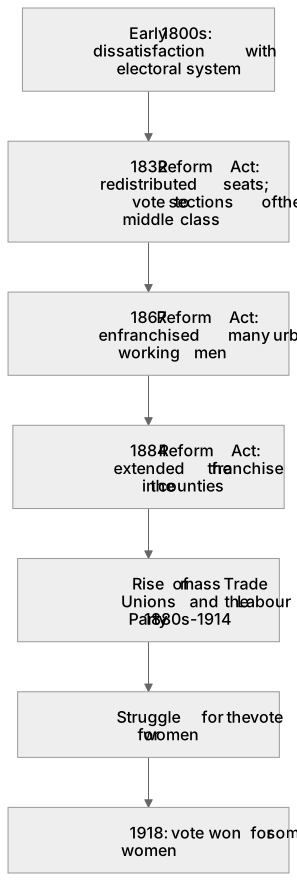
Put it in order
Put these steps in the order they happen.
- 1. 1918: vote won for some women
- 2. Struggle for the vote for women
- 3. 1867 Reform Act: enfranchised many urban working men
- 4. Rise of mass Trade Unions and the Labour Party 1880s-1914
- 5. Early 1800s: dissatisfaction with electoral system
- 6. 1832 Reform Act: redistributed seats; vote to sections of the middle class
- 7. 1884 Reform Act: extended the franchise in the counties
Put the events in order
Put these events in the order they happened, earliest first.
- 1. The vote was won for some women
- 2. Reform Act redistributed seats and extended the vote to sections of the middle class
- 3. Reform Act extended the franchise in the counties
- 4. Reform Act enfranchised many urban working men
Key words
Say what each word means before you turn the card.
Representation and the franchise
Try answering aloud or in your head before turning the card.
Parliamentary reform
Try answering aloud or in your head before turning the card.
Organised labour and political parties
Try answering aloud or in your head before turning the card.
Women's suffrage
Try answering aloud or in your head before turning the card.
See every definition
- Representation and the franchise
- The link between Parliament and the people, including who had the vote and how constituencies were represented.
- Parliamentary reform
- Change to the electoral system through the Reform Acts of 1832, 1867 and 1884, which redistributed seats and extended the vote.
- Organised labour and political parties
- The rise of mass trade unions and the Labour Party from the 1880s to 1914 and their effectiveness in pressing working people's interests.
- Women's suffrage
- The struggle for the vote for women and the reasons why it was won for some women in 1918.
Label the diagram
Some boxes have lost their names. Pick the right name for each number.
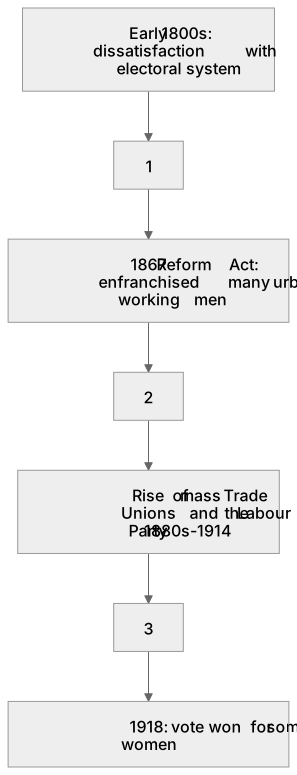
1Box 1
2Box 2
3Box 3
There is more to this lesson
The full lesson goes on to check your understanding and help you earn the marks. Create a free account to carry on, with your progress saved.
A week of Premium from your first lesson · Then the free plan continues · No card, no charge
Test your understanding of Power: Monarchy and Democracy in Britain c.1000 to 2014 (J410/09) - c.1800–2014: The changing relationship between Parliament and people c.1800 to c.1918: dissatisfaction with electoral system by early 1800s; reasons for and impacts of the Parliamentary Reform Acts of 1832, 1867 and 1884; the rise and effectiveness of mass Trade Unions and the Labour Party 1880s–1914; the struggle for the vote for women and the reasons why it was won for some women in 1918.
Active recall beats re-reading. Take an instant quiz now to test what you’ve learned and lock it into long-term memory.
A week of Premium from your first lesson · Then the free plan continues · No card, no charge