OCR · GCSE · History
Course version: J410 · Version from Mar 2026
Monarchy and Democracy in Britain c.1000 to 2014 (J410/09) - c.1800–2014:…
Full specification wording
Power: Monarchy and Democracy in Britain c.1000 to 2014 (J410/09) - c.1800–2014: The changing relationship between Parliament and people c.1914–c.1980: government control in the world wars; the increased role of the state from 1945 to c.1980.
This topic examines how the relationship between Parliament, government and people changed between c.1914 and c.1980.
Checked against the OCR J410 specification (opens in a new tab) on .
- Point 2 of 3
- 4 key terms
Study notes
From the checked teaching notes for this specification point.
The idea
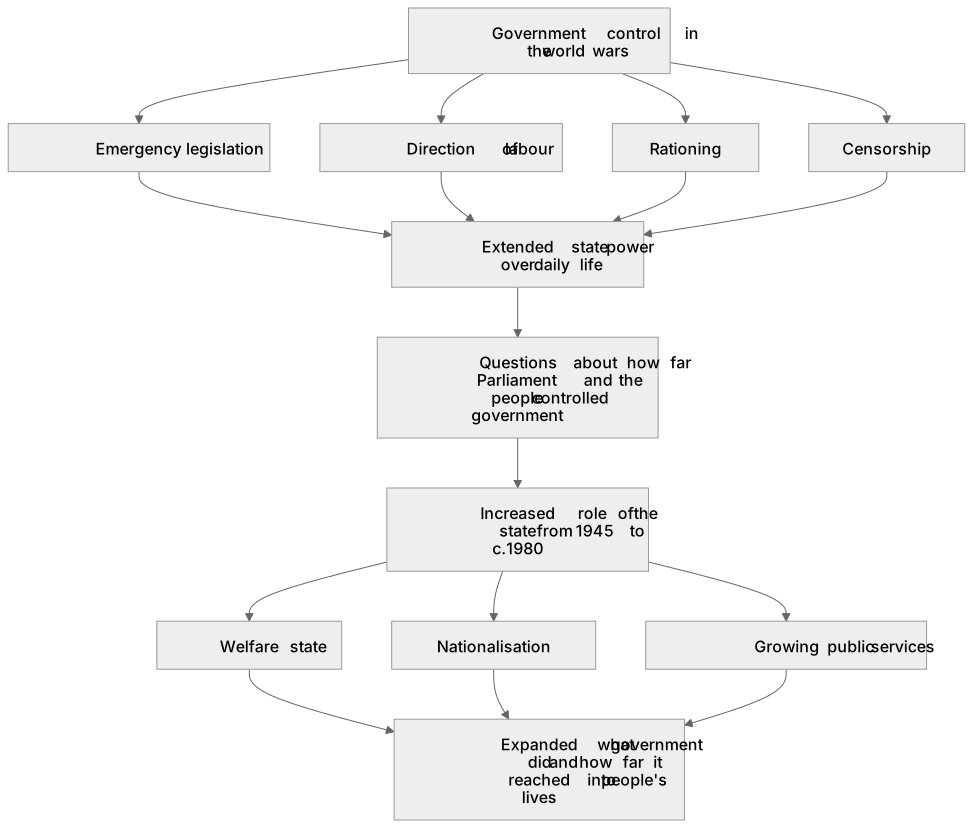
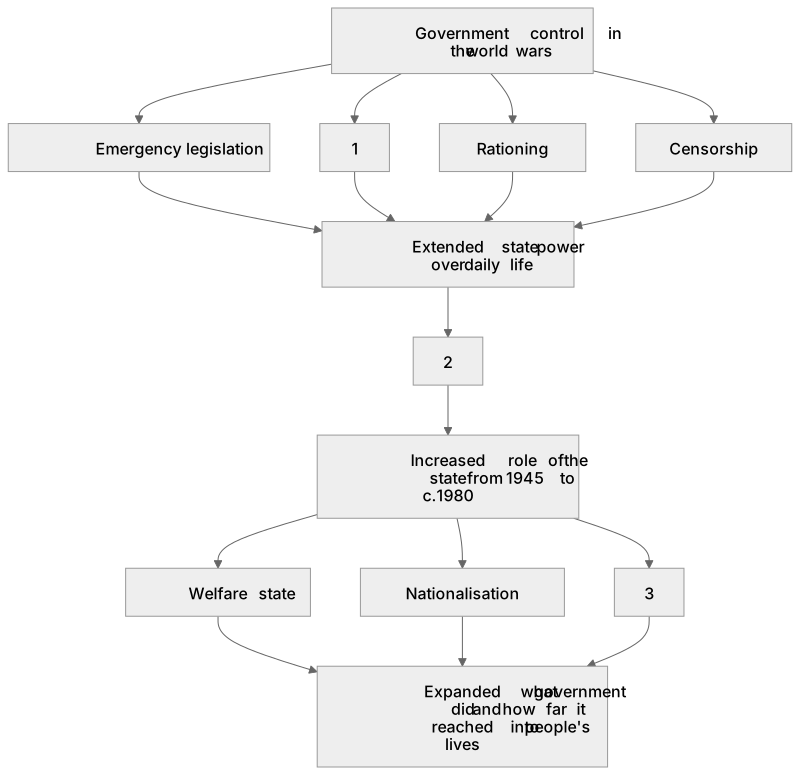
This topic examines how the relationship between Parliament, government and people changed between c.1914 and c.1980. Begin with government control in the two world wars: emergency legislation, direction of labour, rationing and censorship extended state power over daily life, and this raised questions about how far Parliament and the people controlled government. Then trace the increased role of the state from 1945 to c.1980: the welfare state, nationalisation, and growing public services expanded what government did and how far it reached into people's lives. Weigh continuity and change, and judge how far these developments altered the balance between Parliament, government and the public across the period.
What earns the marks
- Identifies examples of government control during the world wars, such as direction of labour, rationing or emergency powers.
- Explains how wartime controls changed the relationship between government and people.
- Describes features of the increased role of the state from 1945 to c.1980, such as the welfare state or nationalisation.
- Assesses how far the growth of state activity changed the relationship between Parliament, government and the people across the period.
Common mistakes and how to put them right
Treats wartime controls as permanent.
Put it right: Recognise that many were temporary emergency measures.
Assumes the increased role of the state began only after 1945.
Put it right: Note that wartime experience helped shape later expectations.
Lists policies without linking them to the changing relationship between government and people.
Put it right: Connect each example to the theme.
Ignores the role of Parliament when discussing government control.
Put it right: Consider how far Parliament retained oversight.
Exam tips
- Anchor each example to a date within c.1914–c.1980 so it stays inside the assessed period.
- Use the phrase 'role of the state' precisely, linking it to specific policies rather than general statements.
- When asked to judge change, compare the start and end of the period explicitly.
Try the lesson
The start of the Power: Monarchy and Democracy in Britain c.1000 to 2014 (J410/09) - c.1800–2014: The changing relationship between Parliament and people c.1914–c.1980: government control in the world wars; the increased role of the state from 1945 to c.1980. lesson, made from checked teaching notes for this specification point.
Have a go first
During the First World War, which law gave the British government power to take over factories and land for war production?
Listen
This topic examines how the relationship between Parliament, government and people changed between c.1914 and c.1980. Begin with government control in the two world wars: emergency legislation, direction of labour, rationing and censorship extended state power over daily life, and this raised questions about how far Parliament and the people controlled government. Then trace the increased role of the state from 1945 to c.1980: the welfare state, nationalisation, and growing public services expanded what government did and how far it reached into people's lives. Weigh continuity and change, and judge how far these developments altered the balance between Parliament, government and the public across the period. A strong answer earns marks for these points. Identifies examples of government control during the world wars, such as direction of labour, rationing or emergency powers. Explains how wartime controls changed the relationship between government and people. Describes features of the increased role of the state from 1945 to c.1980, such as the welfare state or nationalisation. Assesses how far the growth of state activity changed the relationship between Parliament, government and the people across the period. Exam tip: Anchor each example to a date within c.1914–c.1980 so it stays inside the assessed period.
See it
Key words
Say what each word means before you turn the card.
State control in wartime
Try answering aloud or in your head before turning the card.
The welfare state
Try answering aloud or in your head before turning the card.
Nationalisation and public services
Try answering aloud or in your head before turning the card.
Parliament, government and the people
Try answering aloud or in your head before turning the card.
See every definition
- State control in wartime
- Emergency legislation, direction of labour, rationing and censorship extended state power over daily life in the two world wars.
- The welfare state
- Part of the increased role of the state from 1945 to c.1980, expanding what government did and how far it reached into people's lives.
- Nationalisation and public services
- Along with the welfare state, these expanded what government did and how far it reached into people's lives from 1945 to c.1980.
- Parliament, government and the people
- The relationship examined across c.1914–c.1980, including how far Parliament and the people controlled government.
Label the diagram
Some boxes have lost their names. Pick the right name for each number.
1Box 1
2Box 2
3Box 3
There is more to this lesson
The full lesson goes on to check your understanding and help you earn the marks. Create a free account to carry on, with your progress saved.
A week of Premium from your first lesson · Then the free plan continues · No card, no charge
Test your understanding of Power: Monarchy and Democracy in Britain c.1000 to 2014 (J410/09) - c.1800–2014: The changing relationship between Parliament and people c.1914–c.1980: government control in the world wars; the increased role of the state from 1945 to c.1980.
Active recall beats re-reading. Take an instant quiz now to test what you’ve learned and lock it into long-term memory.
A week of Premium from your first lesson · Then the free plan continues · No card, no charge