OCR · GCSE · History
Course version: J410 · Version from Mar 2026
Patterns of Migration (J410/11) - The experiences of immigrants:…
Full specification wording
Urban Environments: Patterns of Migration (J410/11) - The experiences of immigrants: Employment and occupations.
This topic asks you to explain the work immigrants found in urban Britain and how that work shaped their experience.
Checked against the OCR J410 specification (opens in a new tab) on .
- Point 2 of 2
- 4 key terms
Study notes
From the checked teaching notes for this specification point.
The idea
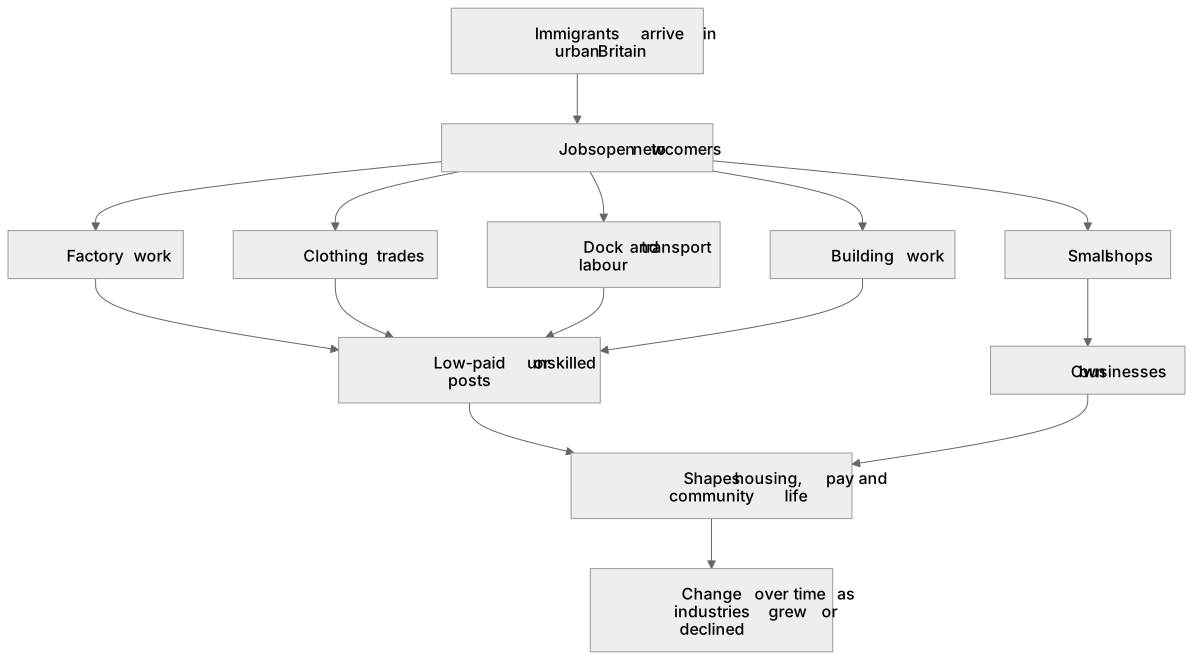
This topic asks you to explain the work immigrants found in urban Britain and how that work shaped their experience. Learn the kinds of jobs commonly open to newcomers, such as factory work, the clothing trades, dock and transport labour, building work and small shops, and note that many arrivals took low-paid or unskilled posts while some ran their own businesses. Link occupation to housing, pay and community life, and to change over time as industries grew or declined. Use named examples from the period and theme you have studied, and be ready to explain why particular groups clustered in particular trades.
What earns the marks
- Identifies specific occupations open to immigrants, such as factory, clothing, dock or building work.
- Explains how employment patterns shaped immigrants' living conditions and community life.
- Uses a named example from the studied period to illustrate an occupation or trade.
- Distinguishes between unskilled labour and self-employed or skilled work among immigrants.
Common mistakes and how to put them right
Assumes all immigrants did the same work.
Put it right: Note the variety of trades and the differences between groups.
Treats occupation as unrelated to housing or community.
Put it right: Connect work to pay, location and daily life.
Invents statistics or job figures.
Put it right: Use only evidence from the studied material.
Ignores change over time.
Put it right: Recognise that available work shifted as industries expanded or declined.
Exam tips
- Read the question stem carefully to see whether it asks for a description or an explanation.
- Anchor each answer in a specific occupation and, where possible, a named group or place.
- Eliminate options that contradict the studied period or that generalise about all immigrants.
Try the lesson
The start of the Urban Environments: Patterns of Migration (J410/11) - The experiences of immigrants: Employment and occupations. lesson, made from checked teaching notes for this specification point.
Have a go first
Many migrants to British cities in the nineteenth and twentieth centuries took work in the textile mills of northern towns. Which type of employment does this describe?
Listen
This topic asks you to explain the work immigrants found in urban Britain and how that work shaped their experience. Learn the kinds of jobs commonly open to newcomers, such as factory work, the clothing trades, dock and transport labour, building work and small shops, and note that many arrivals took low-paid or unskilled posts while some ran their own businesses. Link occupation to housing, pay and community life, and to change over time as industries grew or declined. Use named examples from the period and theme you have studied, and be ready to explain why particular groups clustered in particular trades. A strong answer earns marks for these points. Identifies specific occupations open to immigrants, such as factory, clothing, dock or building work. Explains how employment patterns shaped immigrants' living conditions and community life. Uses a named example from the studied period to illustrate an occupation or trade. Distinguishes between unskilled labour and self-employed or skilled work among immigrants. Exam tip: Read the question stem carefully to see whether it asks for a description or an explanation.
See it
Key words
Say what each word means before you turn the card.
Types of work open to immigrants
Try answering aloud or in your head before turning the card.
Link between occupation and living conditions
Try answering aloud or in your head before turning the card.
Skilled, unskilled and self-employed work
Try answering aloud or in your head before turning the card.
Change in employment over time
Try answering aloud or in your head before turning the card.
See every definition
- Types of work open to immigrants
- Factory work, the clothing trades, dock and transport labour, building work and small shops were the kinds of jobs commonly open to newcomers.
- Link between occupation and living conditions
- Occupation was connected to housing, pay and community life, so work shaped immigrants' living conditions and community life.
- Skilled, unskilled and self-employed work
- Many arrivals took low-paid or unskilled posts, while some ran their own businesses, so unskilled labour is distinguished from self-employed or skilled work.
- Change in employment over time
- Available work shifted as industries expanded or declined, so employment patterns changed over time.
Label the diagram
Some boxes have lost their names. Pick the right name for each number.
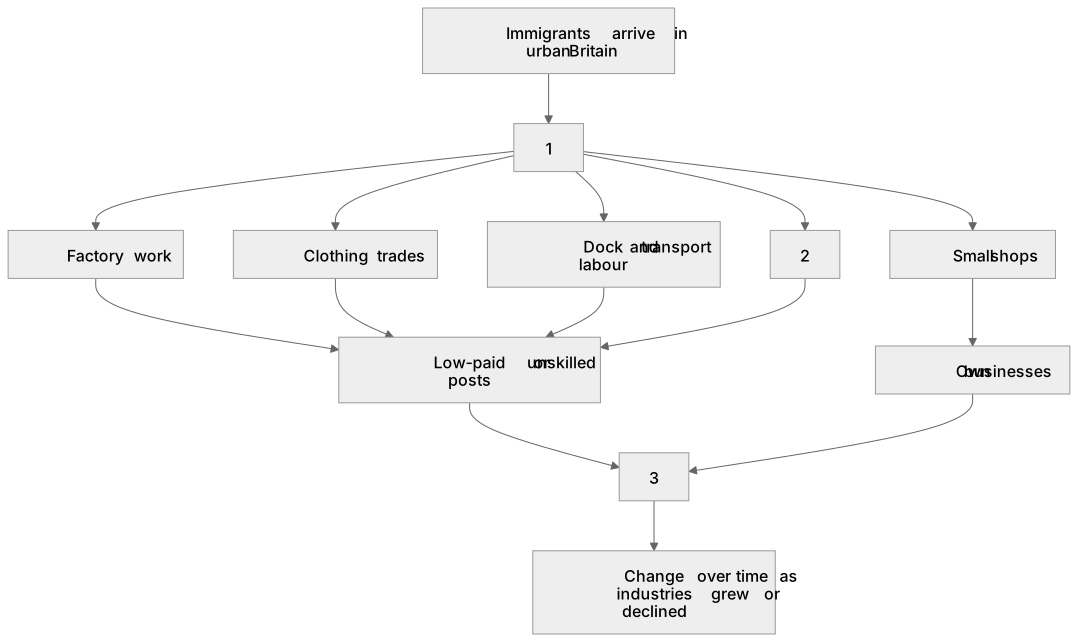
1Box 1
2Box 2
3Box 3
There is more to this lesson
The full lesson goes on to check your understanding and help you earn the marks. Create a free account to carry on, with your progress saved.
A week of Premium from your first lesson · Then the free plan continues · No card, no charge
Test your understanding of Urban Environments: Patterns of Migration (J410/11) - The experiences of immigrants: Employment and occupations.
Active recall beats re-reading. Take an instant quiz now to test what you’ve learned and lock it into long-term memory.
A week of Premium from your first lesson · Then the free plan continues · No card, no charge