OCR · GCSE · History
Course version: J410 · Version from Mar 2026
Patterns of Migration (J410/11) - The experiences of immigrants: Housing,…
Full specification wording
Urban Environments: Patterns of Migration (J410/11) - The experiences of immigrants: Housing, welfare and living conditions.
This criterion covers the housing immigrants found, the welfare available to them and the living conditions they endured.
Checked against the OCR J410 specification (opens in a new tab) on .
- Point 1 of 2
- 4 key terms
Study notes
From the checked teaching notes for this specification point.
The idea
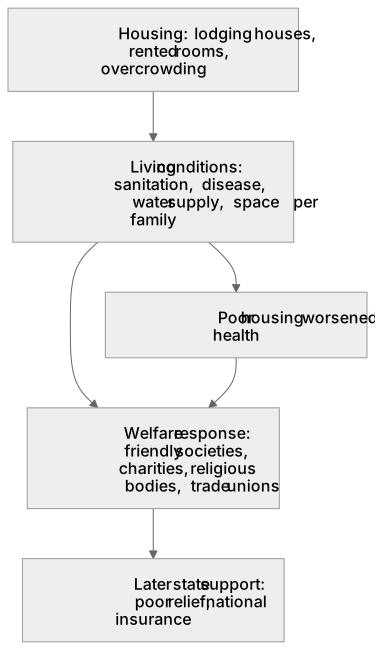
This criterion covers the housing immigrants found, the welfare available to them and the living conditions they endured. Housing includes lodging houses, rented rooms, overcrowding and later council provision. Welfare includes friendly societies, charities, religious bodies, trade unions and, later, state support such as poor relief or national insurance. Living conditions include sanitation, disease, water supply and space per family. A strong answer distinguishes these three strands and shows how they interacted: poor housing worsened health, and welfare bodies responded to that need. Use named examples from your studied period, such as a specific city district or a named charitable organisation, and identify who provided help and who received it.
What earns the marks
- Identifies a specific type of housing, such as lodging houses or rented rooms, available to immigrants in the studied period.
- Names a welfare provider, such as a charity, friendly society, religious body or state scheme, and states what it offered.
- Describes a living condition, such as overcrowding, poor sanitation or disease, and links it to housing or welfare.
- Explains how housing, welfare and living conditions interacted, for example that overcrowding increased disease and prompted charitable response.
- Uses accurate place names and dates from the studied period to support the point.
Common mistakes and how to put them right
Confuses welfare with housing.
Put it right: Keep the provider of support distinct from the type of accommodation.
Assumes all immigrants faced identical conditions.
Put it right: Note variation by city, period and group where evidence allows.
Names a charity or scheme without saying what it provided.
Put it right: State the service offered.
Uses dates outside the studied period.
Put it right: Check each example against the specification's timeframe.
Exam tips
- Read the question stem carefully to see whether it asks about housing, welfare or living conditions before choosing.
- Eliminate options that name a provider without a matching service.
- Check that any date in an option falls inside the studied period.
- Look for the option that links two strands, such as housing and health, because such links show understanding.
Try the lesson
The start of the Urban Environments: Patterns of Migration (J410/11) - The experiences of immigrants: Housing, welfare and living conditions. lesson, made from checked teaching notes for this specification point.
Have a go first
What type of housing did many Irish migrants in 19th-century British cities typically live in?
Listen
This criterion covers the housing immigrants found, the welfare available to them and the living conditions they endured. Housing includes lodging houses, rented rooms, overcrowding and later council provision. Welfare includes friendly societies, charities, religious bodies, trade unions and, later, state support such as poor relief or national insurance. Living conditions include sanitation, disease, water supply and space per family. A strong answer distinguishes these three strands and shows how they interacted: poor housing worsened health, and welfare bodies responded to that need. Use named examples from your studied period, such as a specific city district or a named charitable organisation, and identify who provided help and who received it. A strong answer earns marks for these points. Identifies a specific type of housing, such as lodging houses or rented rooms, available to immigrants in the studied period. Names a welfare provider, such as a charity, friendly society, religious body or state scheme, and states what it offered. Describes a living condition, such as overcrowding, poor sanitation or disease, and links it to housing or welfare. Explains how housing, welfare and living conditions interacted, for example that overcrowding increased disease and prompted charitable response. Exam tip: Read the question stem carefully to see whether it asks about housing, welfare or living conditions before choosing.
See it
Key words
Say what each word means before you turn the card.
Types of immigrant housing
Try answering aloud or in your head before turning the card.
Welfare providers and their services
Try answering aloud or in your head before turning the card.
Living conditions and public health
Try answering aloud or in your head before turning the card.
Interaction between housing, welfare and health
Try answering aloud or in your head before turning the card.
See every definition
- Types of immigrant housing
- Includes lodging houses, rented rooms, overcrowding and later council provision available to immigrants.
- Welfare providers and their services
- Includes friendly societies, charities, religious bodies, trade unions and, later, state support such as poor relief or national insurance.
- Living conditions and public health
- Includes sanitation, disease, water supply and space per family.
- Interaction between housing, welfare and health
- Poor housing worsened health, and welfare bodies responded to that need.
Label the diagram
Some boxes have lost their names. Pick the right name for each number.
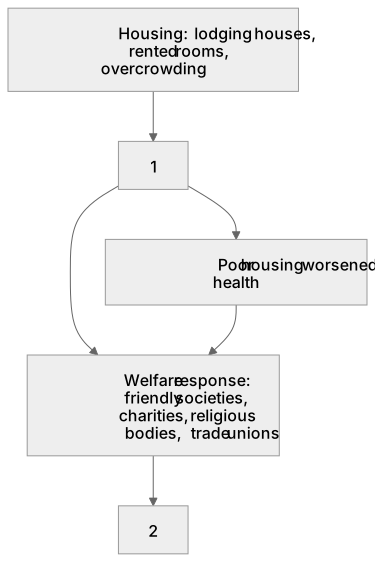
1Box 1
2Box 2
There is more to this lesson
The full lesson goes on to check your understanding and help you earn the marks. Create a free account to carry on, with your progress saved.
A week of Premium from your first lesson · Then the free plan continues · No card, no charge
Test your understanding of Urban Environments: Patterns of Migration (J410/11) - The experiences of immigrants: Housing, welfare and living conditions.
Active recall beats re-reading. Take an instant quiz now to test what you’ve learned and lock it into long-term memory.
A week of Premium from your first lesson · Then the free plan continues · No card, no charge