OCR · GCSE · History
Viking expansion, c.750-c.1050
This comprehensive study guide for OCR GCSE History delves into the dynamic period of Viking expansion from c.750 to c.1050. It moves beyond the stereotype of raiders to explore the Vikings as traders, settlers, and empire-builders, providing the specific knowledge and analytical skills needed to achieve top marks.
- 7 min read
- 3 worked examples
- 5 practice questions
- 6 key terms
Study Notes
Overview
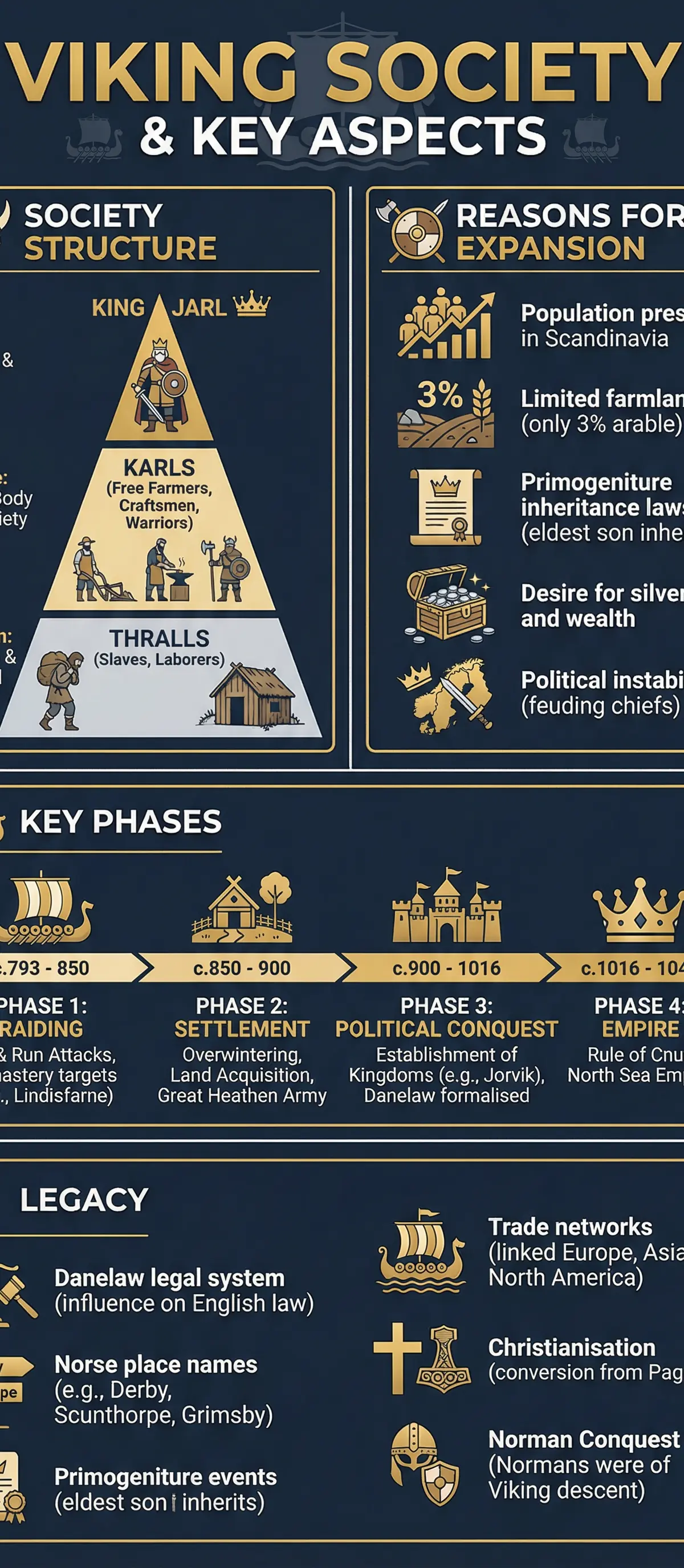
This study covers the expansion of the Scandinavian peoples—often collectively termed Vikings—from approximately 750 to 1050 CE. It is a core component of the OCR B (SHP) World Depth Study, focusing on the causes, course, and consequences of this expansion. Examiners expect candidates to understand the diversity of Viking society and activity, distinguishing between the Danish raids and settlement in England (the Danelaw), the Norwegian exploration of the North Atlantic, and the Swedish trade routes to the East (the Varangian routes). The topic traces a clear progression from initial hit-and-run raids (e.g., Lindisfarne, 793) to large-scale conquest (the Great Heathen Army, 865), political settlement (the Danelaw), and ultimately, the creation of a vast political entity in Cnut the Great's North Sea Empire. High-level responses must demonstrate an analytical understanding of second-order concepts like causation (why they expanded) and significance (the long-term impact of their presence in Britain and beyond).
Key Events & Developments
The Raid on Lindisfarne
Date(s): 793 CE
What happened: Danish Viking raiders attacked the wealthy and undefended monastery of Lindisfarne on the coast of Northumbria. They killed many of the monks and plundered its treasures. The event sent shockwaves through Christian Europe.
Why it matters: This is traditionally seen as the start of the Viking Age in England. It established the Vikings' reputation for brutality and highlighted the vulnerability of coastal settlements. For examiners, it is the key example of the initial 'raiding' phase.
Specific Knowledge: Lindisfarne, 793, Northumbria, Alcuin of York (who wrote a famous account of the raid).
The Great Heathen Army
Date(s): 865-878 CE
What happened: A large, coordinated force of Danish Vikings, known as the Great Heathen Army, arrived in East Anglia. Unlike previous raiding parties, its intention was conquest and settlement. It systematically conquered the kingdoms of Northumbria (866), East Anglia (869), and Mercia (874).
Why it matters: This marked a fundamental shift from raiding to conquest and settlement. It led directly to the establishment of the Danelaw. Candidates must use this specific name to gain credit.
Specific Knowledge: Great Heathen Army, 865, Ivar the Boneless, Halfdan Ragnarsson, conquest of York (Jorvik).
The Danelaw & The Treaty of Wedmore
Date(s): 878 CE
What happened: After his victory at the Battle of Edington, Alfred the Great, King of Wessex, forced the Danish leader Guthrum to accept baptism and agree to a peace treaty. The Treaty of Wedmore formally established a boundary, roughly along the old Roman road of Watling Street, dividing Anglo-Saxon England from the area of Viking rule, known as the Danelaw.
Why it matters: This formalised Viking control over a vast swathe of northern and eastern England. It created a hybrid cultural zone where Norse and Anglo-Saxon customs, laws, and language blended. High-level responses will evaluate the 'significance' of the Danelaw as a cultural and legal entity, not just a line on a map.
Specific Knowledge: Alfred the Great, Guthrum, Battle of Edington (878), Treaty of Wedmore (878), Danelaw.
The North Sea Empire
Date(s): 1016-1035 CE
What happened: Cnut (or Canute), son of the Danish king Sweyn Forkbeard, became King of all England in 1016. He went on to rule a vast 'North Sea Empire' that also included Denmark, Norway, and parts of Sweden.
Why it matters: This represents the zenith of Viking political power and the final phase of expansion. Cnut ruled not as a foreign conqueror but as a sophisticated Christian king, issuing laws and maintaining stability. His reign demonstrates the full evolution from raider to statesman.
Specific Knowledge: Cnut the Great, Sweyn Forkbeard, North Sea Empire, 1016.
Key Individuals
Ivar the Boneless
Role: A principal leader of the Great Heathen Army.
Key Actions: Led the invasion of 865 and the capture of York (Jorvik) in 866. His military strategy was key to the initial success of the conquest.
Impact: Instrumental in the destruction of the Anglo-Saxon kingdoms of Northumbria and East Anglia, paving the way for the Danelaw.
Alfred the Great
Role: King of Wessex (871-899).
Key Actions: Resisted the Danish invasion, defeating Guthrum at the Battle of Edington (878). He established a network of fortified towns (burhs) and a navy to defend his kingdom.
Impact: Saved Wessex from conquest and laid the foundations for the eventual unification of England under his successors. His treaty with Guthrum created the Danelaw.
Cnut the Great
Role: King of England, Denmark, and Norway (ruled England 1016-1035).
Key Actions: Conquered England in 1016. Ruled as an effective and respected monarch, issuing law codes and respecting the English church. Maintained a vast North Sea Empire.
Impact: Represents the culmination of Viking political ambition. His reign was a period of peace and prosperity, showing how Viking leaders could integrate and govern established kingdoms.
Second-Order Concepts
Causation
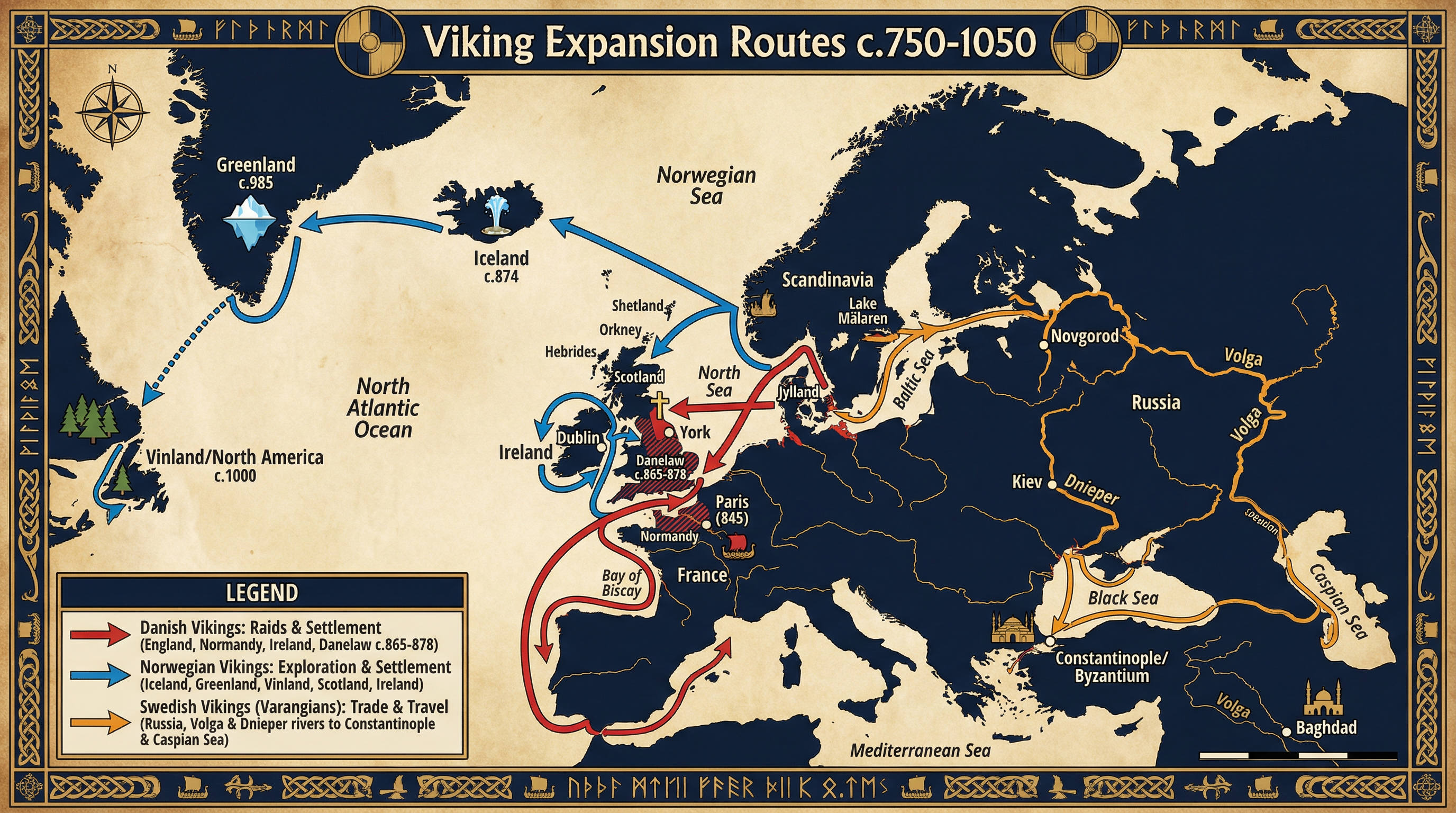
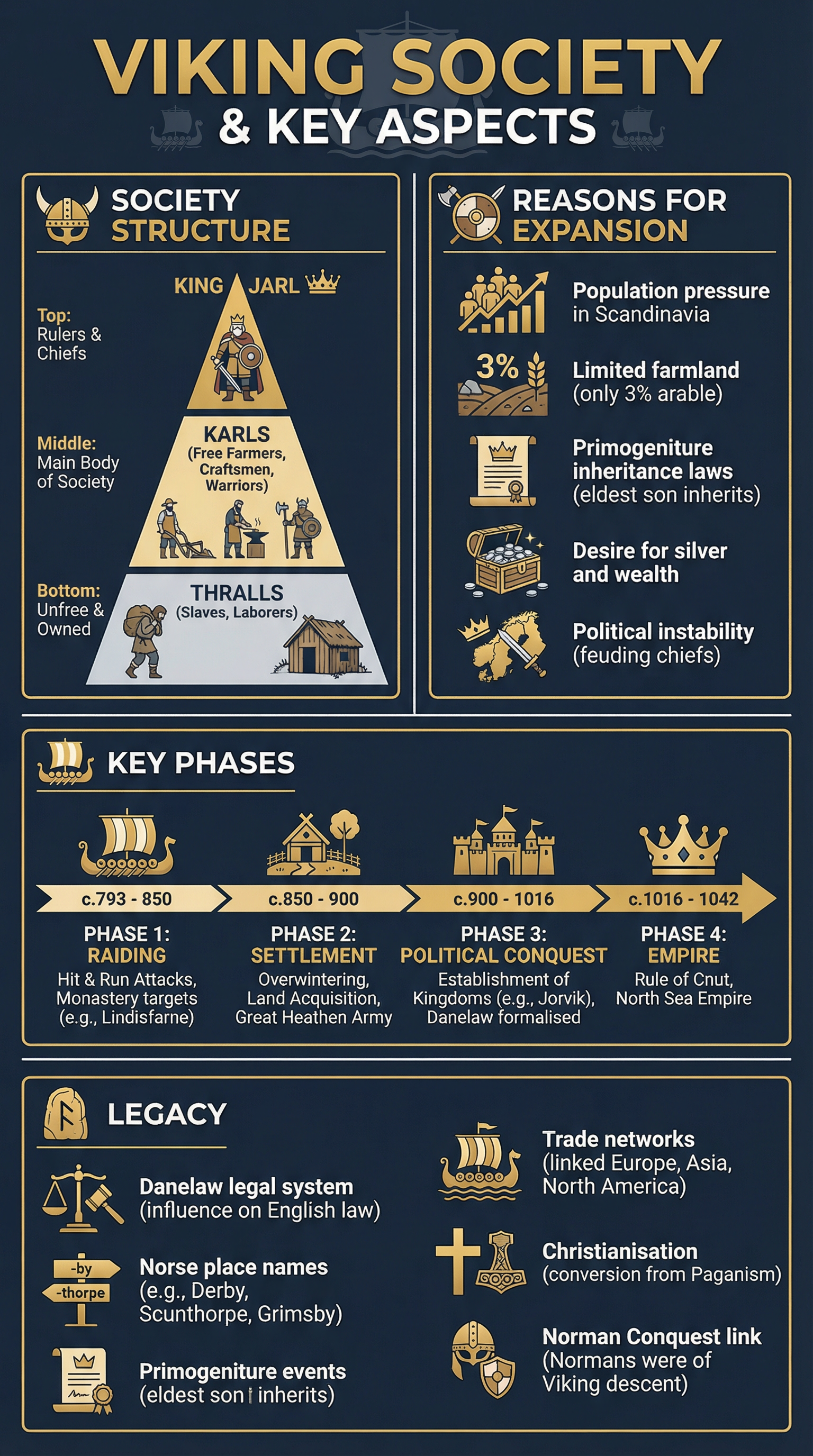
Long-term causes: Population pressure in Scandinavia; limited availability of good farmland (primogeniture meant younger sons inherited nothing); developing longship technology.
Short-term causes: Political instability and feuding among Scandinavian jarls, forcing losers to seek new lands; the lure of portable wealth (silver) from poorly defended monasteries and towns.
Triggers: The success of early raids demonstrated the potential for profit and the weakness of European kingdoms.
Consequence
Immediate effects: Destruction of monasteries; loss of life; establishment of Viking armies on English soil; collapse of the kingdoms of Northumbria, East Anglia, and Mercia.
Long-term effects: Creation of the Danelaw; significant Norse influence on the English language and place names (e.g., endings like -by, -thorpe); development of towns and trade (e.g., York, Lincoln); eventual political unification of England in response to the Viking threat.
Change & Continuity
Change: The nature of Viking activity changed dramatically, from small-scale raids to large-scale settlement and finally to empire-building. Viking society itself changed, adopting Christianity and settled customs.
Continuity: Throughout the period, the sea remained central to Viking power and identity. A warrior ethos, while evolving, remained important.
Significance
The Viking expansion was historically significant because it reshaped the political and cultural map of Northern Europe. It led to the creation of new political entities (the Danelaw, Normandy, the kingdom of Kievan Rus), spurred the unification of others (England), and established vast trade networks linking Scandinavia with Britain, Iceland, Russia, and even the Middle East.
Source Skills
When approaching sources on this topic, consider their origin. Many accounts of early raids (like the Anglo-Saxon Chronicle) were written by the victims (English monks), so they are likely to be hostile and emphasise Viking brutality. They are useful for understanding the English perspective and the impact of the raids, but they are not objective accounts of Viking motives. Later Norse sources, like the Sagas, were written down centuries after the events and are heroic literature, not factual history. They are useful for understanding Viking culture and values, but their details are often unreliable. Archaeology (e.g., grave goods from Repton, the layout of Jorvik) provides crucial physical evidence to balance the written accounts.
Worked Examples
3 worked examples — open one to explore the question and available guidance.
Practice Questions
Test your understanding — click to reveal model answers
Describe two features of the Viking raid on Lindisfarne in 793. (4 marks)
Hint: Think about what the Vikings did and what the target was like.
Explain why the Danelaw was significant. (12 marks)
Hint: Think beyond the political boundary. Consider its impact on law, culture, and the development of England.
Write an account of how the Vikings conquered and established control over a large part of England in the years 865-878. (8 marks)
Hint: This is a narrative question. Tell the story chronologically, linking events together to show cause and effect.
How were the activities of the Swedish Vikings (Varangians) different from those of the Danish Vikings? (8 marks)
Hint: Focus on geography, purpose, and interaction with local populations.
'Cnut the Great was more of an Anglo-Saxon king than a Viking warrior.' How far do you agree? (18 marks)
Hint: This is an essay about interpretation. You need to weigh the evidence for his 'Viking' characteristics against the evidence for his 'Anglo-Saxon' style of rule.
Test your understanding of Viking expansion, c.750-c.1050
Active recall beats re-reading. Take an instant quiz now to test what you’ve learned and lock it into long-term memory.
7 days Premium · Then free forever · No card, no charge