OCR · GCSE · History
Course version: J410 · Version from Mar 2026
The Civil Wars of 1642–1651 in England, Scotland and Ireland: the nature…
Full specification wording
War and British Society c.790 to c.2010 (J410/10) - c.1500–c.1750: The Civil Wars of 1642–1651 in England, Scotland and Ireland: the nature of these wars; their impact on the people of England, Scotland and Ireland.
The Civil Wars of 1642–1651 were not a single conflict but a series fought across England, Scotland and Ireland.
Checked against the OCR J410 specification (opens in a new tab) on .
- Point 3 of 4
Study notes
From the checked teaching notes for this specification point.
The idea
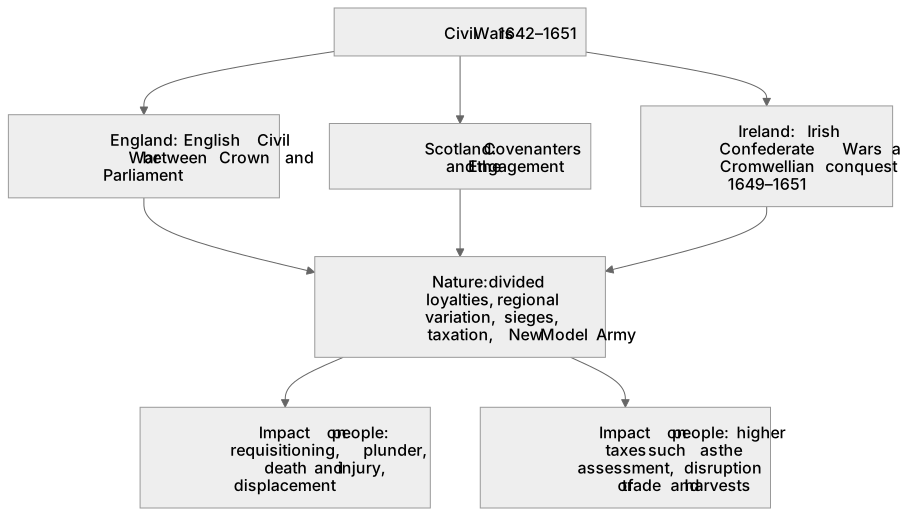
The Civil Wars of 1642–1651 were not a single conflict but a series fought across England, Scotland and Ireland. They included the English Civil War between Crown and Parliament, the Scottish involvement through the Covenanters and the Engagement, and the Irish Confederate Wars and Cromwellian conquest (1649–1651). The nature of the wars involved divided loyalties, regional variation, sieges, taxation and the New Model Army. Impact on people included requisitioning, plunder, death and injury, displacement, higher taxes such as the assessment, and disruption of trade and harvests. A strong answer distinguishes between the three kingdoms and links a specific feature of the wars to a specific effect on civilians.
What earns the marks
- Recognises that the Civil Wars of 1642–1651 involved England, Scotland and Ireland rather than England alone.
- Explains that the wars included distinct conflicts such as the English Civil War, Scottish Covenanter involvement and the Irish Confederate and Cromwellian wars.
- Links a feature of the wars, such as requisitioning or taxation, to an impact on ordinary people.
- Describes the effect of the wars on civilians, including displacement, financial loss or disruption of trade and farming.
- Distinguishes between the experiences of people in England, Scotland and Ireland.
Common mistakes and how to put them right
Treats the Civil Wars as a single English conflict.
Put it right: Recognise the involvement of Scotland and Ireland across 1642–1651.
Dates the wars to a single year or short period.
Put it right: Place them across 1642–1651.
Lists battles without explaining impact on people.
Put it right: Connect warfare to civilian experience.
Assumes all three kingdoms experienced the wars in the same way.
Put it right: Note regional and national differences.
Exam tips
- Check whether the question asks about the nature of the wars or their impact before selecting an option.
- Eliminate options that refer only to England when the question covers all three kingdoms.
- Choose the option that names a specific feature and a specific consequence rather than a general statement.
Try the lesson
The start of the War and British Society c.790 to c.2010 (J410/10) - c.1500–c.1750: The Civil Wars of 1642–1651 in England, Scotland and Ireland: the nature of these wars; their impact on the people of England, Scotland and Ireland. lesson, made from checked teaching notes for this specification point.
Have a go first
In 1642, which side in the English Civil War supported King Charles I?
Listen
The Civil Wars of 1642–1651 were not a single conflict but a series fought across England, Scotland and Ireland. They included the English Civil War between Crown and Parliament, the Scottish involvement through the Covenanters and the Engagement, and the Irish Confederate Wars and Cromwellian conquest (1649–1651). The nature of the wars involved divided loyalties, regional variation, sieges, taxation and the New Model Army. Impact on people included requisitioning, plunder, death and injury, displacement, higher taxes such as the assessment, and disruption of trade and harvests. A strong answer distinguishes between the three kingdoms and links a specific feature of the wars to a specific effect on civilians. A strong answer earns marks for these points. Recognises that the Civil Wars of 1642–1651 involved England, Scotland and Ireland rather than England alone. Explains that the wars included distinct conflicts such as the English Civil War, Scottish Covenanter involvement and the Irish Confederate and Cromwellian wars. Links a feature of the wars, such as requisitioning or taxation, to an impact on ordinary people. Describes the effect of the wars on civilians, including displacement, financial loss or disruption of trade and farming. Exam tip: Check whether the question asks about the nature of the wars or their impact before selecting an option.
See it
Put the events in order
Put these events in the order they happened, earliest first.
- 1. Civil Wars begin across England, Scotland and Ireland
- 2. Civil Wars come to an end
- 3. Cromwellian conquest of Ireland takes place
Label the diagram
Some boxes have lost their names. Pick the right name for each number.
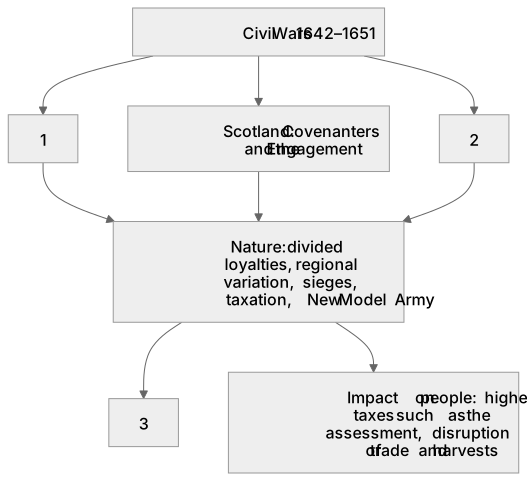
1Box 1
2Box 2
3Box 3
There is more to this lesson
The full lesson goes on to check your understanding and help you earn the marks. Create a free account to carry on, with your progress saved.
A week of Premium from your first lesson · Then the free plan continues · No card, no charge
Test your understanding of War and British Society c.790 to c.2010 (J410/10) - c.1500–c.1750: The Civil Wars of 1642–1651 in England, Scotland and Ireland: the nature of these wars; their impact on the people of England, Scotland and Ireland.
Active recall beats re-reading. Take an instant quiz now to test what you’ve learned and lock it into long-term memory.
A week of Premium from your first lesson · Then the free plan continues · No card, no charge