OCR · GCSE · History
Course version: J410 · Version from Mar 2026
The Jacobite Wars 1715 and 1745: the impact on Scotland of the repression…
Full specification wording
War and British Society c.790 to c.2010 (J410/10) - c.1500–c.1750: The Jacobite Wars 1715 and 1745: the impact on Scotland of the repression of the Jacobites.
This topic asks you to explain how government action against Jacobite supporters after the 1715 and 1745 risings changed life in Scotland.
Checked against the OCR J410 specification (opens in a new tab) on .
- Point 4 of 4
- 4 key terms
Study notes
From the checked teaching notes for this specification point.
The idea
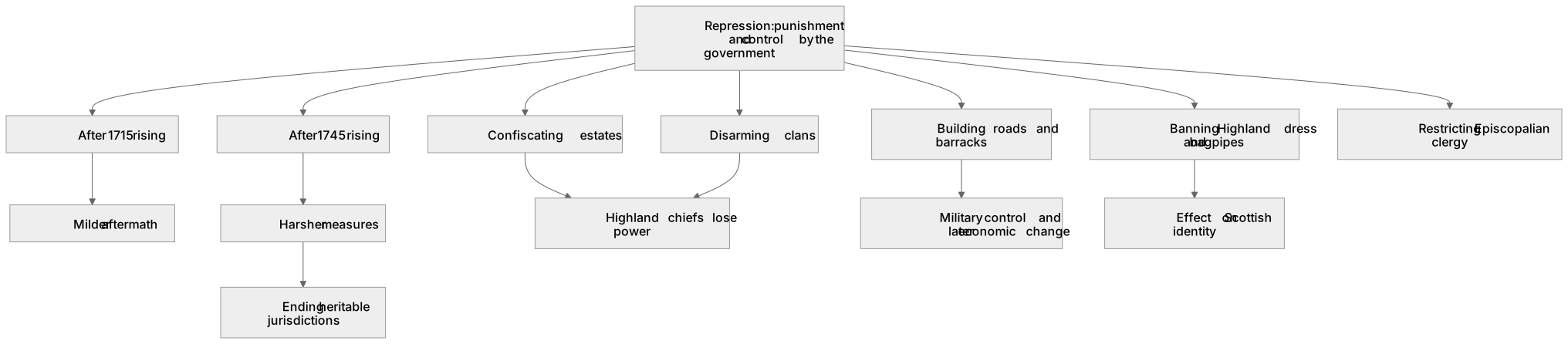
This topic asks you to explain how government action against Jacobite supporters after the 1715 and 1745 risings changed life in Scotland. Repression means punishment and control: confiscating estates, disarming clans, building roads and barracks, banning Highland dress and the bagpipes, and restricting the Episcopalian clergy. After 1745 the government also ended heritable jurisdictions, the private legal powers of clan chiefs. Weigh effects on different groups: Highland clans lost land and weapons; Lowland towns gained trade and roads; some Scots gained careers in the army. A strong answer links each measure to a consequence for Scotland, such as migration, poverty or the decline of Gaelic culture, and distinguishes the 1715 impact from the harsher 1745 aftermath.
What earns the marks
- Identifies repression as punishment and control imposed by the government after the 1715 and 1745 risings.
- Explains how estate confiscation and disarming of clans reduced the power of Highland chiefs.
- Describes the ban on Highland dress and cultural restrictions as an effect on Scottish identity.
- Links road and barracks building to both military control and later economic change in the Highlands.
- Distinguishes the milder 1715 aftermath from the harsher measures after 1745.
Common mistakes and how to put them right
Treats the Jacobite risings as a single event.
Put it right: Separate the 1715 and 1745 risings and their different consequences.
Assumes repression affected all of Scotland equally.
Put it right: Note that Highland and Lowland experiences differed.
Confuses Jacobites with the government side.
Put it right: Jacobites supported the Stuart claim.
Lists measures without stating their impact on Scotland.
Put it right: Connect each measure to a consequence.
Exam tips
- Read the question stem carefully to see whether it asks about 1715, 1745 or both.
- Eliminate options that describe causes of the risings when the question asks about effects of repression.
- Look for the option that names a specific group, such as Highland clans or Episcopalian clergy, and a clear consequence.
- Check dates: measures after 1745 were generally harsher than those after 1715.
Try the lesson
The start of the War and British Society c.790 to c.2010 (J410/10) - c.1500–c.1750: The Jacobite Wars 1715 and 1745: the impact on Scotland of the repression of the Jacobites. lesson, made from checked teaching notes for this specification point.
Have a go first
How did the government's treatment of Jacobite prisoners after 1745 affect Scottish society?
Listen
This topic asks you to explain how government action against Jacobite supporters after the 1715 and 1745 risings changed life in Scotland. Repression means punishment and control: confiscating estates, disarming clans, building roads and barracks, banning Highland dress and the bagpipes, and restricting the Episcopalian clergy. After 1745 the government also ended heritable jurisdictions, the private legal powers of clan chiefs. Weigh effects on different groups: Highland clans lost land and weapons; Lowland towns gained trade and roads; some Scots gained careers in the army. A strong answer links each measure to a consequence for Scotland, such as migration, poverty or the decline of Gaelic culture, and distinguishes the 1715 impact from the harsher 1745 aftermath. A strong answer earns marks for these points. Identifies repression as punishment and control imposed by the government after the 1715 and 1745 risings. Explains how estate confiscation and disarming of clans reduced the power of Highland chiefs. Describes the ban on Highland dress and cultural restrictions as an effect on Scottish identity. Links road and barracks building to both military control and later economic change in the Highlands. Exam tip: Read the question stem carefully to see whether it asks about 1715, 1745 or both.
See it
Key words
Say what each word means before you turn the card.
Government repression and control
Try answering aloud or in your head before turning the card.
Highland clan society and land ownership
Try answering aloud or in your head before turning the card.
Scottish cultural identity and Gaelic culture
Try answering aloud or in your head before turning the card.
Economic change through roads and barracks
Try answering aloud or in your head before turning the card.
See every definition
- Government repression and control
- Punishment and control imposed by the government after the 1715 and 1745 risings, including confiscating estates, disarming clans, building roads and barracks, banning Highland dress and the bagpipes, and restricting the Episcopalian clergy.
- Highland clan society and land ownership
- Highland clans lost land and weapons through estate confiscation and disarming, and after 1745 the government ended heritable jurisdictions, the private legal powers of clan chiefs.
- Scottish cultural identity and Gaelic culture
- Banning Highland dress and the bagpipes and restricting the Episcopalian clergy were cultural restrictions, and a consequence for Scotland was the decline of Gaelic culture.
- Economic change through roads and barracks
- Building roads and barracks served military control and later economic change in the Highlands, while Lowland towns gained trade and roads.
Label the diagram
Some boxes have lost their names. Pick the right name for each number.
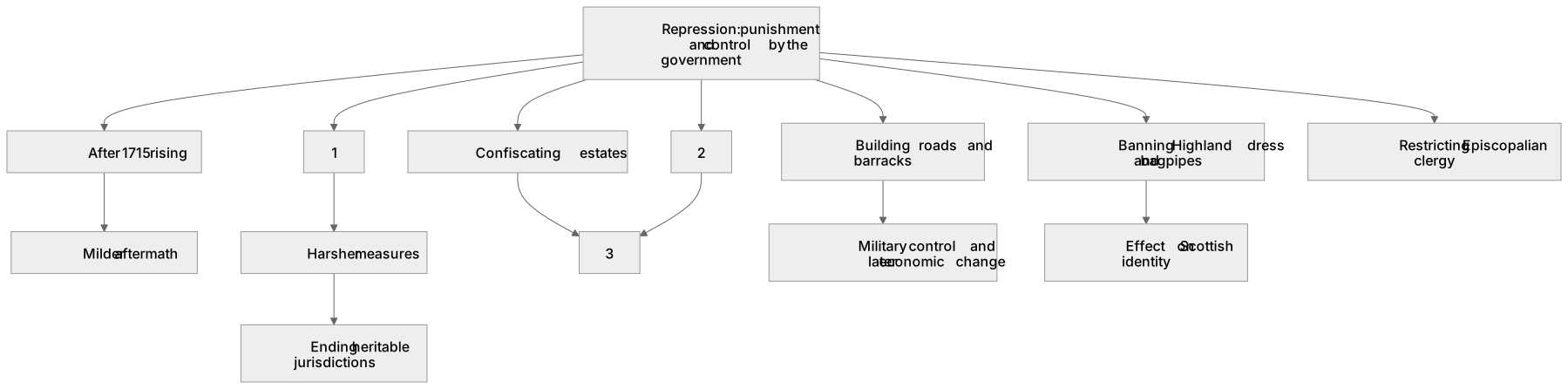
1Box 1
2Box 2
3Box 3
There is more to this lesson
The full lesson goes on to check your understanding and help you earn the marks. Create a free account to carry on, with your progress saved.
A week of Premium from your first lesson · Then the free plan continues · No card, no charge
Test your understanding of War and British Society c.790 to c.2010 (J410/10) - c.1500–c.1750: The Jacobite Wars 1715 and 1745: the impact on Scotland of the repression of the Jacobites.
Active recall beats re-reading. Take an instant quiz now to test what you’ve learned and lock it into long-term memory.
A week of Premium from your first lesson · Then the free plan continues · No card, no charge