OCR · GCSE · History
Course version: J410 · Version from Mar 2026
Imperial conflicts in the second half of the 19th century: effects of the…
Full specification wording
War and British Society c.790 to c.2010 (J410/10) - c.1750–c.2010: Imperial conflicts in the second half of the 19th century: effects of the Crimean War; Boer Wars 1880–1881 and 1899–1902.
This topic covers imperial conflicts in the second half of the nineteenth century and their effects on British society.
Checked against the OCR J410 specification (opens in a new tab) on .
- Point 3 of 5
- 4 key terms
Study notes
From the checked teaching notes for this specification point.
The idea
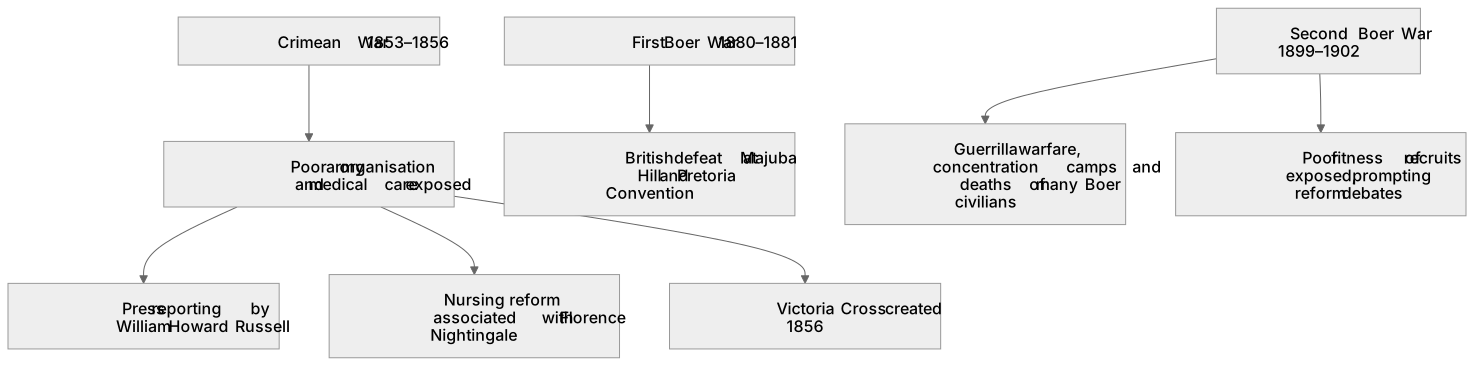
This topic covers imperial conflicts in the second half of the nineteenth century and their effects on British society. The Crimean War (1853–1856) exposed poor army organisation and medical care, prompting reporting by William Howard Russell and nursing reform associated with Florence Nightingale, and it produced the Victoria Cross in 1856. The First Boer War (1880–1881) ended in British defeat at Majuba Hill and the Pretoria Convention. The Second Boer War (1899–1902) involved guerrilla warfare, concentration camps and the deaths of many Boer civilians, and it exposed poor fitness of recruits, prompting reform debates. A strong answer links a specific conflict to a specific effect on British society, such as press reporting, reform of the army or public debate about empire.
What earns the marks
- Places the Crimean War, the First Boer War (1880–1881) and the Second Boer War (1899–1902) correctly within the second half of the nineteenth century.
- Explains one effect of the Crimean War on British society, such as press reporting, nursing reform or the creation of the Victoria Cross.
- Explains one effect of the Boer Wars, such as public debate about empire, concern over army fitness or criticism of concentration camps.
- Links a specific conflict to a specific social or political consequence rather than a general claim about imperial pride.
Common mistakes and how to put them right
Merges the two Boer Wars into one conflict.
Put it right: Keep the 1880–1881 and 1899–1902 wars distinct.
Places the Crimean War in the twentieth century.
Put it right: It belongs to the 1850s.
Treats imperial conflict as having only military effects.
Put it right: Include social effects such as press reporting, nursing and public debate.
Exam tips
- Check the dates in each option against the stated periods before selecting.
- Distinguish effects of the Crimean War from effects of the Boer Wars when the stem asks for one.
- Reject options that describe a different imperial conflict or fall outside the second half of the nineteenth century.
Try the lesson
The start of the War and British Society c.790 to c.2010 (J410/10) - c.1750–c.2010: Imperial conflicts in the second half of the 19th century: effects of the Crimean War; Boer Wars 1880–1881 and 1899–1902. lesson, made from checked teaching notes for this specification point.
Have a go first
In which decade was the First Boer War fought?
Listen
This topic covers imperial conflicts in the second half of the nineteenth century and their effects on British society. The Crimean War (1853–1856) exposed poor army organisation and medical care, prompting reporting by William Howard Russell and nursing reform associated with Florence Nightingale, and it produced the Victoria Cross in 1856. The First Boer War (1880–1881) ended in British defeat at Majuba Hill and the Pretoria Convention. The Second Boer War (1899–1902) involved guerrilla warfare, concentration camps and the deaths of many Boer civilians, and it exposed poor fitness of recruits, prompting reform debates. A strong answer links a specific conflict to a specific effect on British society, such as press reporting, reform of the army or public debate about empire. A strong answer earns marks for these points. Places the Crimean War, the First Boer War (1880–1881) and the Second Boer War (1899–1902) correctly within the second half of the nineteenth century. Explains one effect of the Crimean War on British society, such as press reporting, nursing reform or the creation of the Victoria Cross. Explains one effect of the Boer Wars, such as public debate about empire, concern over army fitness or criticism of concentration camps. Links a specific conflict to a specific social or political consequence rather than a general claim about imperial pride. Exam tip: Check the dates in each option against the stated periods before selecting.
See it
Key words
Say what each word means before you turn the card.
Crimean War
Try answering aloud or in your head before turning the card.
First Boer War
Try answering aloud or in your head before turning the card.
Second Boer War
Try answering aloud or in your head before turning the card.
Victoria Cross
Try answering aloud or in your head before turning the card.
See every definition
- Crimean War
- A war that exposed poor army organisation and medical care, prompting reporting by William Howard Russell and nursing reform associated with Florence Nightingale.
- First Boer War
- A war that ended in British defeat at Majuba Hill and the Pretoria Convention.
- Second Boer War
- A war that involved guerrilla warfare, concentration camps and the deaths of many Boer civilians, and exposed poor fitness of recruits.
- Victoria Cross
- Award produced by the Crimean War in 1856.
Label the diagram
Some boxes have lost their names. Pick the right name for each number.
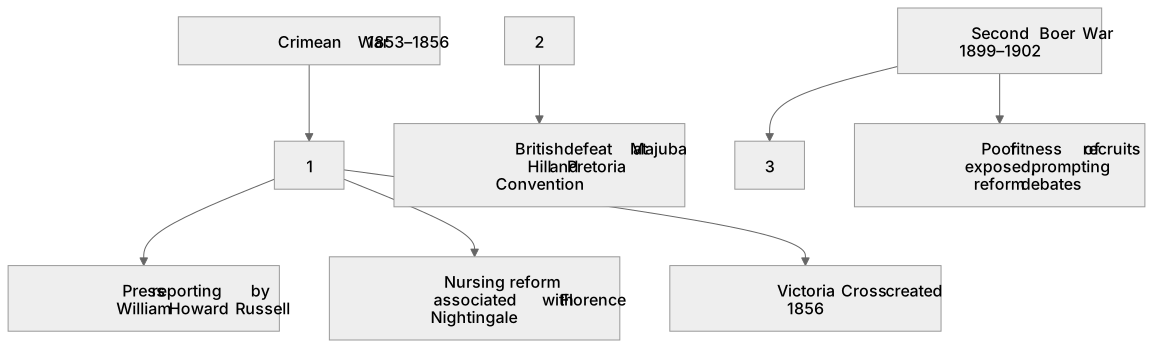
1Box 1
2Box 2
3Box 3
There is more to this lesson
The full lesson goes on to check your understanding and help you earn the marks. Create a free account to carry on, with your progress saved.
A week of Premium from your first lesson · Then the free plan continues · No card, no charge
Test your understanding of War and British Society c.790 to c.2010 (J410/10) - c.1750–c.2010: Imperial conflicts in the second half of the 19th century: effects of the Crimean War; Boer Wars 1880–1881 and 1899–1902.
Active recall beats re-reading. Take an instant quiz now to test what you’ve learned and lock it into long-term memory.
A week of Premium from your first lesson · Then the free plan continues · No card, no charge