OCR · GCSE · History
Course version: J410 · Version from Mar 2026
Wars against Revolutionary / Napoleonic France and subsequent effects on…
Full specification wording
War and British Society c.790 to c.2010 (J410/10) - c.1750–c.2010: Wars against Revolutionary / Napoleonic France and subsequent effects on British society and politics.
Britain fought Revolutionary France from 1793 and Napoleonic France until 1815, and these wars reshaped British society and politics.
Checked against the OCR J410 specification (opens in a new tab) on .
- Point 2 of 5
- 4 key terms
Study notes
From the checked teaching notes for this specification point.
The idea
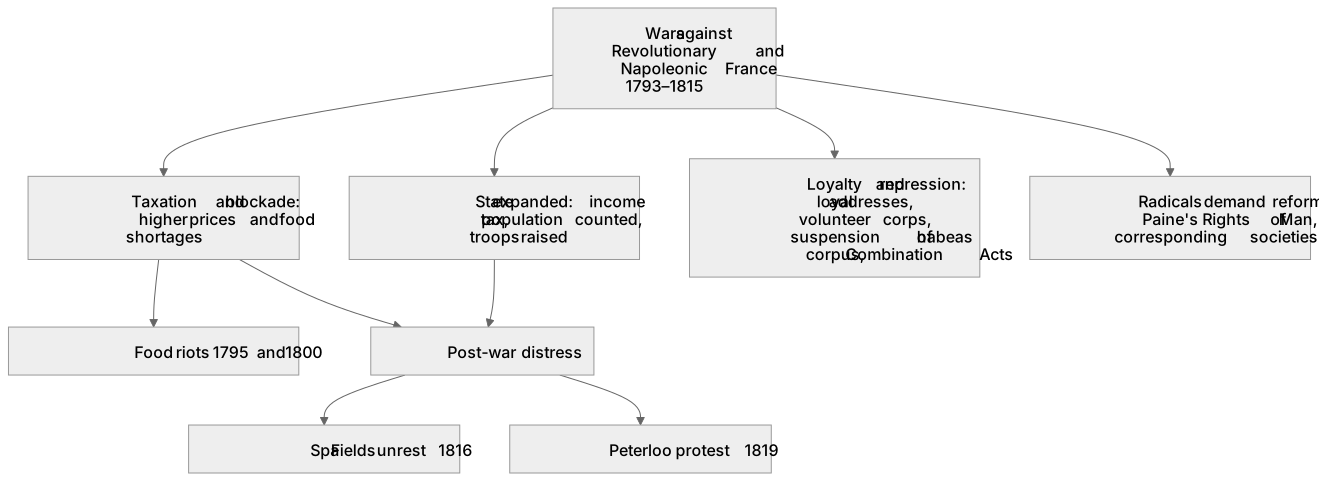
Britain fought Revolutionary France from 1793 and Napoleonic France until 1815, and these wars reshaped British society and politics. The state expanded: income tax was introduced, the population was counted and troops were raised by recruitment and militia ballot. Taxation and the blockade pushed up prices and food shortages, prompting the 1795 and 1800 food riots and the 1816 Spa Fields unrest. Loyalty and repression grew together: loyal addresses and volunteer corps on one side, and the suspension of habeas corpus and the Combination Acts on the other. Radicals such as Thomas Paine's Rights of Man and the corresponding societies demanded reform. A strong answer links a wartime measure to a social or political consequence, for example how wartime taxation fed post-war distress and the Peterloo protest of 1819.
What earns the marks
- Identifies the wars against Revolutionary and Napoleonic France as running from 1793 to 1815 and places them within the c.1750–c.2010 period.
- Explains one social effect of the wars, such as higher food prices, food riots or the growth of volunteer corps.
- Explains one political effect, such as the suspension of habeas corpus, the Combination Acts or the growth of radical reform societies.
- Links a wartime measure to a later consequence, for example wartime taxation and post-war distress leading to protest such as Peterloo in 1819.
Common mistakes and how to put them right
Confuses the Revolutionary and Napoleonic wars with the later Crimean War.
Put it right: Keep the 1793–1815 conflict distinct from mid-nineteenth-century imperial wars.
Treats wartime change as purely military.
Put it right: Include social and political effects such as taxation, food prices and repression.
Assumes all wartime measures were permanent.
Put it right: Note that some, such as income tax, were repealed and later revived.
Exam tips
- Read the question stem carefully to see whether it asks for a social or a political effect before choosing.
- Eliminate options that fall outside the c.1750–c.2010 period or describe a different war.
- Link each option to a specific wartime measure rather than a vague claim about 'change'.
Try the lesson
The start of the War and British Society c.790 to c.2010 (J410/10) - c.1750–c.2010: Wars against Revolutionary / Napoleonic France and subsequent effects on British society and politics. lesson, made from checked teaching notes for this specification point.
Have a go first
At which battle in 1815 was Napoleon finally defeated by British and allied forces?
Listen
Britain fought Revolutionary France from 1793 and Napoleonic France until 1815, and these wars reshaped British society and politics. The state expanded: income tax was introduced, the population was counted and troops were raised by recruitment and militia ballot. Taxation and the blockade pushed up prices and food shortages, prompting the 1795 and 1800 food riots and the 1816 Spa Fields unrest. Loyalty and repression grew together: loyal addresses and volunteer corps on one side, and the suspension of habeas corpus and the Combination Acts on the other. Radicals such as Thomas Paine's Rights of Man and the corresponding societies demanded reform. A strong answer links a wartime measure to a social or political consequence, for example how wartime taxation fed post-war distress and the Peterloo protest of 1819. A strong answer earns marks for these points. Identifies the wars against Revolutionary and Napoleonic France as running from 1793 to 1815 and places them within the c.1750–c.2010 period. Explains one social effect of the wars, such as higher food prices, food riots or the growth of volunteer corps. Explains one political effect, such as the suspension of habeas corpus, the Combination Acts or the growth of radical reform societies. Links a wartime measure to a later consequence, for example wartime taxation and post-war distress leading to protest such as Peterloo in 1819. Exam tip: Read the question stem carefully to see whether it asks for a social or a political effect before choosing.
See it
Key words
Say what each word means before you turn the card.
State expansion and wartime taxation
Try answering aloud or in your head before turning the card.
Food prices, shortages and popular protest
Try answering aloud or in your head before turning the card.
Loyalty, volunteer corps and repression
Try answering aloud or in your head before turning the card.
Radicalism and demands for parliamentary reform
Try answering aloud or in your head before turning the card.
See every definition
- State expansion and wartime taxation
- The state expanded as income tax was introduced, the population was counted and troops were raised by recruitment and militia ballot.
- Food prices, shortages and popular protest
- Taxation and the blockade pushed up prices and food shortages, prompting the 1795 and 1800 food riots and the 1816 Spa Fields unrest.
- Loyalty, volunteer corps and repression
- Loyal addresses and volunteer corps grew alongside the suspension of habeas corpus and the Combination Acts.
- Radicalism and demands for parliamentary reform
- Radicals such as Thomas Paine's Rights of Man and the corresponding societies demanded reform.
Label the diagram
Some boxes have lost their names. Pick the right name for each number.
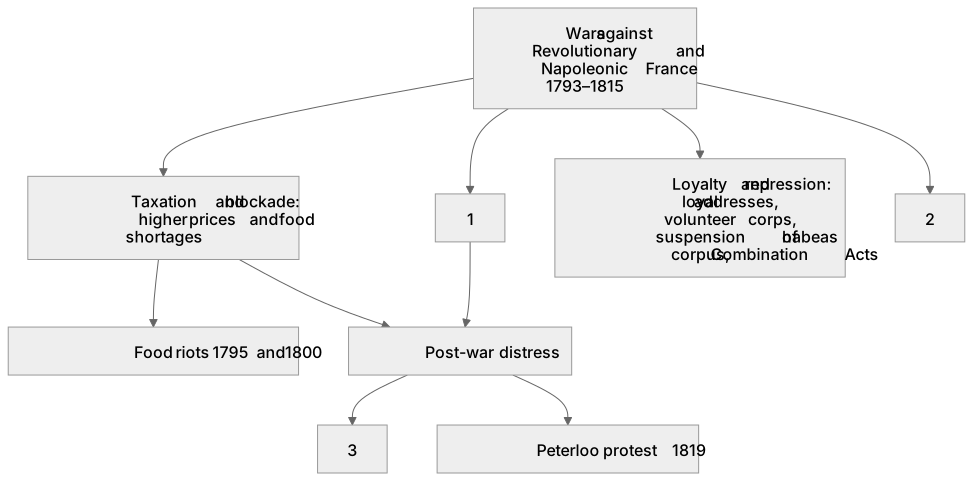
1Box 1
2Box 2
3Box 3
There is more to this lesson
The full lesson goes on to check your understanding and help you earn the marks. Create a free account to carry on, with your progress saved.
A week of Premium from your first lesson · Then the free plan continues · No card, no charge
Test your understanding of War and British Society c.790 to c.2010 (J410/10) - c.1750–c.2010: Wars against Revolutionary / Napoleonic France and subsequent effects on British society and politics.
Active recall beats re-reading. Take an instant quiz now to test what you’ve learned and lock it into long-term memory.
A week of Premium from your first lesson · Then the free plan continues · No card, no charge