OCR · GCSE · History
Course version: J410 · Version from Mar 2026
The Norman Conquest: English resistance; the establishment of Norman…
Full specification wording
War and British Society c.790 to c.2010 (J410/10) - c.790–c.1500: The Norman Conquest: English resistance; the establishment of Norman control under William I; the establishment of the Feudal system; the extent of the impact of the changes introduced by the Normans on different levels of society.
This topic asks you to connect four strands.
Checked against the OCR J410 specification (opens in a new tab) on .
- Point 2 of 4
- 4 key terms
Study notes
From the checked teaching notes for this specification point.
The idea
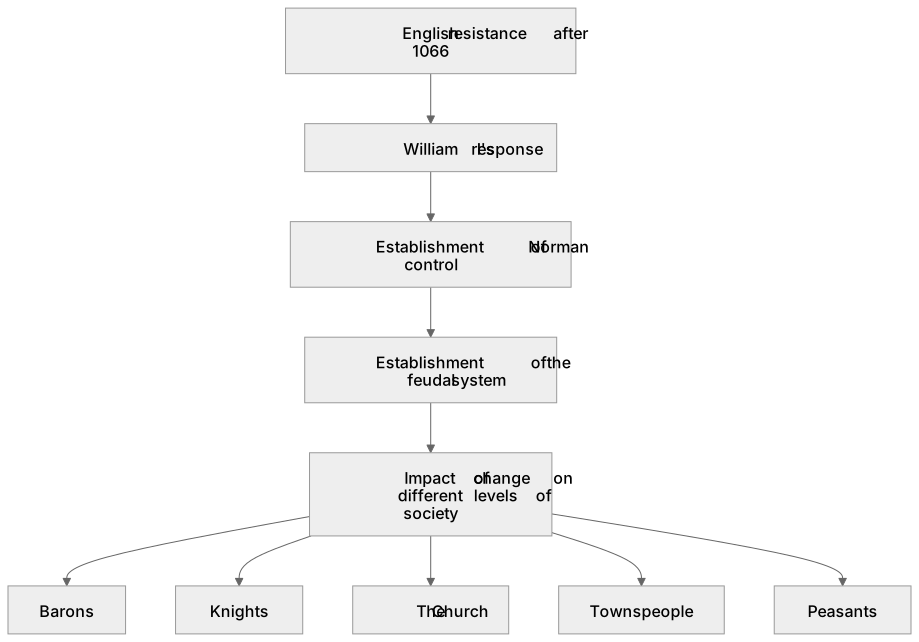
This topic asks you to connect four strands. First, English resistance after 1066: local risings such as the northern revolt of 1069 and Hereward's resistance in the Fens, and how William I answered them. Second, the establishment of Norman control: castle building, the march to harry the north, and the submission at Berkhamsted and later at Ely. Third, the establishment of the feudal system: land held from the king in return for military service, with tenants-in-chief, under-tenants and unfree peasants. Fourth, the extent of change for different levels of society: barons, knights, the Church, townspeople and peasants each felt the Conquest differently. A good answer weighs continuity against change rather than assuming everything altered at once.
What earns the marks
- Identifies English resistance after 1066, such as the northern risings and Hereward's resistance, and explains how William I responded to it.
- Explains how William I established Norman control, for example through castle building, the harrying of the north and the submission of English leaders.
- Describes the feudal system as land held from the monarch in return for service, with tenants-in-chief, under-tenants and peasants at different levels.
- Assesses the extent of change for different levels of society, weighing continuity for peasants against greater change for the Anglo-Saxon nobility.
Common mistakes and how to put them right
Treats the Norman Conquest as a single event in 1066.
Put it right: Recognise that resistance and the establishment of control continued for years afterwards.
Assumes every level of society experienced change equally.
Put it right: Compare barons, knights, the Church, townspeople and peasants separately.
Describes the feudal system as simply a tax.
Put it right: Explain that it was a relationship of land held in return for service.
Exam tips
- Read the whole stem before choosing, because options often differ only in the level of society affected.
- Reject options that claim all change happened instantly in 1066.
- Link each option to a named group, such as barons or peasants, to test whether it is accurate.
Try the lesson
The start of the War and British Society c.790 to c.2010 (J410/10) - c.790–c.1500: The Norman Conquest: English resistance; the establishment of Norman control under William I; the establishment of the Feudal system; the extent of the impact of the changes introduced by the Normans on different levels of society. lesson, made from checked teaching notes for this specification point.
Have a go first
In the feudal system established after the Norman Conquest, what did a lord grant to a knight in return for military service?
Listen
This topic asks you to connect four strands. First, English resistance after 1066: local risings such as the northern revolt of 1069 and Hereward's resistance in the Fens, and how William I answered them. Second, the establishment of Norman control: castle building, the march to harry the north, and the submission at Berkhamsted and later at Ely. Third, the establishment of the feudal system: land held from the king in return for military service, with tenants-in-chief, under-tenants and unfree peasants. Fourth, the extent of change for different levels of society: barons, knights, the Church, townspeople and peasants each felt the Conquest differently. A good answer weighs continuity against change rather than assuming everything altered at once. A strong answer earns marks for these points. Identifies English resistance after 1066, such as the northern risings and Hereward's resistance, and explains how William I responded to it. Explains how William I established Norman control, for example through castle building, the harrying of the north and the submission of English leaders. Describes the feudal system as land held from the monarch in return for service, with tenants-in-chief, under-tenants and peasants at different levels. Assesses the extent of change for different levels of society, weighing continuity for peasants against greater change for the Anglo-Saxon nobility. Exam tip: Read the whole stem before choosing, because options often differ only in the level of society affected.
See it
Key words
Say what each word means before you turn the card.
English resistance after 1066
Try answering aloud or in your head before turning the card.
Norman methods of control under William I
Try answering aloud or in your head before turning the card.
The feudal system and landholding
Try answering aloud or in your head before turning the card.
Differential impact of change on social groups
Try answering aloud or in your head before turning the card.
See every definition
- English resistance after 1066
- Local risings such as the northern revolt of 1069 and Hereward's resistance in the Fens, and how William I answered them.
- Norman methods of control under William I
- Castle building, the march to harry the north, and the submission at Berkhamsted and later at Ely.
- The feudal system and landholding
- Land held from the king in return for military service, with tenants-in-chief, under-tenants and unfree peasants.
- Differential impact of change on social groups
- Barons, knights, the Church, townspeople and peasants each felt the Conquest differently, so continuity is weighed against change.
Label the diagram
Some boxes have lost their names. Pick the right name for each number.
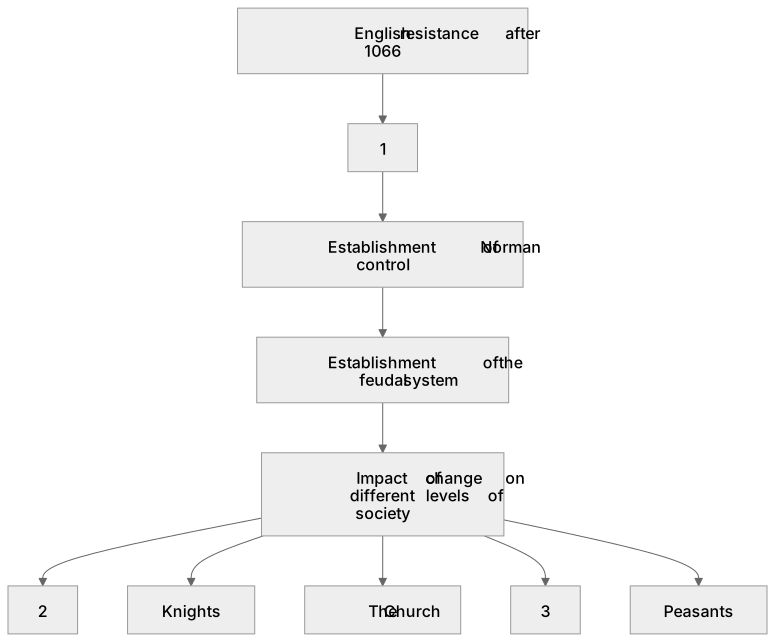
1Box 1
2Box 2
3Box 3
There is more to this lesson
The full lesson goes on to check your understanding and help you earn the marks. Create a free account to carry on, with your progress saved.
A week of Premium from your first lesson · Then the free plan continues · No card, no charge
Test your understanding of War and British Society c.790 to c.2010 (J410/10) - c.790–c.1500: The Norman Conquest: English resistance; the establishment of Norman control under William I; the establishment of the Feudal system; the extent of the impact of the changes introduced by the Normans on different levels of society.
Active recall beats re-reading. Take an instant quiz now to test what you’ve learned and lock it into long-term memory.
A week of Premium from your first lesson · Then the free plan continues · No card, no charge