OCR · GCSE · History
Course version: J410 · Version from Mar 2026
Viking raids on Anglo-Saxon England 790–1066: impact of the raids;…
Full specification wording
War and British Society c.790 to c.2010 (J410/10) - c.790–c.1500: Viking raids on Anglo-Saxon England 790–1066: impact of the raids; responses to the raids.
This depth topic covers Viking attacks on Anglo-Saxon England between 790 and 1066 and asks you to know both their impact and the responses they provoked.
Checked against the OCR J410 specification (opens in a new tab) on .
- Point 1 of 4
- 4 key terms
Study notes
From the checked teaching notes for this specification point.
The idea
This depth topic covers Viking attacks on Anglo-Saxon England between 790 and 1066 and asks you to know both their impact and the responses they provoked. Impact includes destruction of monasteries and settlements, seizure of loot and tribute, disruption of trade and agriculture, and political change as kingdoms reorganised. Responses include payment of tribute or Danegeld, fortified burhs and reorganised armies under Alfred and his successors, and eventual settlement and accommodation with Viking leaders. For a multiple-choice question, read the stem carefully and test each option against these two strands: does it describe an effect of the raids, or a reaction to them? Eliminate options that fall outside 790–1066 or that confuse impact with response. The correct option will match the specific strand the question names.
What earns the marks
- Identifies destruction of monasteries and settlements as an impact of the Viking raids.
- Identifies payment of tribute or Danegeld as a response to the raids.
- Identifies fortified burhs and reorganised defence as a response associated with Alfred and his successors.
- Distinguishes an impact of the raids from a response to them when selecting an option.
- Rejects options that fall outside the 790–1066 period or misattribute a response to the wrong ruler.
Common mistakes and how to put them right
Confuses impact with response.
Put it right: Check whether the option describes an effect of the raids or a reaction to them.
Selects an option dated outside 790–1066.
Put it right: Verify the date against the stated period.
Assumes all responses were military.
Put it right: Tribute payment and negotiated settlement also count as responses.
Attributes a defensive measure to the wrong ruler.
Put it right: Match the response to the figure the source supports.
Exam tips
- Underline the key word in the stem — impact or response — before reading the options.
- Eliminate any option whose date or figure falls outside 790–1066.
- Check the remaining options against both strands before committing to one answer.
Try the lesson
The start of the War and British Society c.790 to c.2010 (J410/10) - c.790–c.1500: Viking raids on Anglo-Saxon England 790–1066: impact of the raids; responses to the raids. lesson, made from checked teaching notes for this specification point.
Have a go first
In 793, Viking raiders attacked the monastery on the island of Lindisfarne. Which immediate effect did this attack have on the monastery?
Listen
This depth topic covers Viking attacks on Anglo-Saxon England between 790 and 1066 and asks you to know both their impact and the responses they provoked. Impact includes destruction of monasteries and settlements, seizure of loot and tribute, disruption of trade and agriculture, and political change as kingdoms reorganised. Responses include payment of tribute or Danegeld, fortified burhs and reorganised armies under Alfred and his successors, and eventual settlement and accommodation with Viking leaders. For a multiple-choice question, read the stem carefully and test each option against these two strands: does it describe an effect of the raids, or a reaction to them? Eliminate options that fall outside 790–1066 or that confuse impact with response. The correct option will match the specific strand the question names. A strong answer earns marks for these points. Identifies destruction of monasteries and settlements as an impact of the Viking raids. Identifies payment of tribute or Danegeld as a response to the raids. Identifies fortified burhs and reorganised defence as a response associated with Alfred and his successors. Distinguishes an impact of the raids from a response to them when selecting an option. Exam tip: Underline the key word in the stem — impact or response — before reading the options.
See it

Key words
Say what each word means before you turn the card.
Viking raids 790–1066
Try answering aloud or in your head before turning the card.
Impact on monasteries and settlements
Try answering aloud or in your head before turning the card.
Tribute and Danegeld
Try answering aloud or in your head before turning the card.
Fortified burhs and defence
Try answering aloud or in your head before turning the card.
See every definition
- Viking raids 790–1066
- Attacks on Anglo-Saxon England between 790 and 1066 whose impact and the responses they provoked are covered by this depth topic.
- Impact on monasteries and settlements
- Destruction of monasteries and settlements, seizure of loot and tribute, and disruption of trade and agriculture.
- Tribute and Danegeld
- Payment of tribute or Danegeld, which counts as a response to the raids rather than an impact.
- Fortified burhs and defence
- Fortified burhs and reorganised armies under Alfred and his successors, a response to the raids.
Label the diagram
Some boxes have lost their names. Pick the right name for each number.
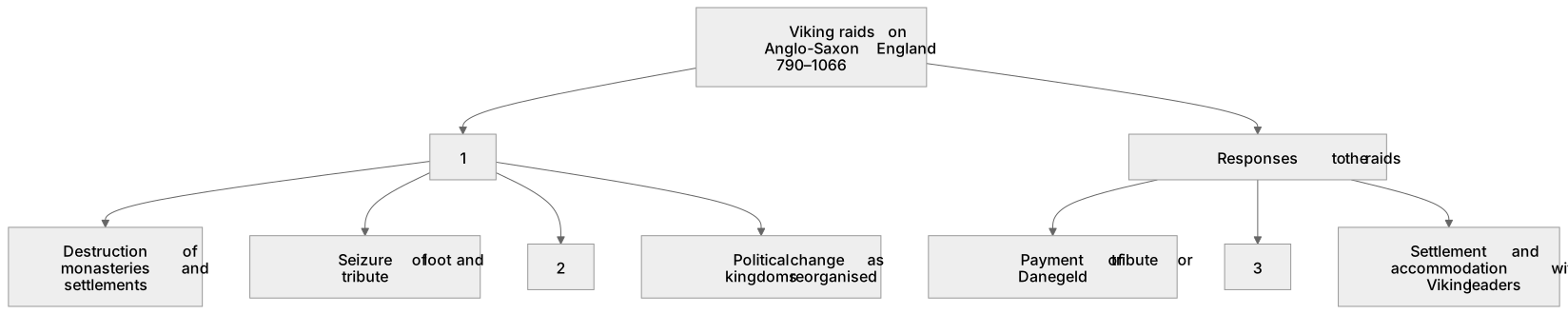
1Box 1
2Box 2
3Box 3
There is more to this lesson
The full lesson goes on to check your understanding and help you earn the marks. Create a free account to carry on, with your progress saved.
A week of Premium from your first lesson · Then the free plan continues · No card, no charge
Test your understanding of War and British Society c.790 to c.2010 (J410/10) - c.790–c.1500: Viking raids on Anglo-Saxon England 790–1066: impact of the raids; responses to the raids.
Active recall beats re-reading. Take an instant quiz now to test what you’ve learned and lock it into long-term memory.
A week of Premium from your first lesson · Then the free plan continues · No card, no charge