Pearson Edexcel · A-Level · History
Course version: 9HI0 · Version from Sept 2015
South Africa, 1948–94: from apartheid state to ‘rainbow nation’ - 2…
Full specification wording
Paper 2, Option 2F.2: South Africa, 1948–94: from apartheid state to ‘rainbow nation’ - 2 Radicalisation of resistance and the consolidation of National Party power, 1960–68: Strengthening ‘separate development’, 1961–68: economic recovery, including international investment; developing the Bantustans; diplomatic ties; Vorster’s use of police powers and defence forces.
Between 1961 and 1968 the National Party government tried to entrench ‘separate development’ while restoring economic confidence after Sharpeville.
Checked against the Pearson Edexcel 9HI0 specification (opens in a new tab) on .
- Point 4 of 4
- 4 key terms
Study notes
From the checked teaching notes for this specification point.
The idea
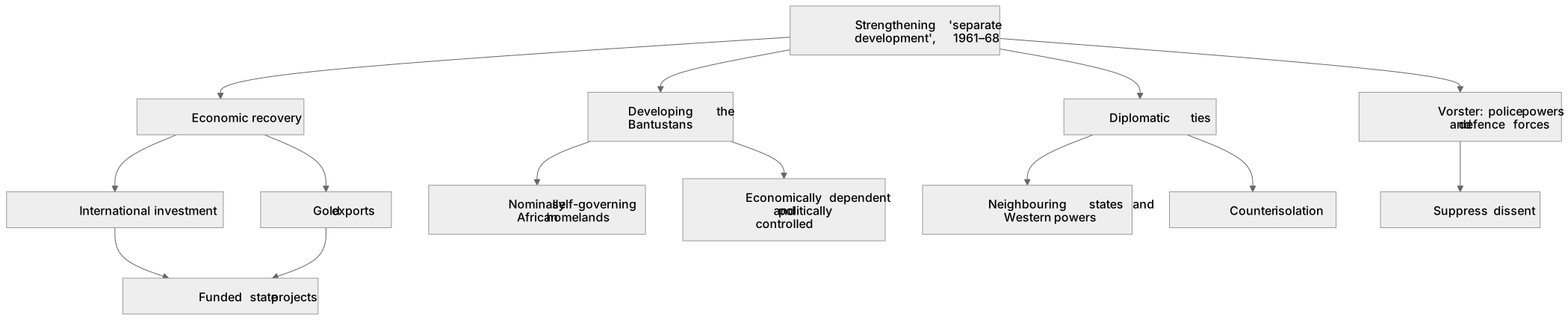
Between 1961 and 1968 the National Party government tried to entrench ‘separate development’ while restoring economic confidence after Sharpeville. Economic recovery was aided by foreign investment and gold exports, which funded state projects. The Bantustans were developed as nominally self-governing African homelands, but they remained economically dependent and politically controlled. South Africa sought diplomatic ties, especially with neighbouring states and Western powers, to counter isolation. Vorster, as Minister of Justice and later Prime Minister, expanded police powers and used the defence forces to suppress dissent, helping the state to contain opposition during this period.
What earns the marks
- Explains how economic recovery after 1960 was supported by international investment and the gold trade, and how this strengthened the state’s capacity.
- Describes the development of the Bantustans as part of ‘separate development’, including their limited self-government and economic dependence.
- Analyses South Africa’s diplomatic efforts to build ties and reduce isolation, including relations with selected African states and Western countries.
- Assesses Vorster’s use of police powers and defence forces to suppress opposition, including legislation, security policing and military deployment.
- Uses specific evidence from 1961–68, such as investment figures, Bantustan legislation, diplomatic visits, and security legislation.
Common mistakes and how to put them right
Assuming the Bantustans were genuinely independent.
Put it right: They were designed to be dependent and were not internationally recognised as sovereign states.
Overlooking the role of international investment in sustaining apartheid.
Put it right: Explain how foreign capital and trade helped the economy recover and fund state repression.
Confusing Vorster’s roles; correction: he was Minister of Justice, Police and Prisons before becoming Prime Minister in 1966, so his use of police powers predates his premiership.
Exam tips
- Connect economic and diplomatic developments to the regime’s aim of maintaining white rule and countering isolation.
- When discussing Bantustans, refer to specific legislation and their lack of viable economic bases.
- Use evidence of police and defence force actions to show how the state enforced ‘separate development’.
Try the lesson
The start of the Paper 2, Option 2F.2: South Africa, 1948–94: from apartheid state to ‘rainbow nation’ - 2 Radicalisation of resistance and the consolidation of National Party power, 1960–68: Strengthening ‘separate development’, 1961–68: economic recovery, including international investment; developing the Bantustans; diplomatic ties; Vorster’s use of police powers and defence forces. lesson, made from checked teaching notes for this specification point.
Have a go first
Which official term did the South African government use during the 1960s to describe its policy of creating Bantustans with limited self-government?
Listen
Between 1961 and 1968 the National Party government tried to entrench ‘separate development’ while restoring economic confidence after Sharpeville. Economic recovery was aided by foreign investment and gold exports, which funded state projects. The Bantustans were developed as nominally self-governing African homelands, but they remained economically dependent and politically controlled. South Africa sought diplomatic ties, especially with neighbouring states and Western powers, to counter isolation. Vorster, as Minister of Justice and later Prime Minister, expanded police powers and used the defence forces to suppress dissent, helping the state to contain opposition during this period. A strong answer earns marks for these points. Explains how economic recovery after 1960 was supported by international investment and the gold trade, and how this strengthened the state’s capacity. Describes the development of the Bantustans as part of ‘separate development’, including their limited self-government and economic dependence. Analyses South Africa’s diplomatic efforts to build ties and reduce isolation, including relations with selected African states and Western countries. Assesses Vorster’s use of police powers and defence forces to suppress opposition, including legislation, security policing and military deployment. A common slip: Assuming the Bantustans were genuinely independent. Instead, they were designed to be dependent and were not internationally recognised as sovereign states. Exam tip: Connect economic and diplomatic developments to the regime’s aim of maintaining white rule and countering isolation.
See it
Key words
Say what each word means before you turn the card.
Economic investment and recovery
Try answering aloud or in your head before turning the card.
Bantustan policy and its limits
Try answering aloud or in your head before turning the card.
Diplomacy and international relations
Try answering aloud or in your head before turning the card.
State repression and control
Try answering aloud or in your head before turning the card.
See every definition
- Economic investment and recovery
- Foreign investment and gold exports aided recovery after Sharpeville, funding state projects and strengthening the state's capacity.
- Bantustan policy and its limits
- Nominally self-governing African homelands were developed, but they remained economically dependent and politically controlled, and were not internationally recognised as sovereign states.
- Diplomacy and international relations
- South Africa sought diplomatic ties, especially with neighbouring states and Western powers, to counter isolation.
- State repression and control
- Vorster expanded police powers and used the defence forces to suppress dissent, helping the state to contain opposition during this period.
Label the diagram
Some boxes have lost their names. Pick the right name for each number.
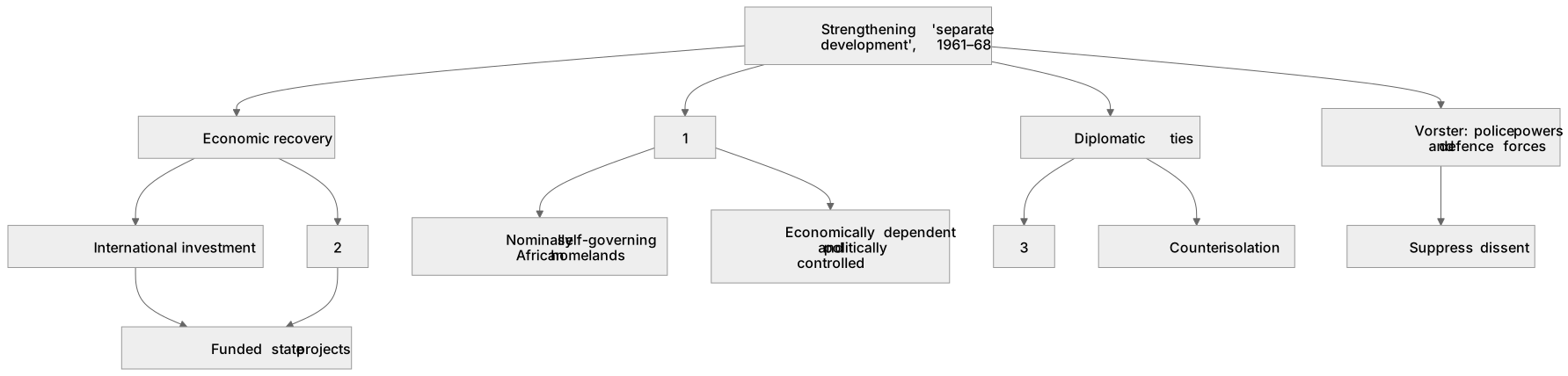
1Box 1
2Box 2
3Box 3
There is more to this lesson
The full lesson goes on to check your understanding and help you earn the marks. Create a free account to carry on, with your progress saved.
A week of Premium from your first lesson · Then the free plan continues · No card, no charge
Test your understanding of Paper 2, Option 2F.2: South Africa, 1948–94: from apartheid state to ‘rainbow nation’ - 2 Radicalisation of resistance and the consolidation of National Party power, 1960–68: Strengthening ‘separate development’, 1961–68: economic recovery, including international investment; developing the Bantustans; diplomatic ties; Vorster’s use of police powers and defence forces.
Active recall beats re-reading. Take an instant quiz now to test what you’ve learned and lock it into long-term memory.
A week of Premium from your first lesson · Then the free plan continues · No card, no charge