Pearson Edexcel · GCSE · History
Course version: 1HI0 · Version from Sept 2016
The historic environment - 1 London and the Second World War, 1939–45: The…
Full specification wording
Option 12: The historic environment - 1 London and the Second World War, 1939–45: The impact of the Blitz on civilian life in London: air-raid precautions, including the use of underground stations and ‘Mickey’s shelter’; the impact of the South Hallsville School (1940) and Bethnal Green (1943) disasters. The continuance of leisure activities in London, including dancehalls and theatre. The extent of disruption to daily life and work, and government concerns about morale.
The Blitz profoundly disrupted daily life and work in London, prompting extensive air-raid precautions.
Checked against the Pearson Edexcel 1HI0 specification (opens in a new tab) on .
- Point 3 of 5
- 3 key terms
Study notes
From the checked teaching notes for this specification point.
The idea
The Blitz profoundly disrupted daily life and work in London, prompting extensive air-raid precautions. Civilians sought refuge in underground stations and community-organised spaces like 'Mickey's shelter' in Stepney. Tragedies such as the South Hallsville School bombing (1940) and the Bethnal Green tube crush (1943) highlighted the severe risks civilians faced even when seeking shelter. Despite the devastation and government concerns about collapsing morale, Londoners attempted to maintain normality. The continuance of leisure activities, including attending dancehalls and theatres, played a crucial role in sustaining public spirits amidst the widespread disruption to employment and domestic life.
What earns the marks
- Describe the evolution of air-raid precautions, including the unofficial use of underground stations.
- Explain the significance of 'Mickey's shelter' as an example of community-led organisation and improved shelter conditions.
- Detail the causes and impact of the South Hallsville School (1940) and Bethnal Green (1943) disasters on public confidence.
- Analyse the extent of disruption to daily life, including the destruction of homes and workplaces.
- Evaluate the role of leisure activities, such as dancehalls and theatre, in countering government concerns about civilian morale.
Common mistakes and how to put them right
Assuming the government initially encouraged the use of underground stations as shelters.
Put it right: Note that the government initially opposed using tube stations, but relented due to public pressure.
Blaming the Bethnal Green disaster on a direct bomb hit.
Put it right: Explain that the 1943 Bethnal Green disaster was a crush caused by panic during an air-raid alert, not a direct bomb strike.
Overstating the complete collapse of daily life.
Put it right: Emphasise that while disruption was severe, work and leisure activities like theatre continued to function.
Exam tips
- Contrast the government's fears about civilian morale with the reality of continued leisure activities to build a nuanced argument.
- Use the South Hallsville School and Bethnal Green disasters as specific evidence of the dangers associated with sheltering.
- Mention 'Mickey's shelter' to demonstrate how local communities took the initiative to improve sanitation and safety in shelters.
Try the lesson
The start of the Option 12: The historic environment - 1 London and the Second World War, 1939–45: The impact of the Blitz on civilian life in London: air-raid precautions, including the use of underground stations and ‘Mickey’s shelter’; the impact of the South Hallsville School (1940) and Bethnal Green (1943) disasters. The continuance of leisure activities in London, including dancehalls and theatre. The extent of disruption to daily life and work, and government concerns about morale. lesson, made from checked teaching notes for this specification point.
Have a go first
What was the cause of the Bethnal Green disaster in 1943?
Listen
The Blitz profoundly disrupted daily life and work in London, prompting extensive air-raid precautions. Civilians sought refuge in underground stations and community-organised spaces like 'Mickey's shelter' in Stepney. Tragedies such as the South Hallsville School bombing (1940) and the Bethnal Green tube crush (1943) highlighted the severe risks civilians faced even when seeking shelter. Despite the devastation and government concerns about collapsing morale, Londoners attempted to maintain normality. The continuance of leisure activities, including attending dancehalls and theatres, played a crucial role in sustaining public spirits amidst the widespread disruption to employment and domestic life. A strong answer earns marks for these points. Describe the evolution of air-raid precautions, including the unofficial use of underground stations. Explain the significance of 'Mickey's shelter' as an example of community-led organisation and improved shelter conditions. Detail the causes and impact of the South Hallsville School (1940) and Bethnal Green (1943) disasters on public confidence. Analyse the extent of disruption to daily life, including the destruction of homes and workplaces. A common slip: Assuming the government initially encouraged the use of underground stations as shelters. Instead, Note that the government initially opposed using tube stations, but relented due to public pressure. Exam tip: Contrast the government's fears about civilian morale with the reality of continued leisure activities to build a nuanced argument.
See it
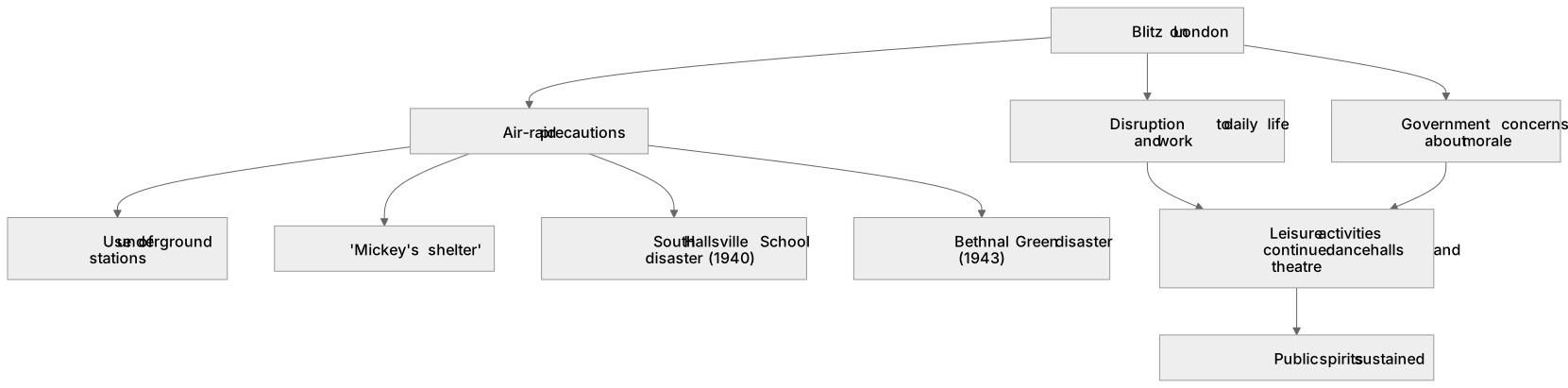
Key words
Say what each word means before you turn the card.
Civilian morale
Try answering aloud or in your head before turning the card.
Air-raid precautions
Try answering aloud or in your head before turning the card.
Wartime disruption
Try answering aloud or in your head before turning the card.
See every definition
- Civilian morale
- The public spirits that the government worried about collapsing during the devastation, and which leisure activities such as dancehalls and theatre helped to sustain.
- Air-raid precautions
- Measures taken to protect Londoners during the Blitz, including the use of underground stations and community-organised spaces such as 'Mickey's shelter' in Stepney.
- Wartime disruption
- The severe interference with daily life and work in London, including the destruction of homes and workplaces, though theatre and other leisure activities continued to function.
Label the diagram
Some boxes have lost their names. Pick the right name for each number.
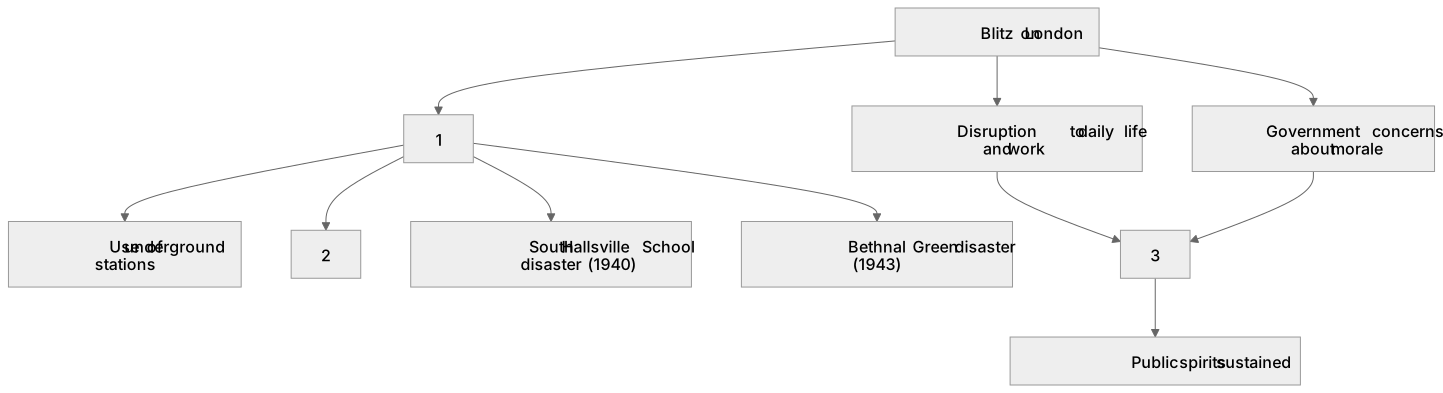
1Box 1
2Box 2
3Box 3
There is more to this lesson
The full lesson goes on to check your understanding and help you earn the marks. Create a free account to carry on, with your progress saved.
A week of Premium from your first lesson · Then the free plan continues · No card, no charge
Test your understanding of Option 12: The historic environment - 1 London and the Second World War, 1939–45: The impact of the Blitz on civilian life in London: air-raid precautions, including the use of underground stations and ‘Mickey’s shelter’; the impact of the South Hallsville School (1940) and Bethnal Green (1943) disasters. The continuance of leisure activities in London, including dancehalls and theatre. The extent of disruption to daily life and work, and government concerns about morale.
Active recall beats re-reading. Take an instant quiz now to test what you’ve learned and lock it into long-term memory.
A week of Premium from your first lesson · Then the free plan continues · No card, no charge