Pearson Edexcel · GCSE · History
Course version: 1HI0 · Version from Sept 2016
Key topic 2: The escalating conflict, 1964–73 - 1 The Six Day War, 1967:…
Full specification wording
Option P5: Key topic 2: The escalating conflict, 1964–73 - 1 The Six Day War, 1967: The actions of the USSR, Nasser and the USA in the period leading to war.
In the build-up to the 1967 Six Day War, the USSR played a critical role by providing false intelligence to Egypt on 13 May, claiming Israel was massing troops on the Syrian border.
Checked against the Pearson Edexcel 1HI0 specification (opens in a new tab) on .
- Point 2 of 3
- 4 key terms
Study notes
From the checked teaching notes for this specification point.
The idea
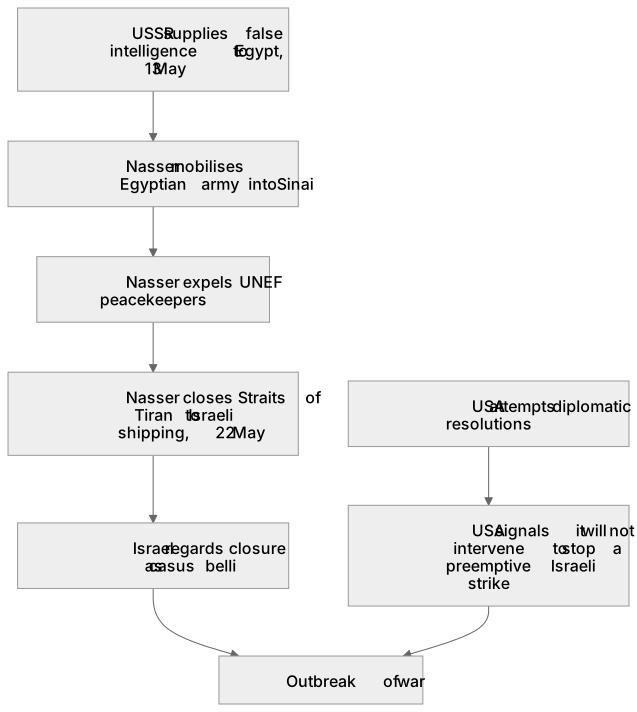
In the build-up to the 1967 Six Day War, the USSR played a critical role by providing false intelligence to Egypt on 13 May, claiming Israel was massing troops on the Syrian border. This prompted Nasser to take decisive actions to maintain his leadership of the Arab world. Nasser mobilised the Egyptian army into the Sinai Peninsula, expelled the UN Emergency Force (UNEF) peacekeepers, and closed the Straits of Tiran to Israeli shipping on 22 May, an act Israel considered a casus belli. Meanwhile, the USA attempted diplomatic resolutions but ultimately signalled to Israel that it would not intervene to stop a preemptive Israeli strike. These combined actions—Soviet misinformation, Nasser's brinkmanship, and tacit US approval—created an unavoidable path to the outbreak of war.
What earns the marks
- Identify the USSR's role in supplying false intelligence regarding Israeli troop movements to Egypt.
- Explain Nasser's three key escalatory steps: moving troops into Sinai, expelling UNEF, and closing the Straits of Tiran.
- Describe the USA's diplomatic stance and its eventual tacit green light for Israeli preemptive action.
- Evaluate how the interaction between superpower politics and regional brinkmanship made war inevitable.
Common mistakes and how to put them right
Believing the USSR wanted a full-scale war.
Put it right: The USSR likely intended to deter Israel and boost its Arab allies, not spark a regional war.
Stating the USA actively fought alongside Israel in 1967.
Put it right: The USA provided diplomatic support and arms, but no direct military intervention.
Thinking Nasser attacked Israel first.
Put it right: Nasser's actions were provocative, but Israel launched the first preemptive military strike.
Exam tips
- Clearly sequence Nasser's actions in May 1967 to show the rapid escalation of the crisis.
- Discuss the closure of the Straits of Tiran as the definitive trigger that made Israeli military action certain.
- Contrast the roles of the USSR and the USA to demonstrate how Cold War dynamics influenced the Middle East conflict.
Try the lesson
The start of the Option P5: Key topic 2: The escalating conflict, 1964–73 - 1 The Six Day War, 1967: The actions of the USSR, Nasser and the USA in the period leading to war. lesson, made from checked teaching notes for this specification point.
Have a go first
Which provocative action did Egyptian President Nasser take in May 1967 that Israel considered an act of war?
Listen
In the build-up to the 1967 Six Day War, the USSR played a critical role by providing false intelligence to Egypt on 13 May, claiming Israel was massing troops on the Syrian border. This prompted Nasser to take decisive actions to maintain his leadership of the Arab world. Nasser mobilised the Egyptian army into the Sinai Peninsula, expelled the UN Emergency Force (UNEF) peacekeepers, and closed the Straits of Tiran to Israeli shipping on 22 May, an act Israel considered a casus belli. Meanwhile, the USA attempted diplomatic resolutions but ultimately signalled to Israel that it would not intervene to stop a preemptive Israeli strike. These combined actions—Soviet misinformation, Nasser's brinkmanship, and tacit US approval—created an unavoidable path to the outbreak of war. A strong answer earns marks for these points. Identify the USSR's role in supplying false intelligence regarding Israeli troop movements to Egypt. Explain Nasser's three key escalatory steps: moving troops into Sinai, expelling UNEF, and closing the Straits of Tiran. Describe the USA's diplomatic stance and its eventual tacit green light for Israeli preemptive action. Evaluate how the interaction between superpower politics and regional brinkmanship made war inevitable. A common slip: Believing the USSR wanted a full-scale war. Instead, The USSR likely intended to deter Israel and boost its Arab allies, not spark a regional war. Exam tip: Clearly sequence Nasser's actions in May 1967 to show the rapid escalation of the crisis.
See it
Key words
Say what each word means before you turn the card.
Brinkmanship
Try answering aloud or in your head before turning the card.
Preemptive warfare
Try answering aloud or in your head before turning the card.
Casus belli
Try answering aloud or in your head before turning the card.
UNEF
Try answering aloud or in your head before turning the card.
See every definition
- Brinkmanship
- Nasser's escalatory actions, including moving troops into Sinai, expelling UNEF and closing the Straits of Tiran, which pushed the crisis towards war.
- Preemptive warfare
- The first military strike launched by Israel, which the USA tacitly approved by signalling it would not intervene to stop it.
- Casus belli
- An act Israel considered justification for war, namely the closure of the Straits of Tiran to Israeli shipping on 22 May.
- UNEF
- The UN Emergency Force peacekeepers whom Nasser expelled as one of his three key escalatory steps.
Label the diagram
Some boxes have lost their names. Pick the right name for each number.
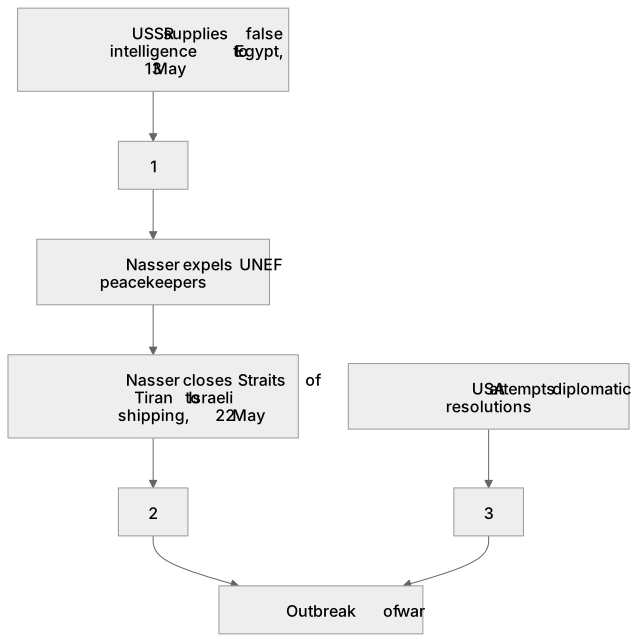
1Box 1
2Box 2
3Box 3
There is more to this lesson
The full lesson goes on to check your understanding and help you earn the marks. Create a free account to carry on, with your progress saved.
A week of Premium from your first lesson · Then the free plan continues · No card, no charge
Test your understanding of Option P5: Key topic 2: The escalating conflict, 1964–73 - 1 The Six Day War, 1967: The actions of the USSR, Nasser and the USA in the period leading to war.
Active recall beats re-reading. Take an instant quiz now to test what you’ve learned and lock it into long-term memory.
A week of Premium from your first lesson · Then the free plan continues · No card, no charge