Pearson Edexcel · GCSE · History
Course version: 1HI0 · Version from Sept 2016
Key topic 2: The escalating conflict, 1964–73 - 1 The Six Day War, 1967:…
Full specification wording
Option P5: Key topic 2: The escalating conflict, 1964–73 - 1 The Six Day War, 1967: The significance of the Cairo Conference (1964). Escalating tension between Israel, Syria and Jordan: Syria’s support for Fatah, Israel’s raid on Samu and events of 7 April 1967.
The 1964 Cairo Conference was significant as Arab leaders agreed to divert the River Jordan's headwaters to deny Israel water, and established the PLO.
Checked against the Pearson Edexcel 1HI0 specification (opens in a new tab) on .
- Point 1 of 3
Study notes
From the checked teaching notes for this specification point.
The idea
The 1964 Cairo Conference was significant as Arab leaders agreed to divert the River Jordan's headwaters to deny Israel water, and established the PLO. This escalated tensions, particularly with Syria, which actively supported Fatah's guerrilla raids into Israel. In November 1966, Israel retaliated with a massive raid on the Jordanian village of Samu, destroying homes and killing Jordanian soldiers. This destabilised King Hussein's regime and drew Arab criticism of Nasser for inaction. Tensions culminated on 7 April 1967, when an artillery clash over the demilitarised zone led to an aerial dogfight. Israel shot down six Syrian MiG fighter jets and flew low over Damascus, deeply humiliating Syria and accelerating the path to the Six Day War.
What earns the marks
- Explain the outcomes of the 1964 Cairo Conference, including the PLO's creation and the water diversion plan.
- Describe Syria's role in escalating tensions by sponsoring Fatah's cross-border guerrilla attacks.
- Detail the events and consequences of the Israeli raid on Samu in 1966, including its impact on Jordan.
- Analyse the significance of the 7 April 1967 dogfight, where Israel destroyed six Syrian MiGs, in precipitating war.
Common mistakes and how to put them right
Confusing the location of the Samu raid.
Put it right: The Samu raid took place in the Jordanian-controlled West Bank, not in Syria.
Assuming the Cairo Conference was a peace summit.
Put it right: The conference aimed to coordinate Arab opposition to Israel, including military and economic strategies.
Stating that Fatah was an Israeli group.
Put it right: Fatah was a Palestinian nationalist and guerrilla organisation supported by Syria.
Exam tips
- Link the events of 7 April 1967 directly to the pressure placed on Nasser to defend his Syrian allies.
- Use the Samu raid to illustrate how cross-border guerrilla attacks led to disproportionate state retaliation.
- Highlight the dispute over water resources following the Cairo Conference as a key catalyst for military escalation.
Try the lesson
The start of the Option P5: Key topic 2: The escalating conflict, 1964–73 - 1 The Six Day War, 1967: The significance of the Cairo Conference (1964). Escalating tension between Israel, Syria and Jordan: Syria’s support for Fatah, Israel’s raid on Samu and events of 7 April 1967. lesson, made from checked teaching notes for this specification point.
Have a go first
What was the primary reason for the Israeli military raid on the village of Samu in November 1966?
Listen
The 1964 Cairo Conference was significant as Arab leaders agreed to divert the River Jordan's headwaters to deny Israel water, and established the PLO. This escalated tensions, particularly with Syria, which actively supported Fatah's guerrilla raids into Israel. In November 1966, Israel retaliated with a massive raid on the Jordanian village of Samu, destroying homes and killing Jordanian soldiers. This destabilised King Hussein's regime and drew Arab criticism of Nasser for inaction. Tensions culminated on 7 April 1967, when an artillery clash over the demilitarised zone led to an aerial dogfight. Israel shot down six Syrian MiG fighter jets and flew low over Damascus, deeply humiliating Syria and accelerating the path to the Six Day War. A strong answer earns marks for these points. Explain the outcomes of the 1964 Cairo Conference, including the PLO's creation and the water diversion plan. Describe Syria's role in escalating tensions by sponsoring Fatah's cross-border guerrilla attacks. Detail the events and consequences of the Israeli raid on Samu in 1966, including its impact on Jordan. Analyse the significance of the 7 April 1967 dogfight, where Israel destroyed six Syrian MiGs, in precipitating war. A common slip: Confusing the location of the Samu raid. Instead, The Samu raid took place in the Jordanian-controlled West Bank, not in Syria. Exam tip: Link the events of 7 April 1967 directly to the pressure placed on Nasser to defend his Syrian allies.
See it
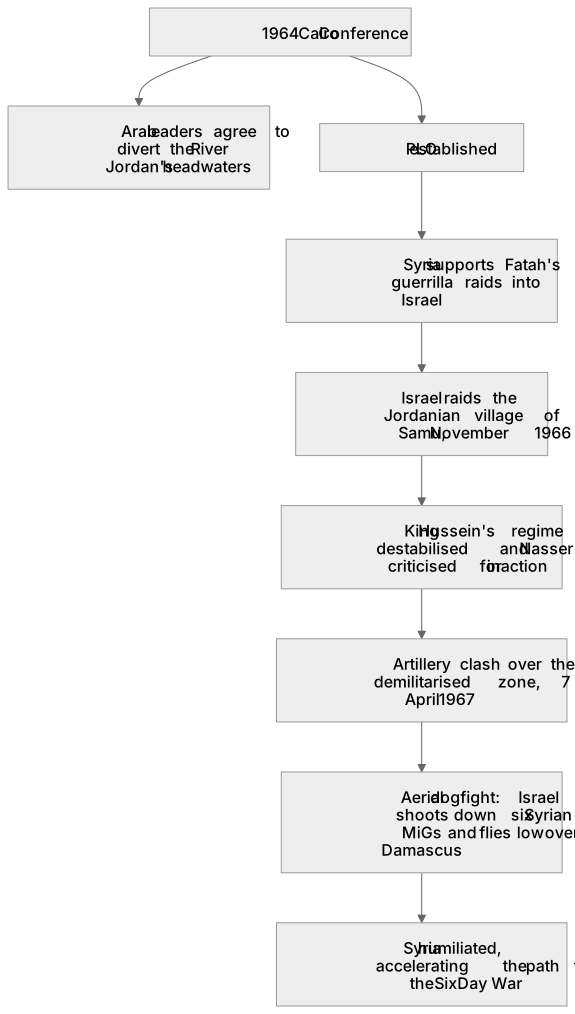
Put the events in order
Put these events in the order they happened, earliest first.
- 1. Cairo Conference held, establishing the PLO
- 2. Artillery clash led to an aerial dogfight over the demilitarised zone
- 3. Israel launched a massive raid on the Jordanian village of Samu
Label the diagram
Some boxes have lost their names. Pick the right name for each number.
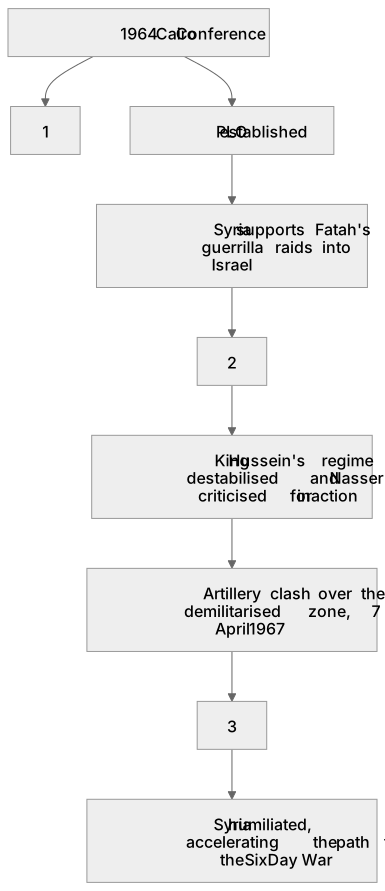
1Box 1
2Box 2
3Box 3
There is more to this lesson
The full lesson goes on to check your understanding and help you earn the marks. Create a free account to carry on, with your progress saved.
A week of Premium from your first lesson · Then the free plan continues · No card, no charge
Test your understanding of Option P5: Key topic 2: The escalating conflict, 1964–73 - 1 The Six Day War, 1967: The significance of the Cairo Conference (1964). Escalating tension between Israel, Syria and Jordan: Syria’s support for Fatah, Israel’s raid on Samu and events of 7 April 1967.
Active recall beats re-reading. Take an instant quiz now to test what you’ve learned and lock it into long-term memory.
A week of Premium from your first lesson · Then the free plan continues · No card, no charge