AQA · GCSE · Mathematics
Course version: 8300 · Version from Sept 2015
Calculate the probability of independent and dependent combined events,…
Full specification wording
Probability: calculate the probability of independent and dependent combined events, including using tree diagrams and other representations, and know the underlying assumptions
Combined events involve two or more stages, such as drawing two counters without replacement.
Checked against the AQA 8300 specification (opens in a new tab) on .
- Point 9 of 10
- 4 key terms
Study notes
From the checked teaching notes for this specification point.
The idea
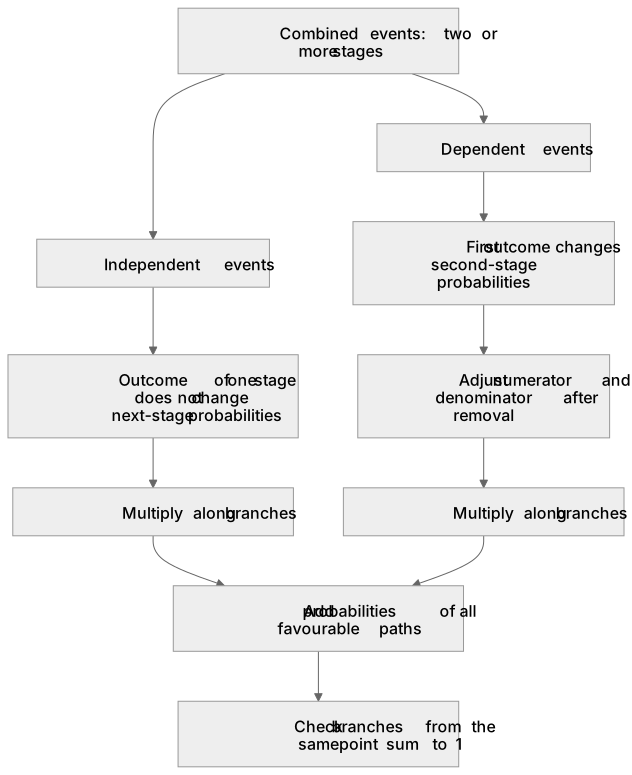
Combined events involve two or more stages, such as drawing two counters without replacement. For independent events, the outcome of one stage does not change the probabilities at the next stage, so multiply along branches: if P(A) = 0.4 and P(B) = 0.7, then P(A and B) = 0.4 × 0.7 = 0.28. For dependent events, the first outcome changes the second-stage probabilities, so adjust the denominator and numerator, for example 3 red and 5 blue counters give P(red then red) = (3/8) × (2/7) = 6/56 = 3/28. Tree diagrams show each stage with branches whose probabilities sum to 1, and other representations include two-way tables, Venn diagrams and outcome grids. Underlying assumptions include independence, fair or biased equipment, and whether selection is with or without replacement.
What earns the marks
- Multiply probabilities along a single path of a tree diagram to find the probability of a combined event.
- Add probabilities of all favourable paths to find the total probability of an event occurring in more than one way.
- For dependent events, adjust the numerator and denominator at the second stage to reflect the item removed.
- Check that probabilities on branches from the same point sum to 1, and state whether selection is with or without replacement.
- Interpret two-way tables, Venn diagrams or outcome grids to identify the required combined event before calculating.
Common mistakes and how to put them right
Adding probabilities along a path instead of multiplying them.
Put it right: The correct method is to multiply along branches for an 'and' event.
Forgetting to reduce the denominator for dependent events.
Put it right: After one item is removed without replacement, the total number of remaining items decreases by 1.
Assuming events are independent when the question describes selection without replacement.
Put it right: Read the context to decide whether the first outcome changes the second probability.
Mixing up 'at least one' with 'exactly one'.
Put it right: List all favourable paths separately and add them, rather than counting only one path.
Exam tips
- Label each branch clearly with its probability and write the multiplication for each path before adding paths.
- Check that the probabilities on branches from any single point sum to 1; this catches arithmetic slips quickly.
- Underline phrases such as 'without replacement' or 'not replaced' because they signal dependent events and a changing denominator.
Try the lesson
The start of the Probability: calculate the probability of independent and dependent combined events, including using tree diagrams and other representations, and know the underlying assumptions lesson, made from checked teaching notes for this specification point.
Have a go first
A fair six-sided dice is rolled twice. The two rolls are independent. What is the probability that both rolls show a 4?
Listen
Combined events involve two or more stages, such as drawing two counters without replacement. For independent events, the outcome of one stage does not change the probabilities at the next stage, so multiply along branches: if P(A) = 0.4 and P(B) = 0.7, then P(A and B) = 0.4 × 0.7 = 0.28. For dependent events, the first outcome changes the second-stage probabilities, so adjust the denominator and numerator, for example 3 red and 5 blue counters give P(red then red) = (3/8) × (2/7) = 6/56 = 3/28. Tree diagrams show each stage with branches whose probabilities sum to 1, and other representations include two-way tables, Venn diagrams and outcome grids. Underlying assumptions include independence, fair or biased equipment, and whether selection is with or without replacement. A strong answer earns marks for these points. Multiply probabilities along a single path of a tree diagram to find the probability of a combined event. Add probabilities of all favourable paths to find the total probability of an event occurring in more than one way. For dependent events, adjust the numerator and denominator at the second stage to reflect the item removed. Check that probabilities on branches from the same point sum to 1, and state whether selection is with or without replacement. Exam tip: Label each branch clearly with its probability and write the multiplication for each path before adding paths.
See it
Key words
Say what each word means before you turn the card.
Independent combined events
Try answering aloud or in your head before turning the card.
Dependent combined events
Try answering aloud or in your head before turning the card.
Tree diagrams and other representations
Try answering aloud or in your head before turning the card.
Underlying assumptions such as with or without replacement
Try answering aloud or in your head before turning the card.
See every definition
- Independent combined events
- Events where the outcome of one stage does not change the probabilities at the next stage, so you multiply along branches.
- Dependent combined events
- Events where the first outcome changes the second-stage probabilities, so you adjust the denominator and numerator.
- Tree diagrams and other representations
- Diagrams showing each stage with branches whose probabilities sum to 1, alongside two-way tables, Venn diagrams and outcome grids.
- Underlying assumptions such as with or without replacement
- The assumptions behind a calculation, including independence, fair or biased equipment, and whether selection is with or without replacement.
There is more to this lesson
The full lesson goes on to check your understanding and help you earn the marks. Create a free account to carry on, with your progress saved.
A week of Premium from your first lesson · Then the free plan continues · No card, no charge
Test your understanding of Probability: calculate the probability of independent and dependent combined events, including using tree diagrams and other representations, and know the underlying assumptions
Active recall beats re-reading. Take an instant quiz now to test what you’ve learned and lock it into long-term memory.
A week of Premium from your first lesson · Then the free plan continues · No card, no charge