AQA · GCSE · Mathematics
Course version: 8300 · Version from Sept 2015
Enumerate sets and combinations of sets systematically, using tables,…
Full specification wording
Probability: enumerate sets and combinations of sets systematically, using tables, grids, Venn diagrams
To enumerate means to list all possible outcomes or members of sets systematically so none are missed or repeated.
Checked against the AQA 8300 specification (opens in a new tab) on .
- Point 6 of 10
- 3 key terms
Study notes
From the checked teaching notes for this specification point.
The idea
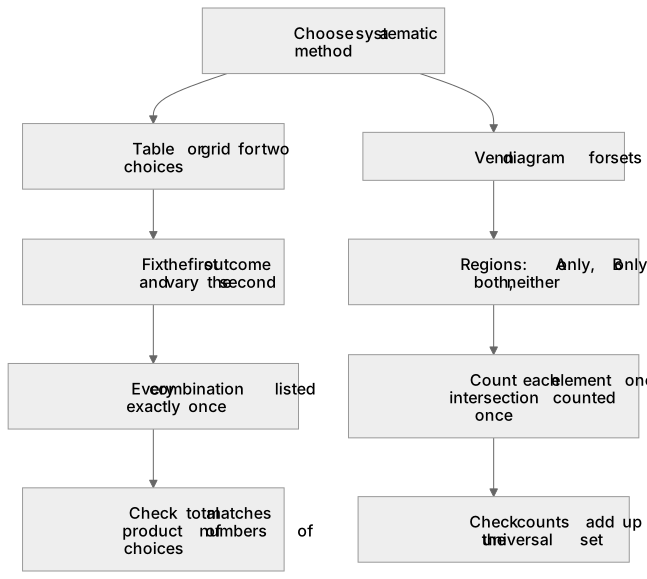
To enumerate means to list all possible outcomes or members of sets systematically so none are missed or repeated. A table or grid is ideal when two choices combine, such as listing pairs from rolling two dice. A Venn diagram is useful for showing sets, their intersections and unions, and counting elements in each region. Systematic working means following a fixed order, like fixing the first outcome and varying the second. For sets A and B, Venn diagram regions represent A only, B only, both, and neither.
What earns the marks
- Defines enumeration as listing all possible outcomes or members of sets in a systematic order.
- Constructs a table or grid to list combinations of two or more sets without missing or repeating any outcome.
- Interprets a Venn diagram to show sets, including their intersection and union, and to count elements in each region.
- Applies a fixed order when listing, such as fixing the first item and varying the second, to ensure completeness.
- Checks that the total number of listed outcomes matches the product of the numbers of choices where appropriate.
Common mistakes and how to put them right
Listing outcomes in a random order and missing some combinations.
Put it right: Use a table, grid or fixed order so every combination appears exactly once.
Counting an outcome twice when it belongs to both sets.
Put it right: Place it in the intersection region of the Venn diagram and count it once.
Confusing the union of two sets with the intersection.
Put it right: The union contains everything in either set, while the intersection contains only elements in both sets.
Exam tips
- Before answering, sketch a quick table, grid or Venn diagram to organise the information.
- Check that the number of listed outcomes matches what you expect from the number of choices.
- In Venn diagram questions, label each region and check that the counts add up to the total.
Try the lesson
The start of the Probability: enumerate sets and combinations of sets systematically, using tables, grids, Venn diagrams lesson, made from checked teaching notes for this specification point.
Have a go first
A café offers a sandwich choice of cheese or ham and a drink choice of tea or juice. Using a systematic list, how many different sandwich-and-drink combinations are possible?
Listen
To enumerate means to list all possible outcomes or members of sets systematically so none are missed or repeated. A table or grid is ideal when two choices combine, such as listing pairs from rolling two dice. A Venn diagram is useful for showing sets, their intersections and unions, and counting elements in each region. Systematic working means following a fixed order, like fixing the first outcome and varying the second. For sets A and B, Venn diagram regions represent A only, B only, both, and neither. A strong answer earns marks for these points. Defines enumeration as listing all possible outcomes or members of sets in a systematic order. Constructs a table or grid to list combinations of two or more sets without missing or repeating any outcome. Interprets a Venn diagram to show sets, including their intersection and union, and to count elements in each region. Applies a fixed order when listing, such as fixing the first item and varying the second, to ensure completeness. A common slip: Listing outcomes in a random order and missing some combinations. Instead, use a table, grid or fixed order so every combination appears exactly once. Exam tip: Before answering, sketch a quick table, grid or Venn diagram to organise the information.
See it
Key words
Say what each word means before you turn the card.
Systematic listing of outcomes
Try answering aloud or in your head before turning the card.
Tables and grids for combinations
Try answering aloud or in your head before turning the card.
Venn diagrams for sets and their regions
Try answering aloud or in your head before turning the card.
See every definition
- Systematic listing of outcomes
- Listing all possible outcomes or members of sets systematically so none are missed or repeated, following a fixed order.
- Tables and grids for combinations
- A table or grid is ideal when two choices combine, such as listing pairs from rolling two dice.
- Venn diagrams for sets and their regions
- A diagram useful for showing sets, their intersections and unions, and counting elements in each region.
Label the diagram
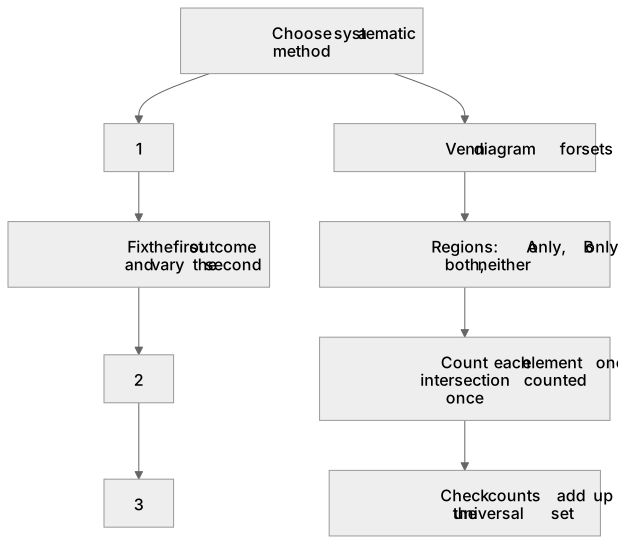
Some boxes have lost their names. Pick the right name for each number.
1Box 1
2Box 2
3Box 3
There is more to this lesson
The full lesson goes on to check your understanding and help you earn the marks. Create a free account to carry on, with your progress saved.
A week of Premium from your first lesson · Then the free plan continues · No card, no charge
Test your understanding of Probability: enumerate sets and combinations of sets systematically, using tables, grids, Venn diagrams
Active recall beats re-reading. Take an instant quiz now to test what you’ve learned and lock it into long-term memory.
A week of Premium from your first lesson · Then the free plan continues · No card, no charge