AQA · GCSE · Mathematics
Course version: 8300 · Version from Sept 2015
Understand that empirical unbiased samples tend towards theoretical…
Full specification wording
Probability: understand that empirical unbiased samples tend towards theoretical probability distributions, with increasing sample size
This idea links experimental trials to theoretical predictions.
Checked against the AQA 8300 specification (opens in a new tab) on .
- Point 5 of 10
- 3 key terms
Study notes
From the checked teaching notes for this specification point.
The idea
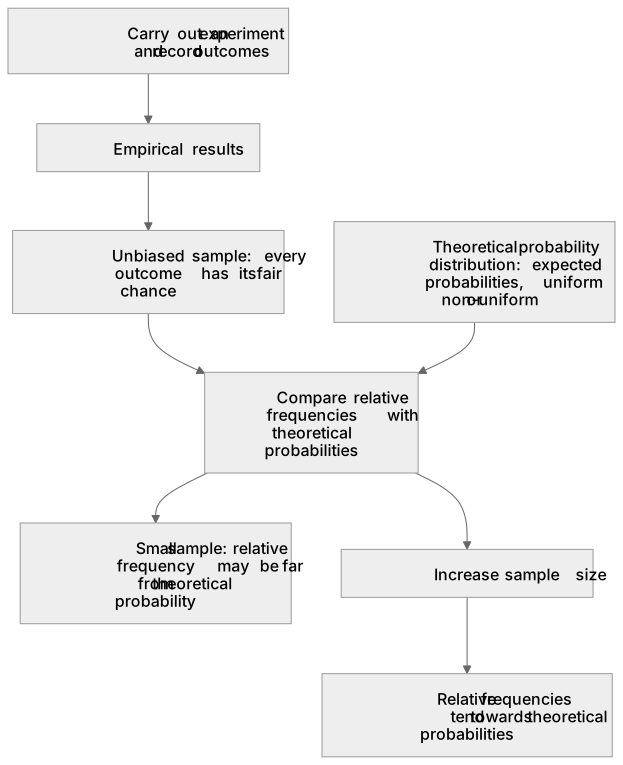
This idea links experimental trials to theoretical predictions. An empirical result comes from carrying out an experiment and recording outcomes. It is unbiased when every outcome has its fair chance and the sample does not favour specific outcomes. The theoretical probability distribution is the set of expected probabilities, which can be uniform (like 1/6 for each face of a fair die) or non-uniform (like a biased spinner with known sector areas). As sample size increases, the relative frequencies of empirical results tend to get closer to these theoretical probabilities. Tossing a fair coin 10 times might give 7 heads, but 1000 tosses will likely yield a proportion close to 0.5.
What earns the marks
- Defines empirical results as outcomes obtained by carrying out a trial or experiment and recording what happens.
- Explains that an unbiased sample gives every outcome its correct chance and is not distorted by selection or measurement.
- States that theoretical probability distributions define the expected probabilities for all outcomes, which can be uniform or non-uniform.
- Explains that as sample size increases, empirical relative frequencies tend towards the theoretical probabilities.
- Recognises that a small sample may give a relative frequency far from the theoretical probability, so one experiment does not disprove the theory.
Common mistakes and how to put them right
Thinking that a small sample must match the theoretical probability exactly.
Put it right: Small samples can vary a lot, and the tendency towards the theoretical distribution becomes clearer as the sample size increases.
Believing that a fair coin is 'due' to land heads after several tails.
Put it right: Each toss is independent, and the long-run proportion approaches 0.5 without the coin remembering past results.
Assuming theoretical probabilities must always be equally likely.
Put it right: Theoretical distributions can be non-uniform, such as probabilities derived from the unequal areas of a spinner.
Treating any experimental result as unbiased.
Put it right: An empirical sample is unbiased only when every outcome has its fair chance and the method of collecting data does not favour particular outcomes.
Exam tips
- Read each option carefully and reject any that claims a small sample must match the theoretical probability exactly.
- Look for the option that links increasing sample size with relative frequencies getting closer to theoretical probabilities.
- Check whether the context describes a fair, unbiased method before accepting a conclusion about the theoretical distribution.
Try the lesson
The start of the Probability: understand that empirical unbiased samples tend towards theoretical probability distributions, with increasing sample size lesson, made from checked teaching notes for this specification point.
Have a go first
Four students each roll a fair six-sided dice and calculate the relative frequency of rolling a 3. Student A rolls the dice 20 times. Student B rolls the dice 50 times. Student C rolls the dice 250 times. Student D rolls the dice 2000 times. Whose empirical relative frequency is most likely to be closest to the theoretical probability of 1/6?
Listen
This idea links experimental trials to theoretical predictions. An empirical result comes from carrying out an experiment and recording outcomes. It is unbiased when every outcome has its fair chance and the sample does not favour specific outcomes. The theoretical probability distribution is the set of expected probabilities, which can be uniform (like 1/6 for each face of a fair die) or non-uniform (like a biased spinner with known sector areas). As sample size increases, the relative frequencies of empirical results tend to get closer to these theoretical probabilities. Tossing a fair coin 10 times might give 7 heads, but 1000 tosses will likely yield a proportion close to 0.5. A strong answer earns marks for these points. Defines empirical results as outcomes obtained by carrying out a trial or experiment and recording what happens. Explains that an unbiased sample gives every outcome its correct chance and is not distorted by selection or measurement. States that theoretical probability distributions define the expected probabilities for all outcomes, which can be uniform or non-uniform. Explains that as sample size increases, empirical relative frequencies tend towards the theoretical probabilities. A common slip: Thinking that a small sample must match the theoretical probability exactly. Instead, small samples can vary a lot, and the tendency towards the theoretical distribution becomes clearer as the sample size increases. Exam tip: Read each option carefully and reject any that claims a small sample must match the theoretical probability exactly.
See it
Key words
Say what each word means before you turn the card.
Empirical result
Try answering aloud or in your head before turning the card.
Unbiased sample
Try answering aloud or in your head before turning the card.
Theoretical probability distribution
Try answering aloud or in your head before turning the card.
See every definition
- Empirical result
- An outcome obtained by carrying out an experiment and recording what happens.
- Unbiased sample
- A sample in which every outcome has its fair chance and the sample does not favour specific outcomes.
- Theoretical probability distribution
- The set of expected probabilities, which can be uniform or non-uniform.
Label the diagram
Some boxes have lost their names. Pick the right name for each number.
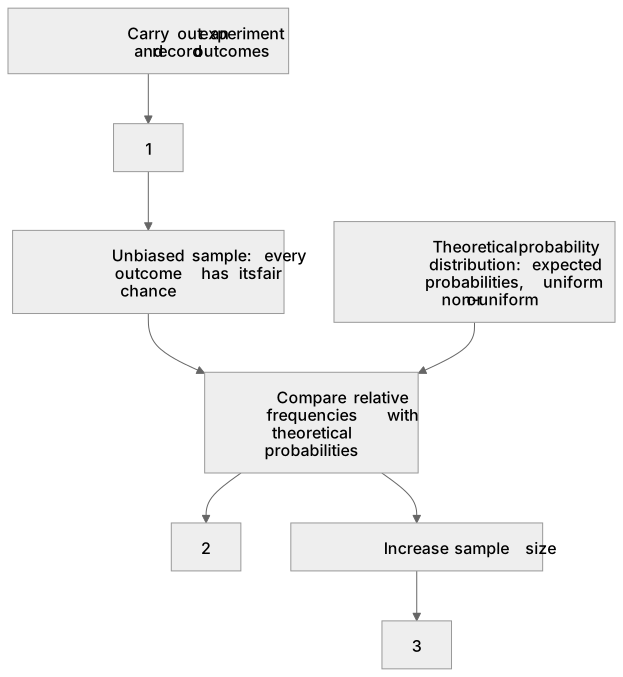
1Box 1
2Box 2
3Box 3
There is more to this lesson
The full lesson goes on to check your understanding and help you earn the marks. Create a free account to carry on, with your progress saved.
A week of Premium from your first lesson · Then the free plan continues · No card, no charge
Test your understanding of Probability: understand that empirical unbiased samples tend towards theoretical probability distributions, with increasing sample size
Active recall beats re-reading. Take an instant quiz now to test what you’ve learned and lock it into long-term memory.
A week of Premium from your first lesson · Then the free plan continues · No card, no charge