AQA · GCSE · Mathematics
Course version: 8300 · Version from Sept 2015
Apply angle facts, triangle congruence, similarity and properties of…
Full specification wording
Properties and constructions: apply angle facts, triangle congruence, similarity and properties of quadrilaterals to conjecture and derive results about angles and sides, including Pythagoras’ theorem and the fact that the base angles of an isosceles triangle are equal, and use known results to obtain simple proofs
This topic links angle facts, congruence, similarity and quadrilateral properties so you can conjecture and derive results about angles and sides.
Checked against the AQA 8300 specification (opens in a new tab) on .
- Point 6 of 15
- 4 key terms
Study notes
From the checked teaching notes for this specification point.
The idea
This topic links angle facts, congruence, similarity and quadrilateral properties so you can conjecture and derive results about angles and sides. You use angle facts such as angles on a straight line summing to 180°, angles in a triangle summing to 180° and vertically opposite angles being equal. Congruence means identical shape and size; similarity means the same shape with equal corresponding angles and proportional sides. Quadrilateral properties include opposite sides of a parallelogram being equal and parallel, and diagonals of a rhombus bisecting at right angles. From these you derive Pythagoras’ theorem and prove base angles of an isosceles triangle are equal. You then use known results to build simple proofs, for example proving a triangle is isosceles by showing two angles are equal.
What earns the marks
- Apply angle facts correctly: angles on a straight line sum to 180°, angles around a point sum to 360°, vertically opposite angles are equal, and angles in a triangle sum to 180°.
- Use congruence criteria (SSS, SAS, ASA, RHS) to justify that two triangles are identical in shape and size, and use similarity to set up proportional sides when corresponding angles are equal.
- Apply properties of quadrilaterals, such as opposite sides of a parallelogram being equal and parallel, or diagonals of a rhombus bisecting at right angles, to find unknown angles and sides.
- Derive Pythagoras’ theorem from similarity or area arguments, and use it to find a missing side in a right-angled triangle, for example a² + b² = c² where c is the hypotenuse.
- Prove that the base angles of an isosceles triangle are equal, for example by drawing the line of symmetry from the apex to the midpoint of the base and using congruent triangles.
- Construct a simple proof by starting from known results, stating each step with a reason, and reaching the required conclusion without gaps.
Common mistakes and how to put them right
Misidentifying the hypotenuse in Pythagoras’ theorem.
Put it right by checking the right angle first.
Assuming two triangles are congruent when only two sides and a non-included angle match.
Put it right by using a valid congruence criterion such as SAS (included angle) or SSS.
Treating similar shapes as congruent.
Put it right by remembering similar shapes have equal angles but sides in proportion, so lengths may differ by a scale factor.
Using a quadrilateral property that does not apply, such as assuming diagonals of every parallelogram bisect at right angles.
Put it right by checking the specific quadrilateral type, since that property belongs to a rhombus.
Exam tips
- Write a reason for every angle fact you use, for example ‘angles in a triangle sum to 180°’, so the examiner can follow your proof.
- When using Pythagoras’ theorem, label the hypotenuse c and substitute carefully; check whether you need to add or subtract squares to find a shorter side.
- For proof questions, work backwards from the required result to plan steps, then write the proof forwards with clear logical order.
- Sketch the figure and mark equal angles or sides; this helps you spot congruent triangles and choose the correct criterion.
Try the lesson
The start of the Properties and constructions: apply angle facts, triangle congruence, similarity and properties of quadrilaterals to conjecture and derive results about angles and sides, including Pythagoras’ theorem and the fact that the base angles of an isosceles triangle are equal, and use known results to obtain simple proofs lesson, made from checked teaching notes for this specification point.
Have a go first
In an isosceles triangle, the two equal sides meet at the apex angle of 50°. What is the size of each base angle?
Listen
This topic links angle facts, congruence, similarity and quadrilateral properties so you can conjecture and derive results about angles and sides. You use angle facts such as angles on a straight line summing to 180°, angles in a triangle summing to 180° and vertically opposite angles being equal. Congruence means identical shape and size; similarity means the same shape with equal corresponding angles and proportional sides. Quadrilateral properties include opposite sides of a parallelogram being equal and parallel, and diagonals of a rhombus bisecting at right angles. From these you derive Pythagoras’ theorem and prove base angles of an isosceles triangle are equal. You then use known results to build simple proofs, for example proving a triangle is isosceles by showing two angles are equal. A strong answer earns marks for these points. Apply angle facts correctly: angles on a straight line sum to 180°, angles around a point sum to 360°, vertically opposite angles are equal, and angles in a triangle sum to 180°. Use congruence criteria (SSS, SAS, ASA, RHS) to justify that two triangles are identical in shape and size, and use similarity to set up proportional sides when corresponding angles are equal. Apply properties of quadrilaterals, such as opposite sides of a parallelogram being equal and parallel, or diagonals of a rhombus bisecting at right angles, to find unknown angles and sides. Derive Pythagoras’ theorem from similarity or area arguments, and use it to find a missing side in a right-angled triangle, for example a² + b² = c² where c is the hypotenuse. A common slip: Misidentifying the hypotenuse in Pythagoras’ theorem: the hypotenuse is always the side opposite the right angle, not simply the longest-looking side. Instead, checking the right angle first. Exam tip: Write a reason for every angle fact you use, for example ‘angles in a triangle sum to 180°’, so the examiner can follow your proof.
See it
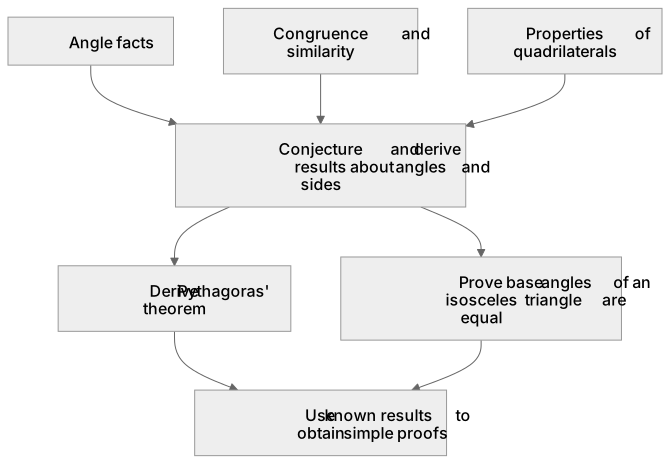
Key words
Say what each word means before you turn the card.
Congruence
Try answering aloud or in your head before turning the card.
Similarity
Try answering aloud or in your head before turning the card.
Pythagoras’ theorem
Try answering aloud or in your head before turning the card.
Simple proof
Try answering aloud or in your head before turning the card.
See every definition
- Congruence
- Identical shape and size, justified using criteria such as SSS, SAS, ASA and RHS.
- Similarity
- The same shape with equal corresponding angles and proportional sides, so lengths may differ by a scale factor.
- Pythagoras’ theorem
- A result derived from similarity or area arguments and used to find a missing side in a right-angled triangle, for example a² + b² = c² where c is the hypotenuse.
- Simple proof
- Starting from known results, stating each step with a reason, and reaching the required conclusion without gaps.
Label the diagram
Some boxes have lost their names. Pick the right name for each number.
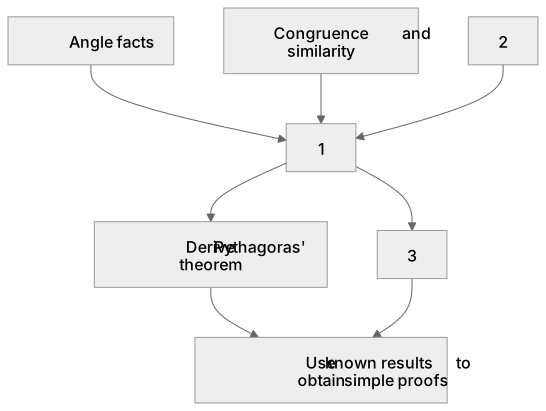
1Box 1
2Box 2
3Box 3
There is more to this lesson
The full lesson goes on to check your understanding and help you earn the marks. Create a free account to carry on, with your progress saved.
A week of Premium from your first lesson · Then the free plan continues · No card, no charge
Test your understanding of Properties and constructions: apply angle facts, triangle congruence, similarity and properties of quadrilaterals to conjecture and derive results about angles and sides, including Pythagoras’ theorem and the fact that the base angles of an isosceles triangle are equal, and use known results to obtain simple proofs
Active recall beats re-reading. Take an instant quiz now to test what you’ve learned and lock it into long-term memory.
A week of Premium from your first lesson · Then the free plan continues · No card, no charge