AQA · GCSE · Mathematics
Course version: 8300 · Version from Sept 2015
Use the basic congruence criteria for triangles (SSS, SAS, ASA, RHS)
Full specification wording
Properties and constructions: use the basic congruence criteria for triangles (SSS, SAS, ASA, RHS)
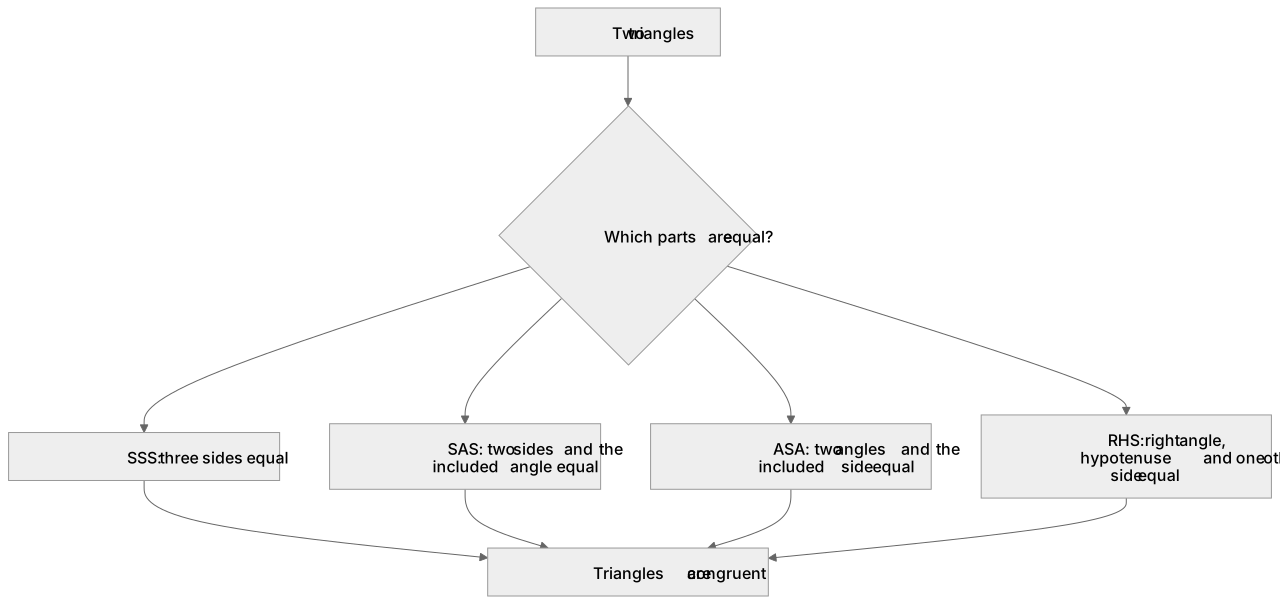
You must use the four basic congruence criteria for triangles: SSS (three sides equal), SAS (two sides and the included angle equal), ASA (two angles and the included side equal) and RHS (right…
Checked against the AQA 8300 specification (opens in a new tab) on .
- Point 5 of 15
- 4 key terms
Study notes
From the checked teaching notes for this specification point.
The idea
You must use the four basic congruence criteria for triangles: SSS (three sides equal), SAS (two sides and the included angle equal), ASA (two angles and the included side equal) and RHS (right angle, hypotenuse and one other side equal). Two triangles are congruent if they are identical in shape and size. These criteria let you prove congruence without checking every side and angle. Identify the matching parts in the two triangles and state which applies. For example, if two triangles share a side and have two pairs of equal angles adjacent to that side, use ASA. The included angle in SAS is between the two given sides. RHS applies only to right-angled triangles. Congruence differs from similarity.
What earns the marks
- SSS: if three sides of one triangle are equal to three sides of another, the triangles are congruent.
- SAS: if two sides and the included angle of one triangle are equal to two sides and the included angle of another, the triangles are congruent.
- ASA: if two angles and the included side of one triangle are equal to two angles and the included side of another, the triangles are congruent.
- RHS: if the right angle, hypotenuse and one other side of one right-angled triangle are equal to those of another, the triangles are congruent.
Common mistakes and how to put them right
Using SSA (two sides and a non-included angle) as a congruence criterion.
Put it right: SSA does not always prove congruence, so use SAS with the included angle instead.
Mixing up ASA and SAS.
Put it right: ASA uses two angles and the side between them, while SAS uses two sides and the angle between them.
Applying RHS to a triangle that is not right-angled.
Put it right: RHS requires a right angle, so check for the 90° angle first.
Exam tips
- Label the equal parts on a diagram before choosing a criterion; this helps you see whether the angle is included between the two sides or the side is included between the two angles.
- When writing a congruence statement, match corresponding vertices in the same order, for example triangle ABC congruent to triangle DEF means A matches D, B matches E and C matches F.
- In multiple-choice questions, check each option against the four criteria; an option that uses SSA or AAA is not a valid congruence criterion.
Try the lesson
The start of the Properties and constructions: use the basic congruence criteria for triangles (SSS, SAS, ASA, RHS) lesson, made from checked teaching notes for this specification point.
Have a go first
Triangle ABC has AB = 7 cm, BC = 9 cm and AC = 11 cm. Triangle PQR has PQ = 7 cm, QR = 9 cm and PR = 11 cm. Which congruence criterion shows that triangle ABC is congruent to triangle PQR?
Listen
You must use the four basic congruence criteria for triangles: SSS (three sides equal), SAS (two sides and the included angle equal), ASA (two angles and the included side equal) and RHS (right angle, hypotenuse and one other side equal). Two triangles are congruent if they are identical in shape and size. These criteria let you prove congruence without checking every side and angle. Identify the matching parts in the two triangles and state which applies. For example, if two triangles share a side and have two pairs of equal angles adjacent to that side, use ASA. The included angle in SAS is between the two given sides. RHS applies only to right-angled triangles. Congruence differs from similarity. A strong answer earns marks for these points. SSS: if three sides of one triangle are equal to three sides of another, the triangles are congruent. SAS: if two sides and the included angle of one triangle are equal to two sides and the included angle of another, the triangles are congruent. ASA: if two angles and the included side of one triangle are equal to two angles and the included side of another, the triangles are congruent. RHS: if the right angle, hypotenuse and one other side of one right-angled triangle are equal to those of another, the triangles are congruent. Exam tip: Label the equal parts on a diagram before choosing a criterion; this helps you see whether the angle is included between the two sides or the side is included between the two angles.
See it
Key words
Say what each word means before you turn the card.
SSS
Try answering aloud or in your head before turning the card.
SAS
Try answering aloud or in your head before turning the card.
ASA
Try answering aloud or in your head before turning the card.
RHS
Try answering aloud or in your head before turning the card.
See every definition
- SSS
- Three sides of one triangle are equal to three sides of another, so the triangles are congruent.
- SAS
- Two sides and the included angle of one triangle are equal to two sides and the included angle of another, so the triangles are congruent.
- ASA
- Two angles and the included side of one triangle are equal to two angles and the included side of another, so the triangles are congruent.
- RHS
- The right angle, hypotenuse and one other side of one right-angled triangle are equal to those of another, so the triangles are congruent.
There is more to this lesson
The full lesson goes on to check your understanding and help you earn the marks. Create a free account to carry on, with your progress saved.
A week of Premium from your first lesson · Then the free plan continues · No card, no charge
Test your understanding of Properties and constructions: use the basic congruence criteria for triangles (SSS, SAS, ASA, RHS)
Active recall beats re-reading. Take an instant quiz now to test what you’ve learned and lock it into long-term memory.
A week of Premium from your first lesson · Then the free plan continues · No card, no charge