AQA · GCSE · Mathematics
Course version: 8300 · Version from Sept 2015
Describe the changes and invariance achieved by combinations of rotations,…
Full specification wording
Properties and constructions: describe the changes and invariance achieved by combinations of rotations, reflections and translations (Higher tier only)
A combination means performing two or more transformations in sequence on a shape.
Checked against the AQA 8300 specification (opens in a new tab) on .
- Point 10 of 15
- 4 key terms
Study notes
From the checked teaching notes for this specification point.
The idea
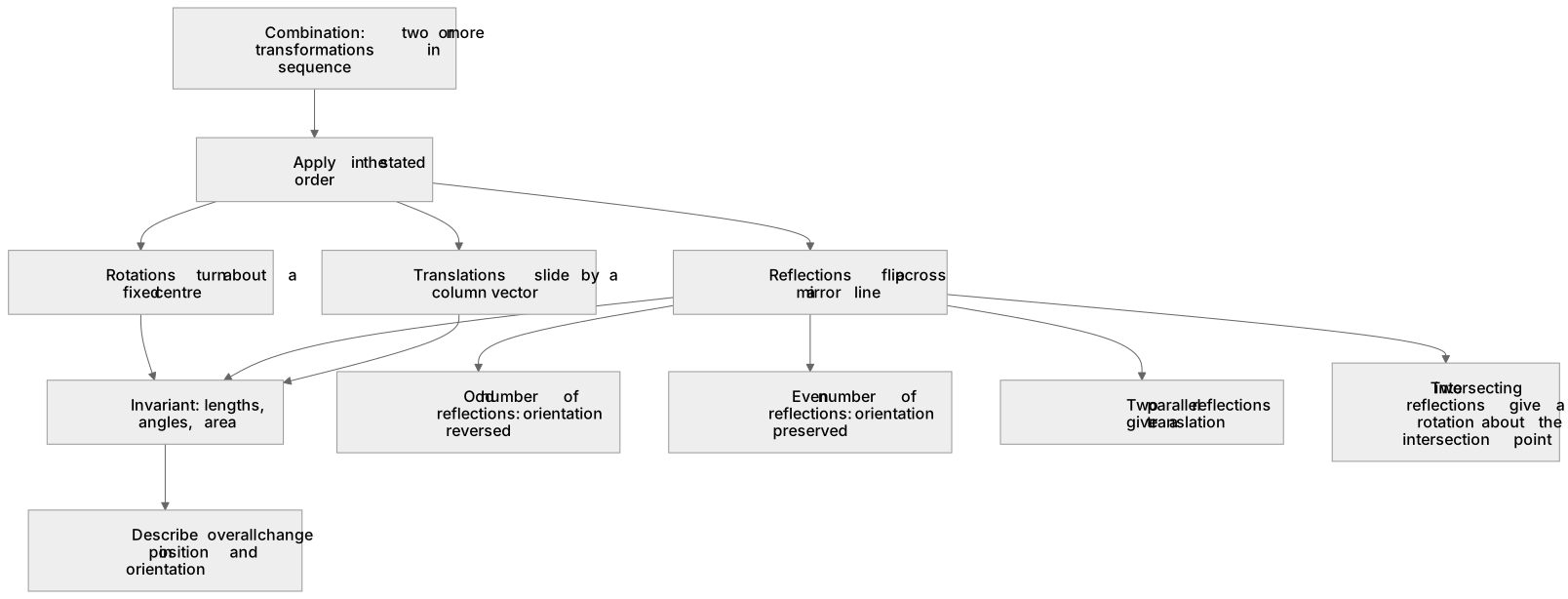
A combination means performing two or more transformations in sequence on a shape. You must state what changes and what stays the same. Rotations turn a shape about a fixed centre by a given angle and direction; reflections flip it across a mirror line; translations slide it by a column vector. Invariance means properties unchanged by the combination. For example, reflect a triangle in the x-axis then rotate 90° anticlockwise about the origin: the final image has the same area, side lengths and angles as the original, but its orientation and position change. A single reflection reverses orientation; two reflections in parallel lines give a translation; two reflections in intersecting lines give a rotation. Describing the combination means naming the overall single transformation that maps the original object to the final image, or listing the changes and invariants precisely.
What earns the marks
- Identify the individual transformations in the combination and the order in which they are applied.
- State that lengths, angles and area are invariant under any combination of rotations, reflections and translations.
- Recognise that orientation is reversed by an odd number of reflections and preserved by an even number.
- Determine the single equivalent transformation: two parallel reflections give a translation; two intersecting reflections give a rotation about the intersection point.
- Describe the overall change in position and orientation of the image compared with the object.
Common mistakes and how to put them right
Thinking that a combination of transformations changes the size or shape of the figure.
Put it right: Rotations, reflections and translations are all congruences, so lengths, angles and area are invariant.
Assuming the order of transformations never matters.
Put it right: In general the final image depends on the order, so apply them in the stated sequence.
Believing that two reflections always produce a reflection.
Put it right: Two reflections in parallel lines produce a translation, and two reflections in intersecting lines produce a rotation.
Confusing orientation with position.
Put it right: Orientation describes the order of vertices (clockwise or anticlockwise), while position is where the shape sits on the grid.
Exam tips
- Trace the shape through each transformation in turn, labelling the intermediate image, so the final position is clear.
- Check whether the number of reflections is odd or even to decide whether orientation is reversed or preserved.
- When asked for the single equivalent transformation, identify its type first, then give the centre, angle and direction for a rotation or the column vector for a translation.
Try the lesson
The start of the Properties and constructions: describe the changes and invariance achieved by combinations of rotations, reflections and translations (Higher tier only) lesson, made from checked teaching notes for this specification point.
Have a go first
A shape is reflected in a vertical mirror line and then translated 4 cm to the right. Which property of the shape is unchanged by this combination?
Listen
A combination means performing two or more transformations in sequence on a shape. You must state what changes and what stays the same. Rotations turn a shape about a fixed centre by a given angle and direction; reflections flip it across a mirror line; translations slide it by a column vector. Invariance means properties unchanged by the combination. For example, reflect a triangle in the x-axis then rotate 90° anticlockwise about the origin: the final image has the same area, side lengths and angles as the original, but its orientation and position change. A single reflection reverses orientation; two reflections in parallel lines give a translation; two reflections in intersecting lines give a rotation. Describing the combination means naming the overall single transformation that maps the original object to the final image, or listing the changes and invariants precisely. A strong answer earns marks for these points. Identify the individual transformations in the combination and the order in which they are applied. State that lengths, angles and area are invariant under any combination of rotations, reflections and translations. Recognise that orientation is reversed by an odd number of reflections and preserved by an even number. Determine the single equivalent transformation: two parallel reflections give a translation; two intersecting reflections give a rotation about the intersection point. A common slip: Thinking that a combination of transformations changes the size or shape of the figure. Instead, rotations, reflections and translations are all congruences, so lengths, angles and area are invariant. Exam tip: Trace the shape through each transformation in turn, labelling the intermediate image, so the final position is clear.
See it
Key words
Say what each word means before you turn the card.
Combinations of transformations
Try answering aloud or in your head before turning the card.
Invariance of length, angle and area
Try answering aloud or in your head before turning the card.
Orientation and congruence
Try answering aloud or in your head before turning the card.
Equivalent single transformations
Try answering aloud or in your head before turning the card.
See every definition
- Combinations of transformations
- Performing two or more transformations in sequence on a shape.
- Invariance of length, angle and area
- Properties unchanged by the combination; lengths, angles and area are invariant under any combination of rotations, reflections and translations.
- Orientation and congruence
- Orientation describes the order of vertices (clockwise or anticlockwise), while position is where the shape sits on the grid; rotations, reflections and translations are all congruences.
- Equivalent single transformations
- The overall single transformation that maps the original object to the final image; two parallel reflections give a translation and two intersecting reflections give a rotation about the intersection point.
Label the diagram
Some boxes have lost their names. Pick the right name for each number.
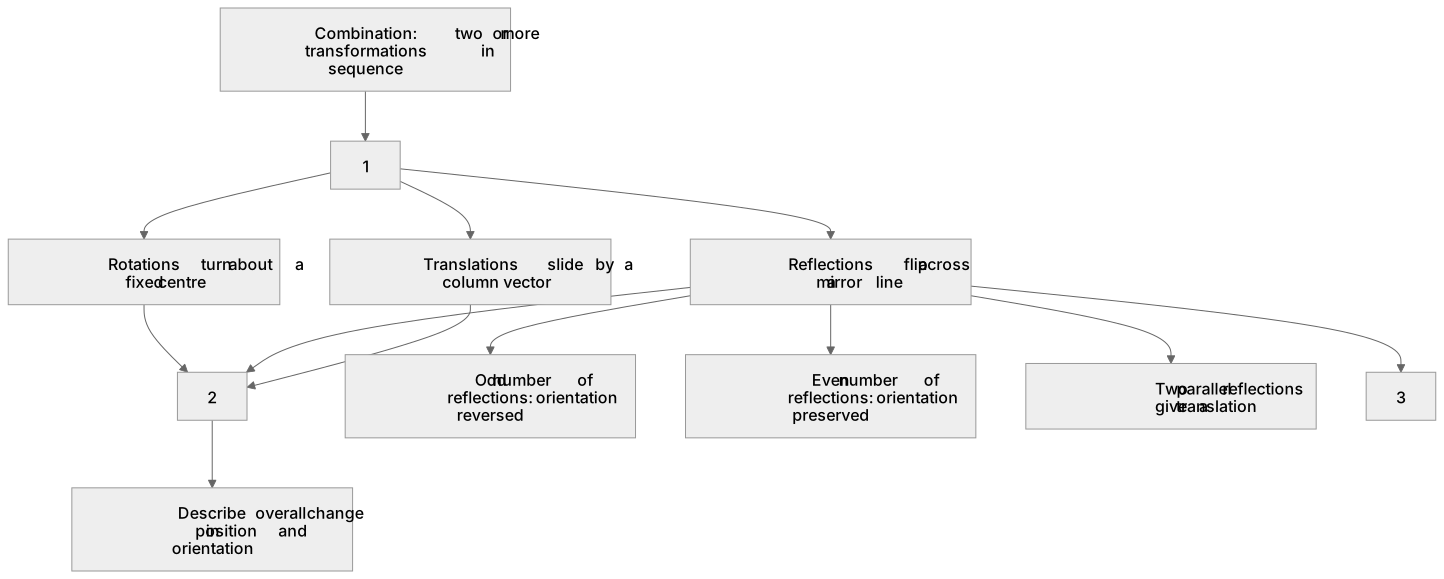
1Box 1
2Box 2
3Box 3
There is more to this lesson
The full lesson goes on to check your understanding and help you earn the marks. Create a free account to carry on, with your progress saved.
A week of Premium from your first lesson · Then the free plan continues · No card, no charge
Test your understanding of Properties and constructions: describe the changes and invariance achieved by combinations of rotations, reflections and translations (Higher tier only)
Active recall beats re-reading. Take an instant quiz now to test what you’ve learned and lock it into long-term memory.
A week of Premium from your first lesson · Then the free plan continues · No card, no charge