AQA · GCSE · Mathematics
Course version: 8300 · Version from Sept 2015
Including negative scale factors
Full specification wording
Properties and constructions: including negative scale factors (Higher tier only)
A negative scale factor reverses the direction of an enlargement: the image lies on the opposite side of the centre from the object.
Checked against the AQA 8300 specification (opens in a new tab) on .
- Point 9 of 15
Study notes
From the checked teaching notes for this specification point.
The idea
A negative scale factor reverses the direction of an enlargement: the image lies on the opposite side of the centre from the object. For scale factor −2 with centre (0, 0), a vertex (x, y) maps to (−2x, −2y). The size change is given by the absolute value of the factor, so a factor of −1/2 produces a smaller image on the opposite side, while −2 produces a larger image on the opposite side. The image is still similar to the object: angles are unchanged and side lengths are multiplied by the magnitude of the scale factor. This content is Higher tier only. When describing a negative enlargement, state the centre and the negative scale factor, and check that each image vertex lies on the line through the centre and its object vertex but on the other side.
What earns the marks
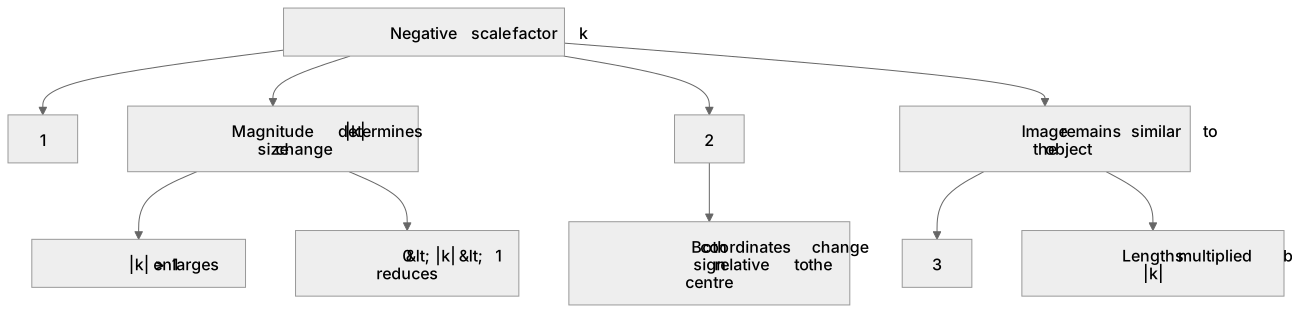
- A negative scale factor places the image on the opposite side of the centre from the object.
- The magnitude of the scale factor determines the size change: |k| > 1 enlarges, 0 < |k| < 1 reduces.
- Coordinates transform as (x, y) → (kx, ky) with k negative, so both coordinates change sign relative to the centre.
- The image remains similar to the object, with angles unchanged and lengths multiplied by |k|.
- A negative fractional scale factor such as −1/2 produces a smaller image on the opposite side of the centre.
- Describing a negative enlargement requires both the centre and the negative scale factor.
Common mistakes and how to put them right
Placing the image on the same side of the centre.
Put it right: A negative factor always puts the image on the opposite side.
Using the signed factor to scale lengths.
Put it right: Lengths are multiplied by the magnitude |k|, while the sign controls direction.
Forgetting to reverse both coordinates when the centre is the origin.
Put it right: Apply the negative sign to both x and y.
Exam tips
- Draw a straight line through the centre and each object vertex, then mark the image vertex on the opposite side at the correct distance.
- Use the magnitude of the scale factor to check whether the image should be larger or smaller than the object.
- State the centre and the negative scale factor clearly when describing an enlargement.
Try the lesson
The start of the Properties and constructions: including negative scale factors (Higher tier only) lesson, made from checked teaching notes for this specification point.
Have a go first
Triangle PQR has vertices P(1, 1), Q(3, 1) and R(1, 2). It is enlarged by scale factor −2 with centre of enlargement the origin. What are the coordinates of the image of Q?
Listen
A negative scale factor reverses the direction of an enlargement: the image lies on the opposite side of the centre from the object. For scale factor −2 with centre (0, 0), a vertex (x, y) maps to (−2x, −2y). The size change is given by the absolute value of the factor, so a factor of −1/2 produces a smaller image on the opposite side, while −2 produces a larger image on the opposite side. The image is still similar to the object: angles are unchanged and side lengths are multiplied by the magnitude of the scale factor. This content is Higher tier only. When describing a negative enlargement, state the centre and the negative scale factor, and check that each image vertex lies on the line through the centre and its object vertex but on the other side. A strong answer earns marks for these points. A negative scale factor places the image on the opposite side of the centre from the object. The magnitude of the scale factor determines the size change: |k| > 1 enlarges, 0 < |k| < 1 reduces. Coordinates transform as (x, y) → (kx, ky) with k negative, so both coordinates change sign relative to the centre. The image remains similar to the object, with angles unchanged and lengths multiplied by |k|. Exam tip: Draw a straight line through the centre and each object vertex, then mark the image vertex on the opposite side at the correct distance.
See it

Label the diagram
Some boxes have lost their names. Pick the right name for each number.
1Box 1
2Box 2
3Box 3
There is more to this lesson
The full lesson goes on to check your understanding and help you earn the marks. Create a free account to carry on, with your progress saved.
A week of Premium from your first lesson · Then the free plan continues · No card, no charge
Test your understanding of Properties and constructions: including negative scale factors (Higher tier only)
Active recall beats re-reading. Take an instant quiz now to test what you’ve learned and lock it into long-term memory.
A week of Premium from your first lesson · Then the free plan continues · No card, no charge