AQA · GCSE · Mathematics
Course version: 8300 · Version from Sept 2015
And work with general iterative processes
Full specification wording
Ratio, proportion and rates of change: and work with general iterative processes (Higher tier only)
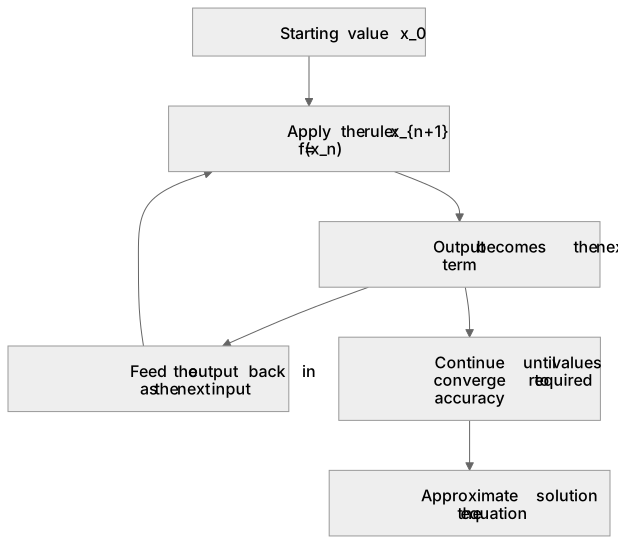
A general iterative process takes a starting value and applies the same rule repeatedly, using each output as the next input.
Checked against the AQA 8300 specification (opens in a new tab) on .
- Point 21 of 21
- 4 key terms
Study notes
From the checked teaching notes for this specification point.
The idea
A general iterative process takes a starting value and applies the same rule repeatedly, using each output as the next input. In Higher tier work you meet this through subscript notation: if x_{n+1} = f(x_n), then x_0 is the starting value, x_1 = f(x_0), x_2 = f(x_1), and so on. For example, with x_{n+1} = 3x_n - 2 and x_0 = 4, you get x_1 = 10, x_2 = 28, x_3 = 82. You must be able to generate successive terms of a sequence from a given formula and starting value. You also need to use iteration to find approximate solutions to equations, continuing the process until the values converge to a required degree of accuracy.
What earns the marks
- Substitutes the given starting value correctly into the iteration formula to obtain the first term.
- Applies the rule repeatedly, using each output as the next input, to generate further terms in the correct order.
- Uses subscript notation correctly, distinguishing x_0, x_1, x_2 and x_{n+1}.
- Recognises when an iteration is converging towards a limit and uses this to find an approximate solution to an equation.
Common mistakes and how to put them right
Restarting from the original starting value each time instead of feeding the previous output into the rule.
Put it right: Each new term becomes the input for the next application.
Misreading x_{n+1} as x_n + 1 rather than 'the next term after x_n'.
Put it right: Read the subscript as a position label, not an arithmetic operation.
Rounding intermediate values too early.
Put it right: Keep full calculator accuracy for each step to ensure the final converged value is correct.
Exam tips
- Write out each substitution line clearly so the examiner can follow the sequence of terms.
- Use the 'ANS' button on your calculator to feed the previous term back into the iterative formula quickly and accurately.
- Keep the starting value visible in your working so the first term can be verified.
Try the lesson
The start of the Ratio, proportion and rates of change: and work with general iterative processes (Higher tier only) lesson, made from checked teaching notes for this specification point.
Have a go first
An iterative process is defined by xₙ₊₁ = 3xₙ − 4. Starting with x₁ = 5, work out the value of x₃.
Listen
A general iterative process takes a starting value and applies the same rule repeatedly, using each output as the next input. In Higher tier work you meet this through subscript notation: if x_{n+1} = f(x_n), then x_0 is the starting value, x_1 = f(x_0), x_2 = f(x_1), and so on. For example, with x_{n+1} = 3x_n - 2 and x_0 = 4, you get x_1 = 10, x_2 = 28, x_3 = 82. You must be able to generate successive terms of a sequence from a given formula and starting value. You also need to use iteration to find approximate solutions to equations, continuing the process until the values converge to a required degree of accuracy. A strong answer earns marks for these points. Substitutes the given starting value correctly into the iteration formula to obtain the first term. Applies the rule repeatedly, using each output as the next input, to generate further terms in the correct order. Uses subscript notation correctly, distinguishing x_0, x_1, x_2 and x_{n+1}. Recognises when an iteration is converging towards a limit and uses this to find an approximate solution to an equation. A common slip: Restarting from the original starting value each time instead of feeding the previous output into the rule. Instead, each new term becomes the input for the next application. Exam tip: Write out each substitution line clearly so the examiner can follow the sequence of terms.
See it
Watch it explained
What is the one idea the video explains? Say it in a sentence.
Read the described scene instead
Iteration is a general process: you take a starting value, apply one rule, and feed the result back in as the next input. Each output becomes the next input, so the rule repeats again and again. Higher tier work uses this repetition to build sequences and to find approximate solutions to equations. The notation uses subscripts as position labels. If x n plus one equals f of x n, then x zero is the starting value, x one is f of x zero, and x two is f of x one. Read that subscript as a position label, not as an arithmetic operation. To generate terms, substitute the starting value into the formula to get the first term. Then apply the same rule again, using that output as the next input. Write each substitution line clearly, and keep full calculator accuracy, because rounding intermediate values too early can spoil the final converged value. Let's try x n plus one equals three x n minus two, with x zero equal to four. Pause here and predict x one before I show it. Substituting four gives x one equals three times four minus two, which is ten. Now feed ten back in: x two equals three times ten minus two, which is twenty-eight. And again: x three equals three times twenty-eight minus two, which is eighty-two. Three mistakes are common. Restarting from the original starting value each time instead of feeding the previous output back in. Misreading x n plus one as x n plus one, when the subscript is a position label, not an arithmetic operation. And rounding intermediate values too early, so keep full calculator accuracy at every step. Iteration is the repeated application of a single rule, using each output as the next input. Subscripts label positions, and you generate terms by substituting and repeating in the correct order. Continue an iteration until the values converge and you have an approximate solution to the required degree of accuracy. Use the ANS button to feed each term back quickly, and keep the starting value visible in your working.
Key words
Say what each word means before you turn the card.
Iteration
Try answering aloud or in your head before turning the card.
Subscript notation
Try answering aloud or in your head before turning the card.
Successive terms
Try answering aloud or in your head before turning the card.
Converge
Try answering aloud or in your head before turning the card.
See every definition
- Iteration
- A process that takes a starting value and applies the same rule repeatedly, using each output as the next input.
- Subscript notation
- A way of labelling terms by position, where x_0 is the starting value and x_{n+1} is the next term after x_n.
- Successive terms
- Further terms of a sequence generated from a given formula and starting value by applying the rule repeatedly in the correct order.
- Converge
- What values do when an iteration is continued until they reach a required degree of accuracy, giving an approximate solution to an equation.
Label the diagram
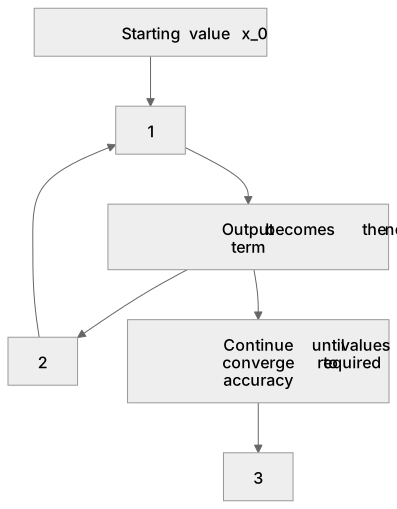
Some boxes have lost their names. Pick the right name for each number.
1Box 1
2Box 2
3Box 3
There is more to this lesson
The full lesson goes on to check your understanding and help you earn the marks. Create a free account to carry on, with your progress saved.
A week of Premium from your first lesson · Then the free plan continues · No card, no charge
Test your understanding of Ratio, proportion and rates of change: and work with general iterative processes (Higher tier only)
Active recall beats re-reading. Take an instant quiz now to test what you’ve learned and lock it into long-term memory.
A week of Premium from your first lesson · Then the free plan continues · No card, no charge