AQA · GCSE · Mathematics
Course version: 8300 · Version from Sept 2015
Converting units
Full specification wording
Ratio, proportion and rates of change: change freely between related standard units (eg time, length, area, volume/capacity, mass) and compound units (eg speed, rates of pay, prices) in numerical contexts
This involves changing measurements within the same unit family and rates built from those units in numerical contexts.
Checked against the AQA 8300 specification (opens in a new tab) on .
- Point 1 of 21
- 3 key terms
Study notes
From the checked teaching notes for this specification point.
The idea
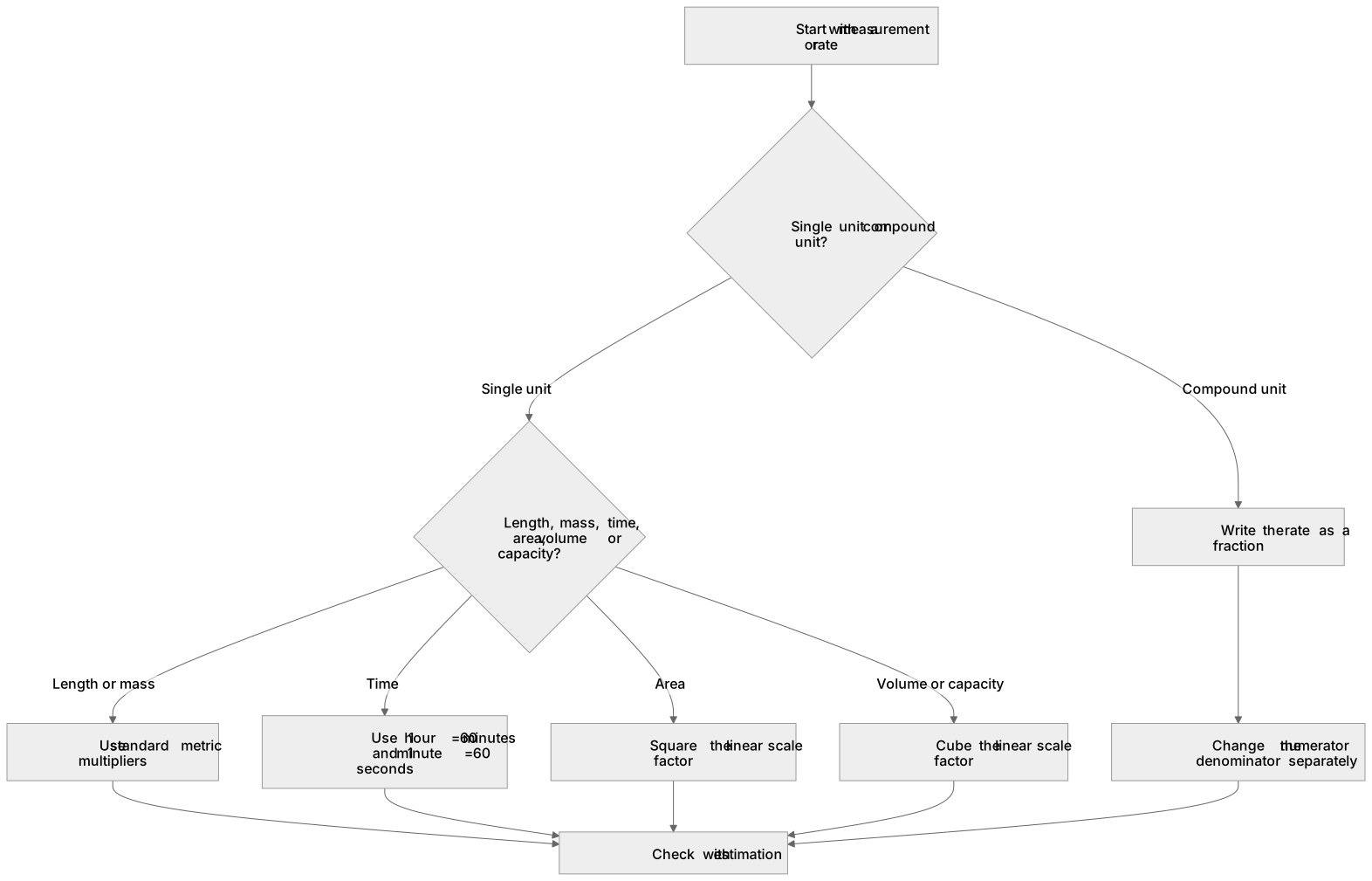
This involves changing measurements within the same unit family and rates built from those units in numerical contexts. For time, 1 hour = 60 minutes. For length, 1 km = 1000 m, 1 m = 100 cm and 1 cm = 10 mm. Area units use squared scale factors: 1 m² = 10000 cm² since 100² = 10000. Volume units use cubed factors: 1 m³ = 1000000 cm³ (100³) and 1 litre = 1000 cm³. Mass uses 1 tonne = 1000 kg and 1 kg = 1000 g. For compound units, change the numerator and denominator separately. To change 90 km/h to m/s: 90 km = 90000 m, and 1 hour = 3600 s, so 90000 ÷ 3600 = 25 m/s. Rates of pay change similarly, such as £5.40 per hour becoming 9p per minute (540p ÷ 60). Prices can be compared by changing to a common unit.
What earns the marks
- Change time units accurately, applying 1 hour = 60 minutes and 1 minute = 60 seconds.
- Change length and mass units using standard metric multipliers (e.g., 1 km = 1000 m, 1 kg = 1000 g).
- Change area units by squaring the linear scale factor, such as 1 m² = 10000 cm².
- Change volume and capacity units by cubing the linear scale factor, such as 1 m³ = 1000000 cm³.
- Change compound units like speed, prices or rates of pay by changing the numerator and denominator independently (e.g., 90 km/h to 25 m/s).
Common mistakes and how to put them right
Using a linear scale factor for area changes, such as treating 1 m² as 100 cm² instead of 10000 cm².
Using a linear scale factor for volume changes, such as treating 1 m³ as 100 cm³ instead of 1000000 cm³.
Changing only one component of a compound unit, for example changing 90 km/h to 90000 m/h but forgetting to change the hours to seconds.
Multiplying instead of dividing when changing from a smaller unit to a larger unit, such as multiplying by 1000 to change grams to kilograms.
Exam tips
- Write down the linear scale factor first, then square or cube it for area or volume changes.
- For compound units, write the rate as a fraction and change the top and bottom in separate, clear steps.
- Use estimation to check your answer: a speed in m/s will have a smaller numerical value than the same speed in km/h.
Try the lesson
The start of the Ratio, proportion and rates of change: change freely between related standard units (eg time, length, area, volume/capacity, mass) and compound units (eg speed, rates of pay, prices) in numerical contexts lesson, made from checked teaching notes for this specification point.
Have a go first
A plank of wood is 3.4 m long. Work out the length of the plank in centimetres.
Listen
This involves changing measurements within the same unit family and rates built from those units in numerical contexts. For time, 1 hour = 60 minutes. For length, 1 km = 1000 m, 1 m = 100 cm and 1 cm = 10 mm. Area units use squared scale factors: 1 m² = 10000 cm² since 100² = 10000. Volume units use cubed factors: 1 m³ = 1000000 cm³ (100³) and 1 litre = 1000 cm³. Mass uses 1 tonne = 1000 kg and 1 kg = 1000 g. For compound units, change the numerator and denominator separately. To change 90 km/h to m/s: 90 km = 90000 m, and 1 hour = 3600 s, so 90000 ÷ 3600 = 25 m/s. Rates of pay change similarly, such as £5.40 per hour becoming 9p per minute (540p ÷ 60). Prices can be compared by changing to a common unit. A strong answer earns marks for these points. Change time units accurately, applying 1 hour = 60 minutes and 1 minute = 60 seconds. Change length and mass units using standard metric multipliers (e.g., 1 km = 1000 m, 1 kg = 1000 g). Change area units by squaring the linear scale factor, such as 1 m² = 10000 cm². Change volume and capacity units by cubing the linear scale factor, such as 1 m³ = 1000000 cm³. Exam tip: Write down the linear scale factor first, then square or cube it for area or volume changes.
See it
Watch it explained
What is the one idea the video explains? Say it in a sentence.
Read the described scene instead
This lesson is about changing measurements within a unit family and changing rates built from those units. For time, one hour equals sixty minutes. For length, one kilometre equals one thousand metres, one metre equals one hundred centimetres, and one centimetre equals ten millimetres. These standard multipliers let you move between related units in numerical contexts. Area and volume need more care. Area units use squared scale factors. Since one metre is one hundred centimetres, one square metre is one hundred squared, which is ten thousand square centimetres. Volume units use cubed factors. One cubic metre is one hundred cubed cubic centimetres, which is one million cubic centimetres. Capacity connects too: one litre equals one thousand cubic centimetres. Pause and ask why the factor is squared or cubed. Mass uses one tonne equals one thousand kilograms, and one kilogram equals one thousand grams. For compound units, change the numerator and denominator separately. Write the rate as a fraction, then change the top and bottom in clear steps. For example, ninety kilometres per hour means ninety kilometres divided by one hour. Change kilometres to metres, and hours to seconds, before you divide. Pause and decide what each part becomes. Now work through ninety kilometres per hour. Ninety kilometres is ninety thousand metres. One hour is three thousand six hundred seconds. So the speed is ninety thousand divided by three thousand six hundred, which equals twenty-five metres per second. A speed in metres per second has a smaller numerical value than the same speed in kilometres per hour, so twenty-five is reasonable. Rates of pay change in the same way. Five pounds forty per hour is five hundred and forty pence per hour. Divide by sixty minutes to get pence per minute: five hundred and forty divided by sixty equals nine pence per minute. For prices, compare by changing to a common unit. Pause and check: does your converted rate use the units you intended? Watch for common errors. Do not use a linear scale factor for area: one square metre is ten thousand square centimetres, not one hundred. Do not use a linear factor for volume: one cubic metre is one million cubic centimetres, not one hundred. For compound units, change both parts. When changing from a smaller unit to a larger unit, check whether to divide. Remember these anchors. Standard metric changes cover length, mass and time. Area uses squared scale factors, and volume and capacity use cubed scale factors. Compound units such as speed, prices and rates of pay change by handling the numerator and denominator separately. Always check whether the changed value is reasonable for the units you now have.
Key words
Say what each word means before you turn the card.
Squared and cubed scale factors
Try answering aloud or in your head before turning the card.
Compound unit changes
Try answering aloud or in your head before turning the card.
Checking the reasonableness
Try answering aloud or in your head before turning the card.
See every definition
- Squared and cubed scale factors
- Area units use squared scale factors and volume units use cubed factors when changing between units.
- Compound unit changes
- Changing compound units such as speed, rates of pay and prices by changing the numerator and denominator separately.
- Checking the reasonableness
- Using estimation to check an answer, since a speed in m/s will have a smaller numerical value than the same speed in km/h.
There is more to this lesson
The full lesson goes on to check your understanding and help you earn the marks. Create a free account to carry on, with your progress saved.
A week of Premium from your first lesson · Then the free plan continues · No card, no charge
Test your understanding of Ratio, proportion and rates of change: change freely between related standard units (eg time, length, area, volume/capacity, mass) and compound units (eg speed, rates of pay, prices) in numerical contexts
Active recall beats re-reading. Take an instant quiz now to test what you’ve learned and lock it into long-term memory.
A week of Premium from your first lesson · Then the free plan continues · No card, no charge