AQA · GCSE · Mathematics
Course version: 8300 · Version from Sept 2015
Compound units (eg density, pressure) in numerical and algebraic contexts
Full specification wording
Ratio, proportion and rates of change: compound units (eg density, pressure) in numerical and algebraic contexts
Compound units combine two measurements; density and pressure are key examples.
Checked against the AQA 8300 specification (opens in a new tab) on .
- Point 2 of 21
- 4 key terms
Study notes
From the checked teaching notes for this specification point.
The idea
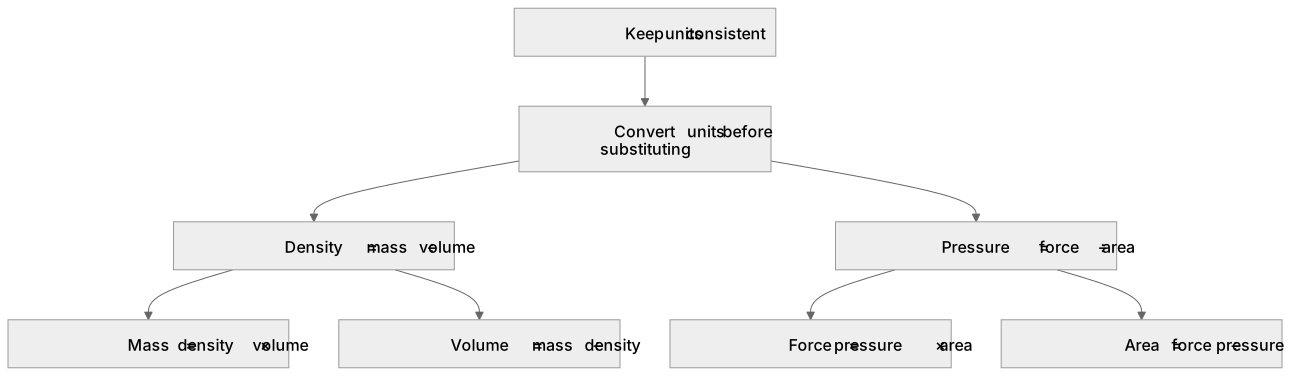
Compound units combine two measurements; density and pressure are key examples. Density is mass per unit volume (density = mass ÷ volume), using units like g/cm³ or kg/m³. Pressure is force per unit area (pressure = force ÷ area), using units like N/m² or pascals. In numerical contexts, substitute values and calculate. For example, a mass of 500 g in a volume of 100 cm³ gives a density of 500 ÷ 100 = 5 g/cm³. To convert 5 g/cm³ to kg/m³, multiply by 1000 to get 5000 kg/m³. In algebraic contexts, rearrange the formula to find the missing quantity: from density = mass ÷ volume, mass = density × volume. Similarly, force = pressure × area. Keep units consistent, converting them before substituting.
What earns the marks
- State and use density = mass ÷ volume with correct units such as g/cm³ or kg/m³.
- State and use pressure = force ÷ area with correct units such as N/m² or pascals.
- Substitute numerical values correctly into density and pressure formulae and evaluate the result.
- Rearrange density = mass ÷ volume to find mass or volume when the other two quantities are known.
- Rearrange pressure = force ÷ area to find force or area when the other two quantities are known.
- Keep units consistent and convert units before substituting when the question uses mixed units.
- Interpret algebraic expressions for density and pressure and solve for an unknown variable.
Common mistakes and how to put them right
Dividing in the wrong order.
Put it right: Remember density is mass per unit volume, so mass is divided by volume.
Forgetting to convert units before substituting.
Put it right: Convert all quantities to matching units first.
Rearranging incorrectly: for example, writing mass = density ÷ volume instead of mass = density × volume.
Put it right: Multiply both sides of density = mass ÷ volume by volume.
Using the wrong unit for pressure.
Put it right: Remember pressure is force per unit area, so the unit includes area in the denominator.
Exam tips
- Write the formula triangle or rearrange the formula before substituting numbers, so the operation is clear.
- Check the units of the answer against the units of the quantities given, and convert if they do not match.
- Substitute values with units into the formula and cancel units where possible to confirm the final unit.
Try the lesson
The start of the Ratio, proportion and rates of change: compound units (eg density, pressure) in numerical and algebraic contexts lesson, made from checked teaching notes for this specification point.
Have a go first
A metal block has a mass of 240 g and a volume of 30 cm³. Using density = mass ÷ volume, work out the density of the block in g/cm³.
Listen
Compound units combine two measurements; density and pressure are key examples. Density is mass per unit volume (density = mass ÷ volume), using units like g/cm³ or kg/m³. Pressure is force per unit area (pressure = force ÷ area), using units like N/m² or pascals. In numerical contexts, substitute values and calculate. For example, a mass of 500 g in a volume of 100 cm³ gives a density of 500 ÷ 100 = 5 g/cm³. To convert 5 g/cm³ to kg/m³, multiply by 1000 to get 5000 kg/m³. In algebraic contexts, rearrange the formula to find the missing quantity: from density = mass ÷ volume, mass = density × volume. Similarly, force = pressure × area. Keep units consistent, converting them before substituting. A strong answer earns marks for these points. State and use density = mass ÷ volume with correct units such as g/cm³ or kg/m³. State and use pressure = force ÷ area with correct units such as N/m² or pascals. Substitute numerical values correctly into density and pressure formulae and evaluate the result. Rearrange density = mass ÷ volume to find mass or volume when the other two quantities are known. A common slip: Dividing in the wrong order: for example, calculating volume ÷ mass instead of mass ÷ volume for density. Instead, remember density is mass per unit volume, so mass is divided by volume. Exam tip: Write the formula triangle or rearrange the formula before substituting numbers, so the operation is clear.
See it
Watch it explained
What is the one idea the video explains? Say it in a sentence.
Read the described scene instead
Compound units combine two measurements. In GCSE maths, density and pressure are key examples. Density describes mass per unit volume, and pressure describes force per unit area. In this lesson, we will use their formulae in numerical and algebraic contexts, and check that units are consistent before substituting values. Density is mass per unit volume, so density equals mass divided by volume. Common units are grams per cubic centimetre, or kilograms per cubic metre. Pressure is force per unit area, so pressure equals force divided by area. Its units include newtons per square metre, also called pascals. Notice that each formula divides a total by a spatial quantity: volume for density, and area for pressure. Before I work through it, pause to think which quantity is divided by which. A mass of 500 grams occupies a volume of 100 cubic centimetres. Substitute into density equals mass divided by volume: 500 divided by 100 equals 5 grams per cubic centimetre. To convert this density to kilograms per cubic metre, multiply by 1000, giving 5000 kilograms per cubic metre. Check that units match before you calculate. In algebraic contexts, rearrange the formula before substituting. Starting from density equals mass divided by volume, multiply both sides by volume. This gives mass equals density multiplied by volume. Similarly, from pressure equals force divided by area, multiply both sides by area to get force equals pressure multiplied by area. You can also rearrange to find volume or area when the other quantities are known. Watch for common errors. Dividing in the wrong order is a mistake: density is mass per unit volume, so divide mass by volume, not volume by mass. Forgetting to convert units can also cause errors, so convert to matching units before substituting. When rearranging, remember that mass equals density multiplied by volume, not density divided by volume. For pressure, the unit is newtons per square metre, not just newtons. To recap: density equals mass divided by volume, and pressure equals force divided by area. Use the correct compound units, such as grams per cubic centimetre or pascals. Substitute numerical values carefully, and rearrange formulae for algebraic problems. Keep units consistent, and convert before substituting when quantities are mixed.
Key words
Say what each word means before you turn the card.
Density
Try answering aloud or in your head before turning the card.
Pressure
Try answering aloud or in your head before turning the card.
Numerical substitution and calculation with compound units
Try answering aloud or in your head before turning the card.
Algebraic rearrangement of compound-unit formulae
Try answering aloud or in your head before turning the card.
See every definition
- Density
- Mass per unit volume, calculated as mass divided by volume, using units such as g/cm³ or kg/m³.
- Pressure
- Force per unit area, calculated as force divided by area, using units such as N/m² or pascals.
- Numerical substitution and calculation with compound units
- Substituting values into the density and pressure formulae and evaluating the result, keeping units consistent and converting them before substituting.
- Algebraic rearrangement of compound-unit formulae
- Rearranging the density and pressure formulae to find the missing quantity, such as mass = density × volume or force = pressure × area.
Label the diagram
Some boxes have lost their names. Pick the right name for each number.
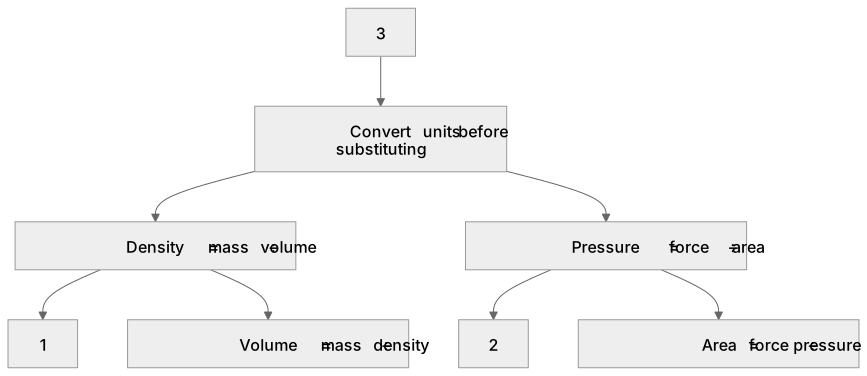
1Box 1
2Box 2
3Box 3
There is more to this lesson
The full lesson goes on to check your understanding and help you earn the marks. Create a free account to carry on, with your progress saved.
A week of Premium from your first lesson · Then the free plan continues · No card, no charge
Test your understanding of Ratio, proportion and rates of change: compound units (eg density, pressure) in numerical and algebraic contexts
Active recall beats re-reading. Take an instant quiz now to test what you’ve learned and lock it into long-term memory.
A week of Premium from your first lesson · Then the free plan continues · No card, no charge