AQA · GCSE · Mathematics
Course version: 8300 · Version from Sept 2015
Express a multiplicative relationship between two quantities as a ratio or…
Full specification wording
Ratio, proportion and rates of change: express a multiplicative relationship between two quantities as a ratio or a fraction
A multiplicative relationship compares two quantities by multiplication or division.
Checked against the AQA 8300 specification (opens in a new tab) on .
- Point 7 of 21
- 4 key terms
Study notes
From the checked teaching notes for this specification point.
The idea
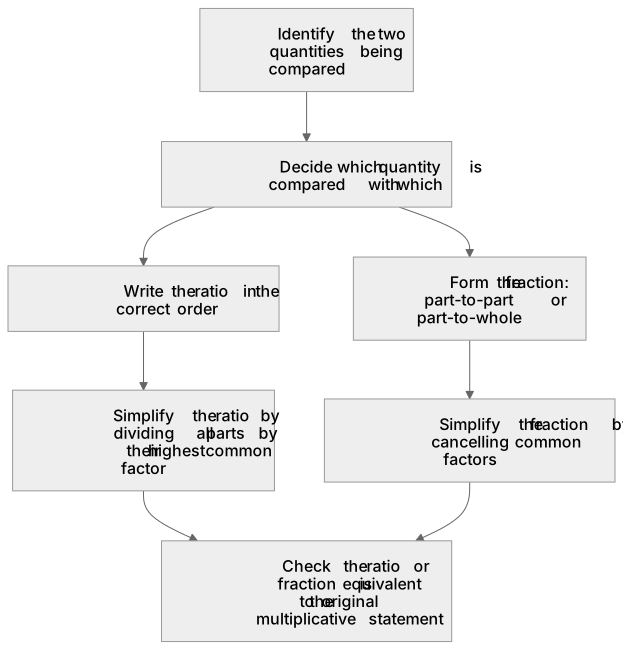
A multiplicative relationship compares two quantities by multiplication or division. If one quantity is a multiple of the other, you can write the relationship as a ratio or as a fraction. For example, if a recipe uses 200 g of flour and 50 g of sugar, the flour is 4 times the sugar, so the ratio flour : sugar is 4 : 1 and the fraction of the total that is sugar is 50/250 = 1/5. To express the relationship, identify the two quantities, decide which is being compared with which, and write the ratio in the correct order or form the fraction of one quantity out of the other or out of the total. Simplify ratios by dividing all parts by their highest common factor, and simplify fractions by cancelling common factors. The same multiplicative relationship can be represented in several equivalent ways, so check that your chosen ratio or fraction is correct.
What earns the marks
- Identifies the two quantities being compared and the multiplicative relationship between them, for example one quantity is a whole-number multiple of the other.
- Writes the relationship as a ratio in the correct order, such as 4 : 1 for 'four times as many as', and simplifies it by dividing all parts by their highest common factor.
- Writes the relationship as a fraction, choosing correctly between a part-to-part fraction and a part-to-whole fraction according to what the question asks.
- Checks that the ratio or fraction is equivalent to the original multiplicative statement, for example by multiplying back or by testing with a simple numerical example.
Common mistakes and how to put them right
Reversing the order of the ratio.
Put it right: The quantity named first in the comparison goes first in the ratio, so A : B = 3 : 1.
Confusing part-to-part and part-to-whole fractions.
Put it right: The smaller part is 1 out of 4 equal parts, so the fraction is 1/4.
Forgetting to simplify: leaving a ratio as 200 : 50 instead of 4 : 1.
Put it right: Divide every part of the ratio by the highest common factor, here 50, to reach the simplest form.
Treating an additive relationship as multiplicative.
Put it right: A ratio compares by multiplication or division, so the ratio of A to B is 10 : 15, which simplifies to 2 : 3.
Exam tips
- Read the question carefully to see whether it asks for a ratio, a fraction of one quantity, or a fraction of the total, and label your answer so the meaning is clear.
- Write the ratio in the order the quantities are mentioned, then simplify by dividing all parts by their highest common factor; show the division so the method is visible.
- Check your answer by substituting simple numbers: if the ratio is 4 : 1, then 4 times the second quantity should equal the first, confirming the multiplicative relationship.
Try the lesson
The start of the Ratio, proportion and rates of change: express a multiplicative relationship between two quantities as a ratio or a fraction lesson, made from checked teaching notes for this specification point.
Have a go first
In a bag there are 5 green marbles and 15 yellow marbles. What is the ratio of green marbles to yellow marbles in its simplest form?
Listen
A multiplicative relationship compares two quantities by multiplication or division. If one quantity is a multiple of the other, you can write the relationship as a ratio or as a fraction. For example, if a recipe uses 200 g of flour and 50 g of sugar, the flour is 4 times the sugar, so the ratio flour : sugar is 4 : 1 and the fraction of the total that is sugar is 50/250 = 1/5. To express the relationship, identify the two quantities, decide which is being compared with which, and write the ratio in the correct order or form the fraction of one quantity out of the other or out of the total. Simplify ratios by dividing all parts by their highest common factor, and simplify fractions by cancelling common factors. The same multiplicative relationship can be represented in several equivalent ways, so check that your chosen ratio or fraction is correct. A strong answer earns marks for these points. Identifies the two quantities being compared and the multiplicative relationship between them, for example one quantity is a whole-number multiple of the other. Writes the relationship as a ratio in the correct order, such as 4 : 1 for 'four times as many as', and simplifies it by dividing all parts by their highest common factor. Writes the relationship as a fraction, choosing correctly between a part-to-part fraction and a part-to-whole fraction according to what the question asks. Checks that the ratio or fraction is equivalent to the original multiplicative statement, for example by multiplying back or by testing with a simple numerical example. A common slip: Reversing the order of the ratio: for 'A is 3 times B', writing 1 : 3 instead of 3 : 1. Instead, the quantity named first in the comparison goes first in the ratio, so A : B = 3 : 1. Exam tip: Read the question carefully to see whether it asks for a ratio, a fraction of one quantity, or a fraction of the total, and label your answer so the meaning is clear.
See it
Watch it explained
What is the one idea the video explains? Say it in a sentence.
Read the described scene instead
A multiplicative relationship compares two quantities by multiplication or division. In this lesson, you will express that relationship as a ratio or as a fraction. You will identify the two quantities, keep the comparison in the correct order, and recognise equivalent simplified forms. The key is to say clearly what is being compared with what. Ratio notation compares parts or quantities in a stated order. For a flour-to-sugar comparison of 200 grams to 50 grams, flour is four times sugar, so the ratio flour to sugar is 4 to 1. A fraction can be part-to-part or part-to-whole. The sugar is 50 out of 250 grams total, so the fraction of the total that is sugar is 50 over 250, which simplifies to 1 over 5. Decide which fraction the question asks for. When you express a multiplicative relationship, first identify the two quantities. Next decide which quantity is being compared with which. Then write the ratio in the correct order, or form the fraction of one quantity out of the other or out of the total. Simplify ratios by dividing all parts by their highest common factor. Simplify fractions by cancelling common factors. Pause here and think: if A is three times B, which ratio order matches the words? Use the flour and sugar example. The recipe uses 200 grams of flour and 50 grams of sugar. Flour is four times sugar because 50 times 4 equals 200. So the ratio flour to sugar is 4 to 1, not 1 to 4. For sugar as a fraction of the total, the total is 200 plus 50, which is 250 grams. Sugar is 50 out of 250, so the fraction is 50 over 250, equal to 1 over 5. The ratio and fraction describe the same relationship. Watch for common mistakes. For A is three times B, write A to B as 3 to 1, not 1 to 3. In the ratio 3 to 1, the smaller part is 1 out of 4 equal parts, so its fraction of the total is 1 over 4. Remember to simplify: 200 to 50 becomes 4 to 1 by dividing by 50. And a ratio compares by multiplication or division: with A 10 and B 15, the ratio is 10 to 15, which simplifies to 2 to 3, not 5 to 1. To finish, a ratio or fraction expresses a multiplicative comparison. Keep the order clear. Decide whether you need part-to-part or part-to-whole. Simplify ratios by the highest common factor and fractions by common factors. Check equivalence by multiplying back or testing simple numbers: if the ratio is 4 to 1, four times the second quantity should equal the first.
Key words
Say what each word means before you turn the card.
Multiplicative comparison of two quantities
Try answering aloud or in your head before turning the card.
Ratio notation and ordering
Try answering aloud or in your head before turning the card.
Fraction notation: part-to-part and part-to-whole
Try answering aloud or in your head before turning the card.
Simplification and equivalent forms
Try answering aloud or in your head before turning the card.
See every definition
- Multiplicative comparison of two quantities
- A comparison of two quantities by multiplication or division, where one quantity may be a multiple of the other.
- Ratio notation and ordering
- Writing the relationship as a ratio in the correct order, with the quantity named first in the comparison going first.
- Fraction notation: part-to-part and part-to-whole
- Writing the relationship as a fraction, choosing correctly between a part-to-part fraction and a part-to-whole fraction according to what the question asks.
- Simplification and equivalent forms
- Dividing all parts of a ratio by their highest common factor and cancelling common factors in fractions, since the same relationship can be represented in several equivalent ways.
Label the diagram
Some boxes have lost their names. Pick the right name for each number.
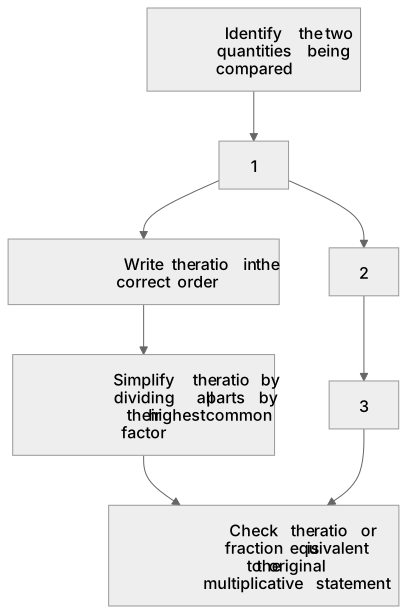
1Box 1
2Box 2
3Box 3
There is more to this lesson
The full lesson goes on to check your understanding and help you earn the marks. Create a free account to carry on, with your progress saved.
A week of Premium from your first lesson · Then the free plan continues · No card, no charge
Test your understanding of Ratio, proportion and rates of change: express a multiplicative relationship between two quantities as a ratio or a fraction
Active recall beats re-reading. Take an instant quiz now to test what you’ve learned and lock it into long-term memory.
A week of Premium from your first lesson · Then the free plan continues · No card, no charge