AQA · GCSE · Mathematics
Course version: 8300 · Version from Sept 2015
Understand and use proportion as equality of ratios
Full specification wording
Ratio, proportion and rates of change: understand and use proportion as equality of ratios
Proportion is the statement that two ratios are equal.
Checked against the AQA 8300 specification (opens in a new tab) on .
- Point 8 of 21
- 4 key terms
Study notes
From the checked teaching notes for this specification point.
The idea
Proportion is the statement that two ratios are equal. If the ratio a : b is in proportion to the ratio c : d, then a/b = c/d, and the two ratios describe the same multiplicative relationship even though the actual quantities may differ. For example, 2 : 3 and 10 : 15 are in proportion because 2/3 = 10/15; both simplify to 2 : 3. To use proportion, set up an equation of the form a/b = c/d, substitute the known values, and solve for the unknown by cross-multiplying or by finding the scale factor between the ratios. Always keep the quantities in the same order on each side of the equation, and check that the units match. This idea underpins scaling recipes, converting between currencies at a fixed rate, and solving problems involving similar shapes, where corresponding lengths are in the same ratio.
What earns the marks
- States that two ratios are in proportion when they are equal, for example 2 : 3 and 10 : 15, because both simplify to the same ratio.
- Sets up a correct equation of the form a/b = c/d, keeping corresponding quantities in the same positions on each side.
- Solves the proportion for an unknown quantity by cross-multiplying or by identifying and applying the scale factor between the two ratios.
- Checks the solution by substituting back into the original proportion or by confirming that both ratios simplify to the same simplest form.
Common mistakes and how to put them right
Mismatching the order of quantities.
Put it right: Keep the same quantity in the numerator on both sides and the same quantity in the denominator on both sides.
Adding rather than multiplying when scaling.
Put it right: In a proportion, both parts of the ratio are multiplied by the same non-zero scale factor.
Cross-multiplying incorrectly: from a/b = c/d writing ad = bc but then substituting the wrong values.
Put it right: Multiply the numerator of the first fraction by the denominator of the second, and set it equal to the denominator of the first multiplied by the numerator of the second, then substitute carefully.
Ignoring units: comparing 2 hours to 30 minutes as 2 : 30.
Put it right: Convert to the same unit first, so 2 hours : 30 minutes becomes 120 : 30, which simplifies to 4 : 1.
Exam tips
- Write the proportion as an equation with clear labels for each quantity, so you can see that corresponding quantities are in the same position on both sides.
- Use the scale factor method when the numbers are friendly: find what one ratio has been multiplied by to reach the other, then apply the same multiplier to the unknown part.
- Check your answer by simplifying both ratios to their simplest form; if they match, the proportion is correct.
Try the lesson
The start of the Ratio, proportion and rates of change: understand and use proportion as equality of ratios lesson, made from checked teaching notes for this specification point.
Have a go first
Which of these pairs of ratios is a proportion, because the two ratios are equal?
Listen
Proportion is the statement that two ratios are equal. If the ratio a : b is in proportion to the ratio c : d, then a/b = c/d, and the two ratios describe the same multiplicative relationship even though the actual quantities may differ. For example, 2 : 3 and 10 : 15 are in proportion because 2/3 = 10/15; both simplify to 2 : 3. To use proportion, set up an equation of the form a/b = c/d, substitute the known values, and solve for the unknown by cross-multiplying or by finding the scale factor between the ratios. Always keep the quantities in the same order on each side of the equation, and check that the units match. This idea underpins scaling recipes, converting between currencies at a fixed rate, and solving problems involving similar shapes, where corresponding lengths are in the same ratio. A strong answer earns marks for these points. States that two ratios are in proportion when they are equal, for example 2 : 3 and 10 : 15, because both simplify to the same ratio. Sets up a correct equation of the form a/b = c/d, keeping corresponding quantities in the same positions on each side. Solves the proportion for an unknown quantity by cross-multiplying or by identifying and applying the scale factor between the two ratios. Checks the solution by substituting back into the original proportion or by confirming that both ratios simplify to the same simplest form. A common slip: Mismatching the order of quantities: writing 2/3 = 15/10 instead of 2/3 = 10/15. Instead, keep the same quantity in the numerator on both sides and the same quantity in the denominator on both sides. Exam tip: Write the proportion as an equation with clear labels for each quantity, so you can see that corresponding quantities are in the same position on both sides.
See it
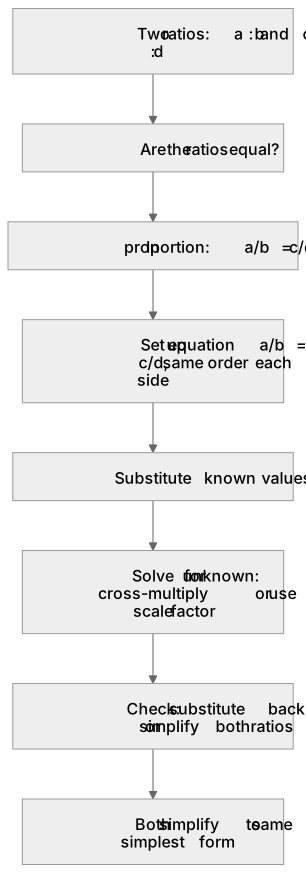
Put it in order
Put these steps in the order they happen.
- 1. Substitute known values
- 2. Both simplify to same simplest form
- 3. Solve for unknown: cross-multiply or use scale factor
- 4. Two ratios: a : b and c : d
- 5. Are the ratios equal?
- 6. Check: substitute back or simplify both ratios
- 7. In proportion: a/b = c/d
- 8. Set up equation a/b = c/d, same order each side
Watch it explained
What is the one idea the video explains? Say it in a sentence.
Read the described scene instead
Proportion is the statement that two ratios are equal. If a to b is in proportion to c to d, then a over b equals c over d. The actual quantities can differ, but the multiplicative relationship is the same. For example, 2 to 3 and 10 to 15 are in proportion because 2 over 3 equals 10 over 15. Both ratios simplify to 2 to 3. So each part of 2 to 3 has been multiplied by five. To use proportion, set up an equation of the form a over b equals c over d. Substitute the known values and keep corresponding quantities in the same order on each side. Check that units match before solving. Then solve for the unknown by cross-multiplying, or by finding the scale factor between the ratios. Pause for a moment and think how you would find the missing part in 2 to 3 equals 10 to what. Keep the order: parts compare to parts. From 2 to 10, the scale factor is five. Multiply both parts of 2 to 3 by five. The missing part is fifteen, giving 10 to 15. Check: both ratios simplify to 2 to 3. A common mistake is mismatching the order, writing 2 over 3 equals 15 over 10 instead of 2 over 3 equals 10 over 15. Another is adding instead of multiplying when scaling: for 2 to 3, adding eight gives 10 to 11, but multiplying both parts by five gives 10 to 15. Also convert units first: 2 hours to 30 minutes is 120 to 30, which simplifies to 4 to 1. Proportion supports scaling recipes, converting currency at a fixed rate, and similar shapes, where corresponding lengths are in the same ratio. To check a proportion, substitute back or simplify both ratios to their simplest form. If they match, the proportion is correct. Remember: equal ratios, careful order, matching units, and multiply both parts by the same scale factor.
Key words
Say what each word means before you turn the card.
Proportion
Try answering aloud or in your head before turning the card.
Equality of ratios
Try answering aloud or in your head before turning the card.
Setting up and solving proportion equations
Try answering aloud or in your head before turning the card.
Scale factors and equivalent ratios
Try answering aloud or in your head before turning the card.
See every definition
- Proportion
- The statement that two ratios are equal, so that the two ratios describe the same multiplicative relationship even though the actual quantities may differ.
- Equality of ratios
- Two ratios are in proportion when they are equal, for example 2 : 3 and 10 : 15, because both simplify to the same ratio.
- Setting up and solving proportion equations
- An equation of the form a/b = c/d is set up, known values are substituted, and the unknown is found by cross-multiplying or by finding the scale factor between the ratios.
- Scale factors and equivalent ratios
- In a proportion, both parts of the ratio are multiplied by the same non-zero scale factor, and the scale factor between the ratios can be identified and applied to the unknown part.
Label the diagram
Some boxes have lost their names. Pick the right name for each number.
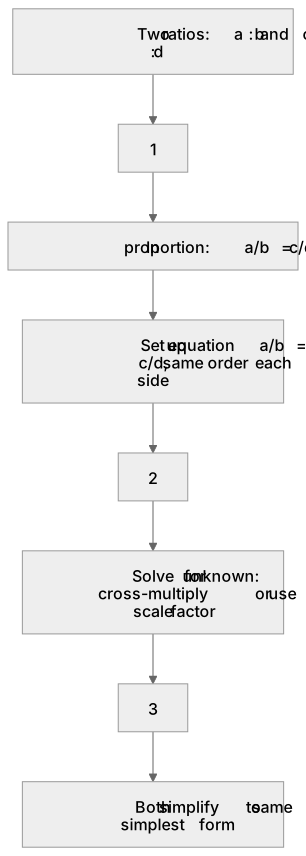
1Box 1
2Box 2
3Box 3
There is more to this lesson
The full lesson goes on to check your understanding and help you earn the marks. Create a free account to carry on, with your progress saved.
A week of Premium from your first lesson · Then the free plan continues · No card, no charge
Test your understanding of Ratio, proportion and rates of change: understand and use proportion as equality of ratios
Active recall beats re-reading. Take an instant quiz now to test what you’ve learned and lock it into long-term memory.
A week of Premium from your first lesson · Then the free plan continues · No card, no charge