AQA · GCSE · Mathematics
Course version: 8300 · Version from Sept 2015
Make links to similarity (including trigonometric ratios)
Full specification wording
Ratio, proportion and rates of change: make links to similarity (including trigonometric ratios)
Similar figures have equal corresponding angles and corresponding sides in a constant ratio, the scale factor.
Checked against the AQA 8300 specification (opens in a new tab) on .
- Point 15 of 21
- 4 key terms
Study notes
From the checked teaching notes for this specification point.
The idea
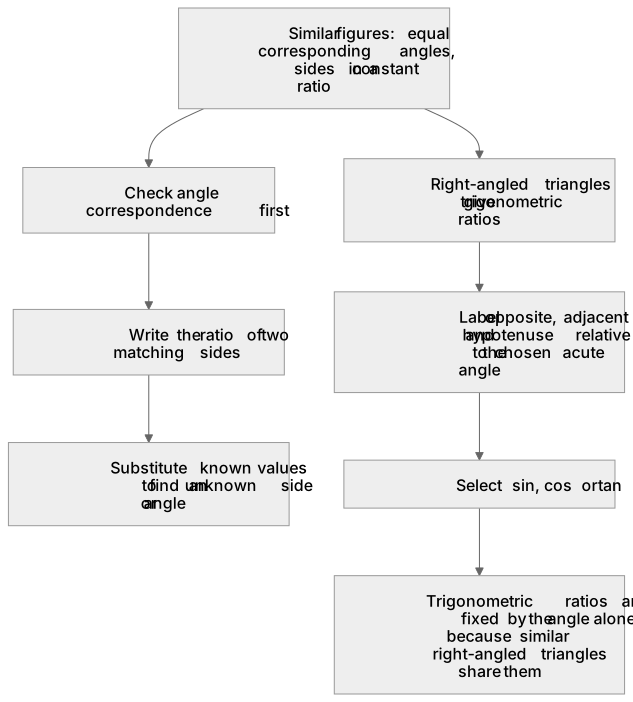
Similar figures have equal corresponding angles and corresponding sides in a constant ratio, the scale factor. If two triangles are similar, each side of the image equals the matching side of the object multiplied by that factor, so missing lengths follow from a proportion such as a/A = b/B. Right-angled triangles give the trigonometric ratios: for a chosen acute angle, sin = opposite ÷ hypotenuse, cos = adjacent ÷ hypotenuse and tan = opposite ÷ adjacent. These ratios are fixed by the angle alone, which is why similar right-angled triangles share them. A learner links the topics by writing the ratio of two matching sides, checking the angle correspondence first, then substituting known values to find an unknown side or angle.
What earns the marks
- States that similar figures have equal corresponding angles and corresponding sides in the same ratio (a constant scale factor).
- Uses a correct proportion between matching sides, for example a/A = b/B, to find a missing length in similar triangles.
- Identifies the opposite, adjacent and hypotenuse sides relative to a chosen acute angle before selecting a trigonometric ratio.
- Selects and applies sin, cos or tan correctly, for example tan θ = opposite ÷ adjacent, to find a missing side or angle.
- Explains that trigonometric ratios are constant for a given angle because all right-angled triangles with that angle are similar.
Common mistakes and how to put them right
Matching non-corresponding sides when forming a proportion.
Put it right by pairing each side with the side opposite the same angle before writing the ratio.
Using the hypotenuse as the adjacent side.
Put it right by labelling the hypotenuse first, opposite the right angle, then naming the remaining sides relative to the chosen angle.
Assuming triangles are similar from side lengths alone.
Put it right by checking that corresponding angles are equal or that all three pairs of sides are in one constant ratio.
Applying a trigonometric ratio to a non-right-angled triangle.
Put it right by identifying a right angle or dropping a perpendicular to create one.
Exam tips
- Label corresponding vertices in the same order in both figures so matching sides are easy to read off.
- Write the ratio or trigonometric equation before substituting numbers, so the method is visible even if arithmetic slips.
- Check the answer is sensible: a scale factor greater than 1 enlarges, and a sine or cosine value must lie between 0 and 1.
- Keep the calculator in degree mode when the question uses degrees, and state the unit of an angle you calculate.
Try the lesson
The start of the Ratio, proportion and rates of change: make links to similarity (including trigonometric ratios) lesson, made from checked teaching notes for this specification point.
Have a go first
Two right-angled triangles, A and B, each have an angle of 25°. Triangle B is an enlargement of Triangle A by a scale factor of 3. In Triangle A, the ratio of the side opposite the 25° angle to the hypotenuse is x. What is the ratio of the side opposite the 25° angle to the hypotenuse in Triangle B?
Listen
Similar figures have equal corresponding angles and corresponding sides in a constant ratio, the scale factor. If two triangles are similar, each side of the image equals the matching side of the object multiplied by that factor, so missing lengths follow from a proportion such as a/A = b/B. Right-angled triangles give the trigonometric ratios: for a chosen acute angle, sin = opposite ÷ hypotenuse, cos = adjacent ÷ hypotenuse and tan = opposite ÷ adjacent. These ratios are fixed by the angle alone, which is why similar right-angled triangles share them. A learner links the topics by writing the ratio of two matching sides, checking the angle correspondence first, then substituting known values to find an unknown side or angle. A strong answer earns marks for these points. States that similar figures have equal corresponding angles and corresponding sides in the same ratio (a constant scale factor). Uses a correct proportion between matching sides, for example a/A = b/B, to find a missing length in similar triangles. Identifies the opposite, adjacent and hypotenuse sides relative to a chosen acute angle before selecting a trigonometric ratio. Selects and applies sin, cos or tan correctly, for example tan θ = opposite ÷ adjacent, to find a missing side or angle. A common slip: Matching non-corresponding sides when forming a proportion. Instead, pairing each side with the side opposite the same angle before writing the ratio. Exam tip: Label corresponding vertices in the same order in both figures so matching sides are easy to read off.
See it
Watch it explained
What is the one idea the video explains? Say it in a sentence.
Read the described scene instead
Similar figures have equal corresponding angles, and their matching sides are in a constant ratio called the scale factor. This lesson links that idea to right-angled triangles and the trigonometric ratios. Think about how a proportion can find a missing length before we use sine, cosine or tangent. In two similar triangles, each side of the image equals the matching side of the object multiplied by the scale factor. To use this, pair each side with the side opposite the same angle. Then a correct proportion is a over A equals b over B. The proportion finds a missing length once the matching sides and known values are identified. For a chosen acute angle in a right-angled triangle, label the hypotenuse opposite the right angle. The opposite side is across from the chosen angle, and the adjacent side is next to it. The ratios are fixed by the angle alone: sine equals opposite divided by hypotenuse, cosine equals adjacent divided by hypotenuse, and tangent equals opposite divided by adjacent. The link is similarity. All right-angled triangles with the same acute angle are similar, so their matching side ratios are equal. That is why sine, cosine and tangent depend only on the angle. Start by checking angle correspondence, then write the ratio of two matching sides. Substitute known values to find an unknown side or angle. A common mistake is matching non-corresponding sides, so pair each side with the side opposite the same angle. Do not call the hypotenuse adjacent: label the hypotenuse opposite the right angle, then name the remaining sides from the chosen angle. Do not assume similarity from side lengths alone; check equal corresponding angles or all three side pairs in one constant ratio. Never apply a trigonometric ratio to a non-right-angled triangle; identify a right angle or drop a perpendicular. Pause here and decide which matching sides or which trigonometric ratio you need. For a similar-triangle proportion, write a over A equals b over B, then rearrange to b equals B times a over A. Substitute known values to find the missing length. For a right-angled triangle, choose sine, cosine or tangent from the sides relative to the angle, write the equation, then substitute. Check a sine or cosine value lies between zero and one. Similar figures have equal corresponding angles and matching sides in a constant ratio. Use a correct proportion such as a over A equals b over B to find a missing length. In right-angled triangles, label opposite, adjacent and hypotenuse relative to the chosen acute angle, then apply sine, cosine or tangent. Keep the calculator in degree mode when angles are in degrees, and state the unit of any angle you calculate.
Key words
Say what each word means before you turn the card.
Similarity and scale factors
Try answering aloud or in your head before turning the card.
Corresponding sides and angles
Try answering aloud or in your head before turning the card.
Trigonometric ratios in right-angled triangles
Try answering aloud or in your head before turning the card.
Using proportion to find unknown lengths and angles
Try answering aloud or in your head before turning the card.
See every definition
- Similarity and scale factors
- Similar figures have equal corresponding angles and corresponding sides in a constant ratio, the scale factor.
- Corresponding sides and angles
- Matching sides are paired with the side opposite the same angle, and corresponding angles are equal in similar figures.
- Trigonometric ratios in right-angled triangles
- For a chosen acute angle, sin = opposite ÷ hypotenuse, cos = adjacent ÷ hypotenuse and tan = opposite ÷ adjacent.
- Using proportion to find unknown lengths and angles
- Missing lengths follow from a proportion such as a/A = b/B, and substituting known values finds an unknown side or angle.
Label the diagram
Some boxes have lost their names. Pick the right name for each number.
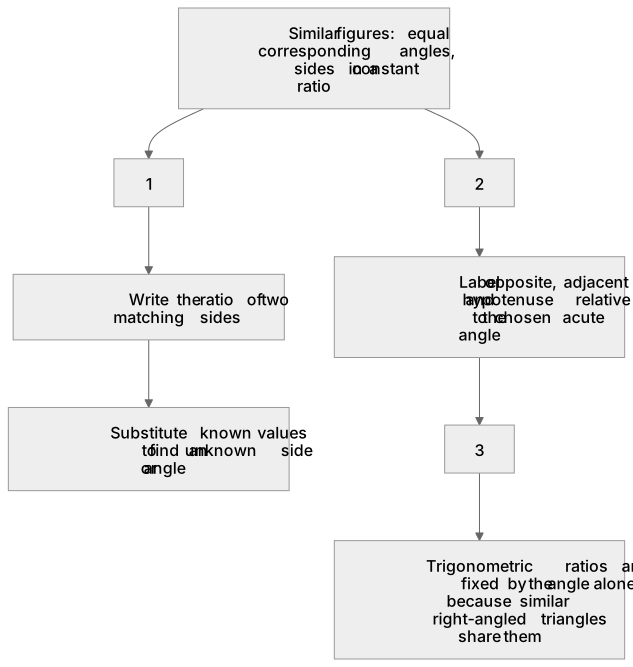
1Box 1
2Box 2
3Box 3
There is more to this lesson
The full lesson goes on to check your understanding and help you earn the marks. Create a free account to carry on, with your progress saved.
A week of Premium from your first lesson · Then the free plan continues · No card, no charge
Test your understanding of Ratio, proportion and rates of change: make links to similarity (including trigonometric ratios)
Active recall beats re-reading. Take an instant quiz now to test what you’ve learned and lock it into long-term memory.
A week of Premium from your first lesson · Then the free plan continues · No card, no charge