AQA · GCSE · Mathematics
Course version: 8300 · Version from Sept 2015
Understand that X is inversely proportional to Y is equivalent to X is…
Full specification wording
Ratio, proportion and rates of change: understand that X is inversely proportional to Y is equivalent to X is proportional to 1/Y interpret equations that describe direct and inverse proportion
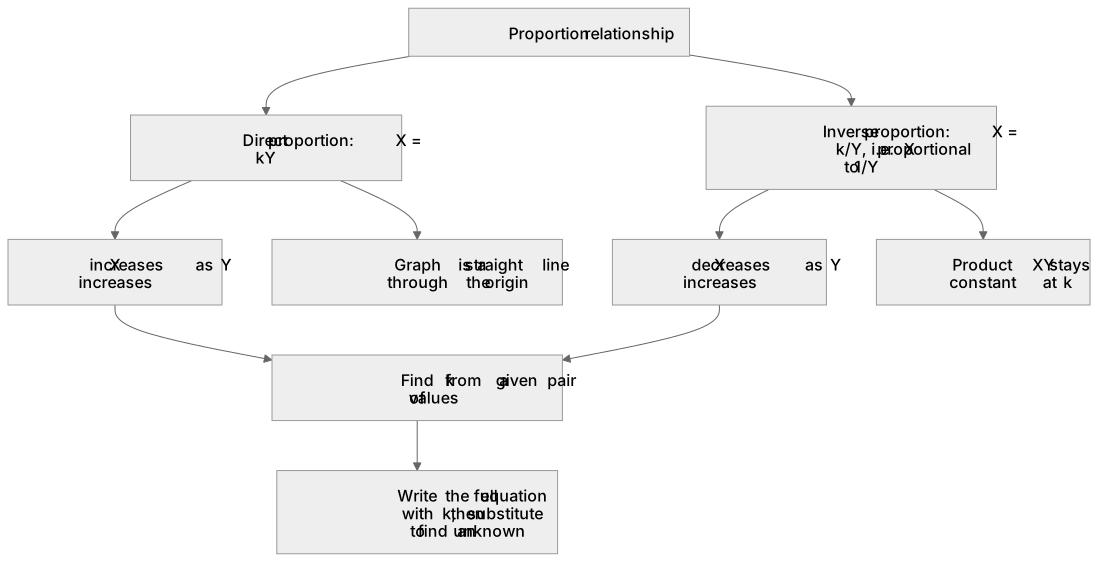
Direct proportion means X = kY for a constant k, so X increases as Y increases and the graph is a straight line through the origin.
Checked against the AQA 8300 specification (opens in a new tab) on .
- Point 16 of 21
- 3 key terms
Study notes
From the checked teaching notes for this specification point.
The idea
Direct proportion means X = kY for a constant k, so X increases as Y increases and the graph is a straight line through the origin. Inverse proportion means X is proportional to 1/Y, written X = k/Y, so as Y increases X decreases and the product XY stays constant at k. The two statements are equivalent: saying X is inversely proportional to Y is the same as saying X is directly proportional to the reciprocal of Y. To interpret an equation, a learner checks whether it has the form X = kY (direct) or X = k/Y (inverse), identifies k from a given pair of values, then substitutes to find an unknown.
For example: If X = 24/Y then k = 24, and when Y = 6, X = 4.
What earns the marks
- States that direct proportion has the form X = kY, where k is a non-zero constant.
- States that inverse proportion has the form X = k/Y, equivalently X is proportional to 1/Y.
- Recognises that X inversely proportional to Y and X proportional to 1/Y describe the same relationship.
- Finds the constant k from a given pair of values and uses it to calculate an unknown value.
- Distinguishes direct from inverse proportion by testing whether the ratio X/Y or the product XY is constant.
Common mistakes and how to put them right
Treating inverse proportion as X = kY.
Put it right by using X = k/Y so that X falls as Y rises.
Adding or subtracting a constant instead of multiplying or dividing by k.
Put it right by keeping the proportional form X = kY or X = k/Y.
Using one pair of values to find k but then substituting into the wrong equation.
Put it right by writing the full equation with k before substituting.
Assuming any decreasing relationship is inverse proportion.
Put it right by checking that the product XY is constant.
Exam tips
- Write the general form first, then substitute a known pair to find k before answering the actual question.
- Test your equation with a second pair of values from the table or graph to confirm it fits.
- For inverse proportion, check that doubling Y halves X, which is a quick way to verify the model.
- Give k with its correct units where the context supplies them, and keep values exact or rounded as the question requires.
Try the lesson
The start of the Ratio, proportion and rates of change: understand that X is inversely proportional to Y is equivalent to X is proportional to 1/Y interpret equations that describe direct and inverse proportion lesson, made from checked teaching notes for this specification point.
Have a go first
X is inversely proportional to Y. When Y = 4, X = 15. Which single equation links X and Y?
Listen
Direct proportion means X = kY for a constant k, so X increases as Y increases and the graph is a straight line through the origin. Inverse proportion means X is proportional to 1/Y, written X = k/Y, so as Y increases X decreases and the product XY stays constant at k. The two statements are equivalent: saying X is inversely proportional to Y is the same as saying X is directly proportional to the reciprocal of Y. To interpret an equation, a learner checks whether it has the form X = kY (direct) or X = k/Y (inverse), identifies k from a given pair of values, then substitutes to find an unknown. For example, if X = 24/Y then k = 24, and when Y = 6, X = 4. A strong answer earns marks for these points. States that direct proportion has the form X = kY, where k is a non-zero constant. States that inverse proportion has the form X = k/Y, equivalently X is proportional to 1/Y. Recognises that X inversely proportional to Y and X proportional to 1/Y describe the same relationship. Finds the constant k from a given pair of values and uses it to calculate an unknown value. A common slip: Treating inverse proportion as X = kY. Instead, using X = k/Y so that X falls as Y rises. Exam tip: Write the general form first, then substitute a known pair to find k before answering the actual question.
See it
Watch it explained
What is the one idea the video explains? Say it in a sentence.
Read the described scene instead
Direct and inverse proportion describe two different relationships between two variables. In direct proportion, X equals k times Y for a constant k. In inverse proportion, X is proportional to one over Y, written X equals k over Y. Both use a constant of proportionality, k, and that constant is the key to interpreting each equation. For direct proportion, the equation has the form X equals kY. As Y increases, X increases. The graph is a straight line through the origin. You can also test direct proportion by checking whether the ratio X over Y stays constant; that constant ratio is k. Inverse proportion has the form X equals k over Y, which is the same as saying X is proportional to one over Y. As Y increases, X decreases. The product X times Y stays constant at k. So X inversely proportional to Y and X proportional to one over Y describe the same relationship. To interpret an equation, first check whether it has the direct form X equals kY or the inverse form X equals k over Y. Then identify k from a given pair of values. Write the full equation with k before substituting to find an unknown. Before the worked example, pause and decide which form an equation uses. Suppose X equals 24 over Y. This is inverse proportion, because it has the form X equals k over Y, so k is 24. When Y equals 6, substitute into the equation: X equals 24 divided by 6, which is 4. The product X times Y is 24, which matches k. One common mistake is treating inverse proportion as X equals kY. Instead use X equals k over Y, so X falls as Y rises. Another mistake is adding or subtracting a constant rather than multiplying or dividing by k. Also, do not assume any decreasing relationship is inverse proportion; check that the product X times Y is constant. Remember these two forms. Direct proportion is X equals kY, and inverse proportion is X equals k over Y, or X proportional to one over Y. To answer a proportion question, write the general form, use a known pair to find k, then substitute. Test your equation with a second pair of values to confirm it fits.
Key words
Say what each word means before you turn the card.
Direct proportion
Try answering aloud or in your head before turning the card.
Inverse proportion
Try answering aloud or in your head before turning the card.
Constant of proportionality
Try answering aloud or in your head before turning the card.
See every definition
- Direct proportion
- A relationship of the form X = kY for a constant k, so X increases as Y increases and the graph is a straight line through the origin.
- Inverse proportion
- A relationship where X is proportional to 1/Y, written X = k/Y, so as Y increases X decreases and the product XY stays constant at k.
- Constant of proportionality
- The constant k in the form X = kY or X = k/Y, found from a given pair of values and used to calculate an unknown value.
Label the diagram
Some boxes have lost their names. Pick the right name for each number.
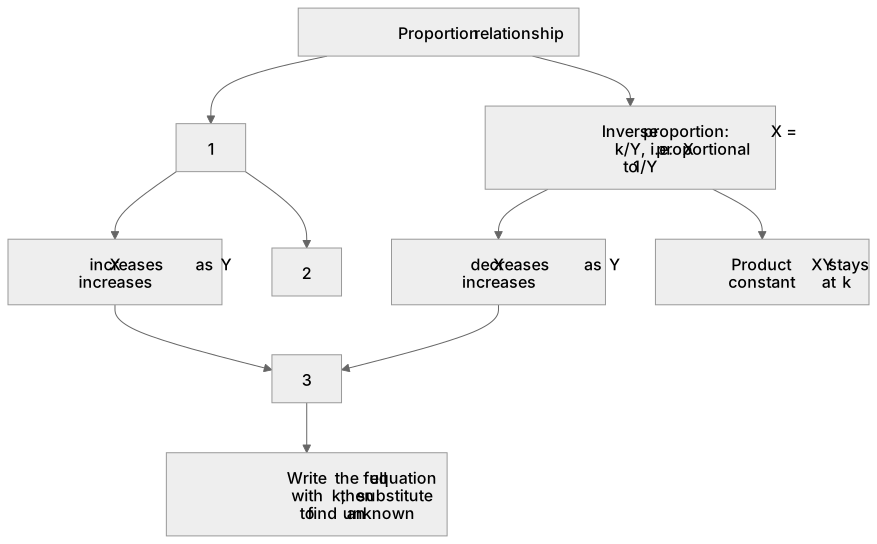
1Box 1
2Box 2
3Box 3
There is more to this lesson
The full lesson goes on to check your understanding and help you earn the marks. Create a free account to carry on, with your progress saved.
A week of Premium from your first lesson · Then the free plan continues · No card, no charge
Test your understanding of Ratio, proportion and rates of change: understand that X is inversely proportional to Y is equivalent to X is proportional to 1/Y interpret equations that describe direct and inverse proportion
Active recall beats re-reading. Take an instant quiz now to test what you’ve learned and lock it into long-term memory.
A week of Premium from your first lesson · Then the free plan continues · No card, no charge