AQA · GCSE · Mathematics
Course version: 8300 · Version from Sept 2015
Solve problems involving direct and inverse proportion, including…
Full specification wording
Ratio, proportion and rates of change: solve problems involving direct and inverse proportion, including graphical and algebraic representations
Direct proportion means one quantity is a constant multiple of another, so y = kx and the graph is a straight line through the origin.
Checked against the AQA 8300 specification (opens in a new tab) on .
- Point 11 of 21
- 4 key terms
Study notes
From the checked teaching notes for this specification point.
The idea
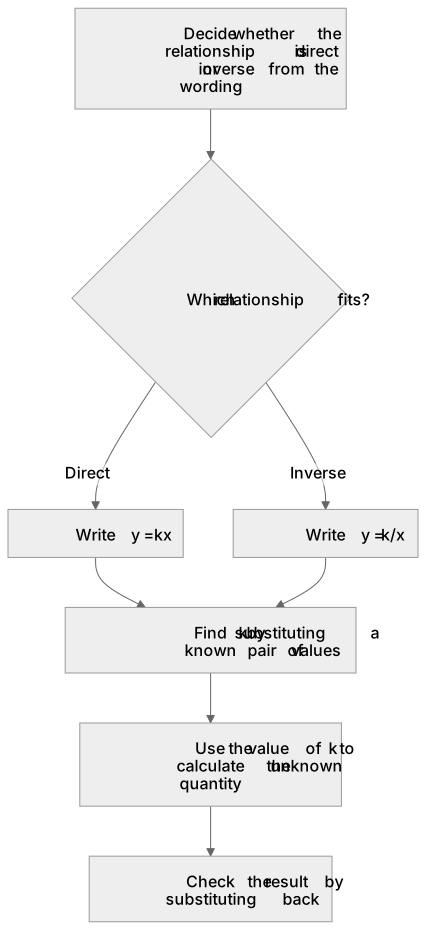
Direct proportion means one quantity is a constant multiple of another, so y = kx and the graph is a straight line through the origin. Inverse proportion means the product is constant, so y = k/x and the graph is a curve that never touches the axes. To solve a problem, first decide which relationship fits the wording, then find k from a given pair of values, then substitute the required value. For example, if 4 pens cost £6, the unit rate is £1.50, so 10 pens cost £15. Graphically, direct proportion passes through (0, 0); inverse proportion has a decreasing curve. Algebraically, rearrange to find k before answering the question asked.
What earns the marks
- Identify whether the relationship is direct (y = kx) or inverse (y = k/x) from the wording of the problem.
- Find the constant of proportionality k by substituting a known pair of values into the correct equation.
- Use the value of k to calculate the unknown quantity, showing the substitution clearly.
- Interpret a direct proportion graph as a straight line through the origin and an inverse proportion graph as a curve with constant product.
- Solve algebraic proportion problems by forming and solving an equation such as 4k = 6 or k/4 = 6.
Common mistakes and how to put them right
Assuming every proportion is direct.
Put it right: If doubling one quantity halves the other, the relationship is inverse, so use y = k/x rather than y = kx.
Forgetting to find k first.
Put it right: Substituting values straight into y = kx without calculating k gives an incorrect answer; always find k from the given pair.
Misreading a graph: a straight line through the origin shows direct proportion, while a curve that gets closer to the axes shows inverse proportion; do not treat a curve as a straight line.
Using the wrong operation when rearranging.
Put it right: For inverse proportion, multiply the known pair to find k, then divide k by the new value.
Exam tips
- Underline the words 'direct' or 'inverse' in the question and write the matching equation before doing any arithmetic.
- Show the step where you calculate k, because method marks are often available even if the final value is wrong.
- Check your answer by substituting back into the original relationship: for direct proportion the ratio should stay constant, and for inverse proportion the product should stay constant.
Try the lesson
The start of the Ratio, proportion and rates of change: solve problems involving direct and inverse proportion, including graphical and algebraic representations lesson, made from checked teaching notes for this specification point.
Have a go first
The cost of pens is directly proportional to the number of pens bought. If 6 pens cost £9, work out the cost of 15 pens.
Listen
Direct proportion means one quantity is a constant multiple of another, so y = kx and the graph is a straight line through the origin. Inverse proportion means the product is constant, so y = k/x and the graph is a curve that never touches the axes. To solve a problem, first decide which relationship fits the wording, then find k from a given pair of values, then substitute the required value. For example, if 4 pens cost £6, the unit rate is £1.50, so 10 pens cost £15. Graphically, direct proportion passes through (0, 0); inverse proportion has a decreasing curve. Algebraically, rearrange to find k before answering the question asked. A strong answer earns marks for these points. Identify whether the relationship is direct (y = kx) or inverse (y = k/x) from the wording of the problem. Find the constant of proportionality k by substituting a known pair of values into the correct equation. Use the value of k to calculate the unknown quantity, showing the substitution clearly. Interpret a direct proportion graph as a straight line through the origin and an inverse proportion graph as a curve with constant product. Exam tip: Underline the words 'direct' or 'inverse' in the question and write the matching equation before doing any arithmetic.
See it
Watch it explained
What is the one idea the video explains? Say it in a sentence.
Read the described scene instead
This lesson looks at direct and inverse proportion. You will connect the wording of a problem to an equation, to a graph, and to a numerical answer. The key question is whether one quantity is a constant multiple of the other, or whether their product stays constant. Direct proportion means y equals k x, so the graph is a straight line through the origin. Inverse proportion means y equals k over x, so the product x y is constant and the graph is a curve that never touches the axes. Here k is the constant of proportionality. To solve a proportion problem, first decide which relationship fits the wording. Then find the constant of proportionality k by substituting a known pair of values into the correct equation. Next, use k to calculate the unknown quantity, showing the substitution clearly. Finally, check whether the ratio or the product stays constant. Pause here and decide whether the pen problem is direct or inverse. Four pens cost six pounds. Because the cost per pen is constant, this is direct proportion. The unit rate is one pound fifty per pen. So ten pens cost fifteen pounds. You can also write y equals k x, with k equal to one point five, then substitute x equals ten. Do not assume every proportion is direct. If doubling one quantity halves the other, the relationship is inverse, so use y equals k over x. Always find k before substituting; otherwise the answer is likely wrong. On a graph, a straight line through the origin shows direct proportion, while a curve approaching the axes shows inverse proportion. For inverse proportion, multiply the known pair to find k, then divide k by the new value. Remember that direct proportion is a constant ratio and a straight-line graph through the origin. Inverse proportion is a constant product and a reciprocal curve. In both cases, find k from a known pair, then substitute the required value. Move between the algebraic equation, the graph, and the numerical answer, checking that the ratio or product remains constant.
Key words
Say what each word means before you turn the card.
Direct proportion
Try answering aloud or in your head before turning the card.
Inverse proportion
Try answering aloud or in your head before turning the card.
Constant of proportionality k
Try answering aloud or in your head before turning the card.
Graphical representation
Try answering aloud or in your head before turning the card.
See every definition
- Direct proportion
- One quantity is a constant multiple of another, so y = kx and the graph is a straight line through the origin.
- Inverse proportion
- The product is constant, so y = k/x and the graph is a curve that never touches the axes.
- Constant of proportionality k
- Found by substituting a known pair of values into the correct equation before calculating the unknown quantity.
- Graphical representation
- Direct proportion passes through (0, 0), while inverse proportion has a decreasing curve.
There is more to this lesson
The full lesson goes on to check your understanding and help you earn the marks. Create a free account to carry on, with your progress saved.
A week of Premium from your first lesson · Then the free plan continues · No card, no charge
Test your understanding of Ratio, proportion and rates of change: solve problems involving direct and inverse proportion, including graphical and algebraic representations
Active recall beats re-reading. Take an instant quiz now to test what you’ve learned and lock it into long-term memory.
A week of Premium from your first lesson · Then the free plan continues · No card, no charge