AQA · GCSE · Mathematics
Course version: 8300 · Version from Sept 2015
Define percentage as ‘number of parts per hundred’ interpret percentages…
Full specification wording
Ratio, proportion and rates of change: define percentage as ‘number of parts per hundred’ interpret percentages and percentage changes as a fraction or a decimal, and interpret these multiplicatively express one quantity as a percentage of another compare two quantities using percentages work with percentages greater than 100% solve problems involving percentage change, including percentage increase/decrease and original value problems, and simple interest including in financial mathematics
A percentage is a number of parts per hundred, so 35% means 35/100 = 0.35.
Checked against the AQA 8300 specification (opens in a new tab) on .
- Point 10 of 21
- 4 key terms
Study notes
From the checked teaching notes for this specification point.
The idea
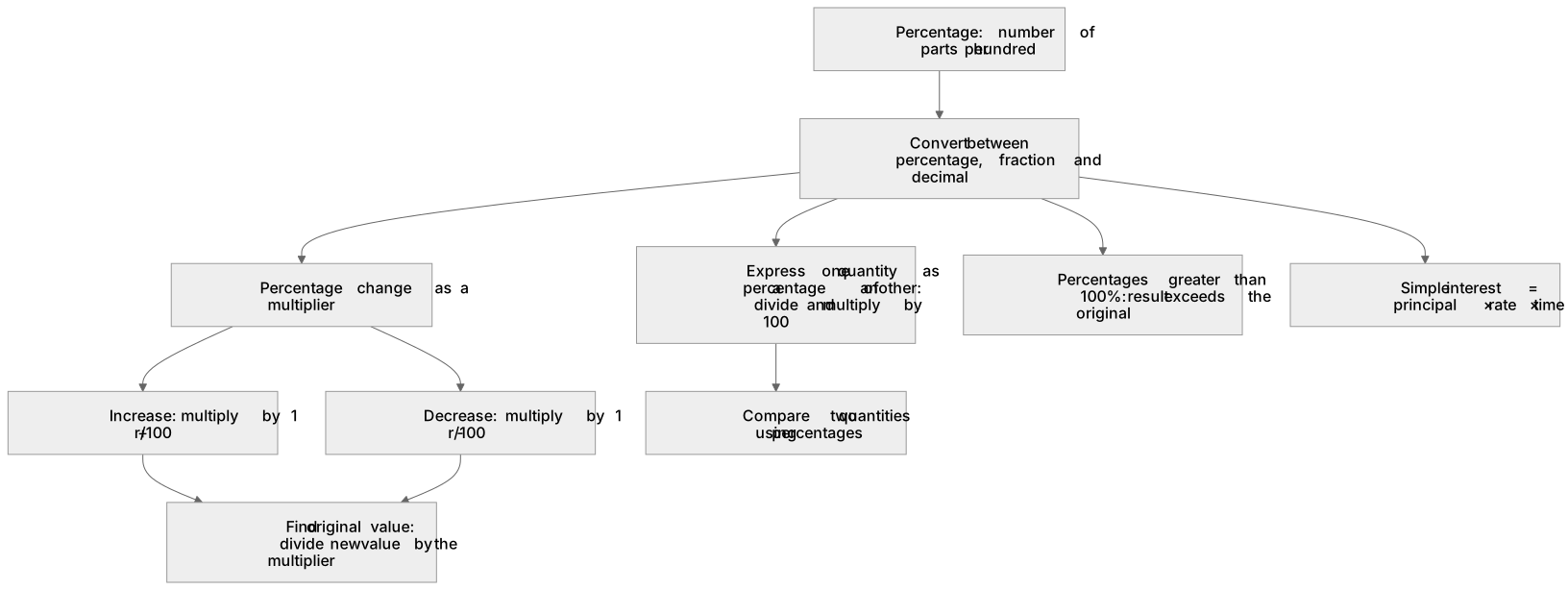
A percentage is a number of parts per hundred, so 35% means 35/100 = 0.35. Percentage changes are interpreted multiplicatively: an increase of 20% multiplies by 1.20, and a decrease of 20% multiplies by 0.80. To express one quantity as a percentage of another, divide the first by the second and multiply by 100. Percentages above 100% represent amounts larger than the original, for example 150% of 80 is 120. Percentage change problems include finding a new value after an increase or decrease, and finding the original value when the new value and percentage change are known, using division by the multiplier. Simple interest is calculated on the original amount only, using interest = principal × rate × time, and is common in financial mathematics.
What earns the marks
- Define percentage as a number of parts per hundred and convert between percentages, fractions and decimals.
- Use a multiplier to apply a percentage increase or decrease, for example ×1.20 for a 20% increase and ×0.80 for a 20% decrease.
- Express one quantity as a percentage of another by dividing and multiplying by 100.
- Compare two quantities by calculating each as a percentage of a common base.
- Work with percentages greater than 100%, recognising that the result exceeds the original amount.
- Find an original value by dividing the new value by the appropriate multiplier.
- Calculate simple interest using principal × rate × time in financial contexts.
Common mistakes and how to put them right
Adding or subtracting the percentage of the original instead of using a single multiplier, which can lead to errors in multi-step problems.
Put it right: The correct method is to multiply by 1 ± r/100.
Finding the original value by subtracting the percentage change from the new value rather than dividing by the multiplier.
Put it right: For example, after a 20% increase to 96, the original is 96 ÷ 1.20 = 80, not 96 − 19.2.
Treating a percentage greater than 100% as impossible or as a decrease.
Put it right: 150% of a quantity is 1.5 times that quantity.
Calculating simple interest on the accumulated total rather than on the original principal.
Put it right: Simple interest uses the principal only.
Exam tips
- Write the multiplier for each percentage change before calculating, and keep it as a decimal to avoid rounding errors.
- For original value problems, set up the equation new value = original × multiplier and solve by division.
- In financial questions, identify the principal, the annual rate and the time in years before substituting into the simple interest formula.
Try the lesson
The start of the Ratio, proportion and rates of change: define percentage as ‘number of parts per hundred’ interpret percentages and percentage changes as a fraction or a decimal, and interpret these multiplicatively express one quantity as a percentage of another compare two quantities using percentages work with percentages greater than 100% solve problems involving percentage change, including percentage increase/decrease and original value problems, and simple interest including in financial mathematics lesson, made from checked teaching notes for this specification point.
Have a go first
A test has 50 marks. Sam scores 23 marks. Express Sam's score as a percentage of the total marks.
Listen
A percentage is a number of parts per hundred, so 35% means 35/100 = 0.35. Percentage changes are interpreted multiplicatively: an increase of 20% multiplies by 1.20, and a decrease of 20% multiplies by 0.80. To express one quantity as a percentage of another, divide the first by the second and multiply by 100. Percentages above 100% represent amounts larger than the original, for example 150% of 80 is 120. Percentage change problems include finding a new value after an increase or decrease, and finding the original value when the new value and percentage change are known, using division by the multiplier. Simple interest is calculated on the original amount only, using interest = principal × rate × time, and is common in financial mathematics. A strong answer earns marks for these points. Define percentage as a number of parts per hundred and convert between percentages, fractions and decimals. Use a multiplier to apply a percentage increase or decrease, for example ×1.20 for a 20% increase and ×0.80 for a 20% decrease. Express one quantity as a percentage of another by dividing and multiplying by 100. Compare two quantities by calculating each as a percentage of a common base. Exam tip: Write the multiplier for each percentage change before calculating, and keep it as a decimal to avoid rounding errors.
See it
Watch it explained
What is the one idea the video explains? Say it in a sentence.
Read the described scene instead
A percentage is a number of parts per hundred. So thirty-five percent means thirty-five out of one hundred, which is thirty-five hundredths, or zero point three five. This definition lets us convert between percentages, fractions and decimals before calculating. Percentage changes are interpreted multiplicatively. An increase of twenty percent multiplies by one point two zero. A decrease of twenty percent multiplies by zero point eight zero. Percentages above one hundred percent represent amounts larger than the original, for example one hundred fifty percent of eighty is one hundred twenty. To express one quantity as a percentage of another, divide the first by the second and multiply by one hundred. To compare two quantities using percentages, calculate each as a percentage of a common base, so the comparison uses the same whole. Here is an original value problem. After a twenty percent increase, a value becomes ninety-six. Write the multiplier first: a twenty percent increase gives one point two zero. Set new value equal to original times multiplier. So ninety-six equals original times one point two zero. Divide ninety-six by one point two zero to get eighty. The original value is eighty. Avoid subtracting the percentage change from the new value when finding an original value. After a twenty percent increase to ninety-six, the original is ninety-six divided by one point two zero, which is eighty, not ninety-six minus nineteen point two. Also, a percentage greater than one hundred percent is not impossible; one hundred fifty percent of a quantity is one point five times that quantity. Simple interest is calculated on the original amount only. Use interest equals principal times rate times time. In financial mathematics, identify the principal, the annual rate and the time in years before substituting into the formula. Do not calculate simple interest on the accumulated total. Remember: a percentage is parts per hundred; changes use multipliers; one quantity as a percentage of another uses divide and multiply by one hundred; original value problems divide by the multiplier; and simple interest uses the original principal. Pause here and choose one multiplier to write before you calculate.
Key words
Say what each word means before you turn the card.
Percentage as parts per hundred
Try answering aloud or in your head before turning the card.
Multiplicative reasoning with percentages
Try answering aloud or in your head before turning the card.
Percentage change and original value problems
Try answering aloud or in your head before turning the card.
Simple interest in financial mathematics
Try answering aloud or in your head before turning the card.
See every definition
- Percentage as parts per hundred
- A number of parts per hundred, so 35% means 35/100 = 0.35.
- Multiplicative reasoning with percentages
- Percentage changes are interpreted multiplicatively: an increase of 20% multiplies by 1.20, and a decrease of 20% multiplies by 0.80.
- Percentage change and original value problems
- Problems include finding a new value after an increase or decrease, and finding the original value when the new value and percentage change are known, using division by the multiplier.
- Simple interest in financial mathematics
- Calculated on the original amount only, using interest = principal × rate × time, and is common in financial mathematics.
Label the diagram
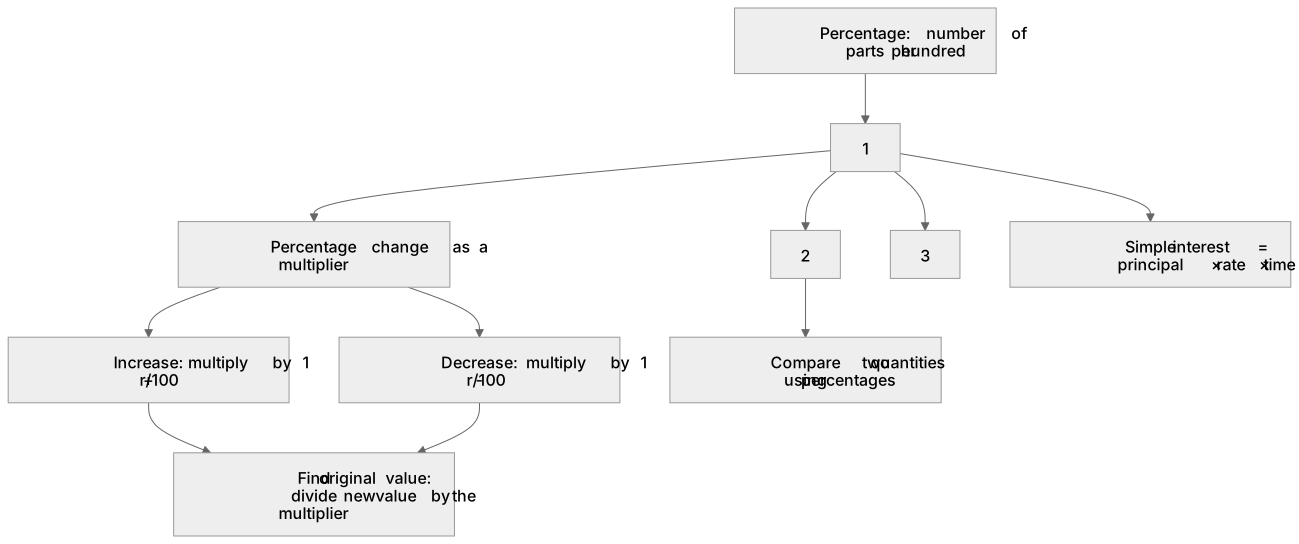
Some boxes have lost their names. Pick the right name for each number.
1Box 1
2Box 2
3Box 3
There is more to this lesson
The full lesson goes on to check your understanding and help you earn the marks. Create a free account to carry on, with your progress saved.
A week of Premium from your first lesson · Then the free plan continues · No card, no charge
Test your understanding of Ratio, proportion and rates of change: define percentage as ‘number of parts per hundred’ interpret percentages and percentage changes as a fraction or a decimal, and interpret these multiplicatively express one quantity as a percentage of another compare two quantities using percentages work with percentages greater than 100% solve problems involving percentage change, including percentage increase/decrease and original value problems, and simple interest including in financial mathematics
Active recall beats re-reading. Take an instant quiz now to test what you’ve learned and lock it into long-term memory.
A week of Premium from your first lesson · Then the free plan continues · No card, no charge