Pearson Edexcel · A-Level · Mathematics
Course version: 9MA0 · Version from Mar 2026
Understand and use the derivative of f(x) as the gradient of the tangent…
Full specification wording
Differentiation: 7.1 Understand and use the derivative of f(x) as the gradient of the tangent to the graph of y = f(x) at a general point (x, y); the gradient of the tangent as a limit; interpretation as a rate of change; sketching the gradient function for a given curve; second derivatives; differentiation from first principles for small positive integer powers of x and for sin x and cos x. Understand and use the second derivative as the rate of change of gradient; connection to convex and concave sections of curves and points of inflection.
The derivative f′(x) gives the gradient of the tangent to y = f(x) at the general point (x, y).
Checked against the Pearson Edexcel 9MA0 specification (opens in a new tab) on .
- Point 1 of 6
- 4 key terms
Study notes
From the checked teaching notes for this specification point.
The idea
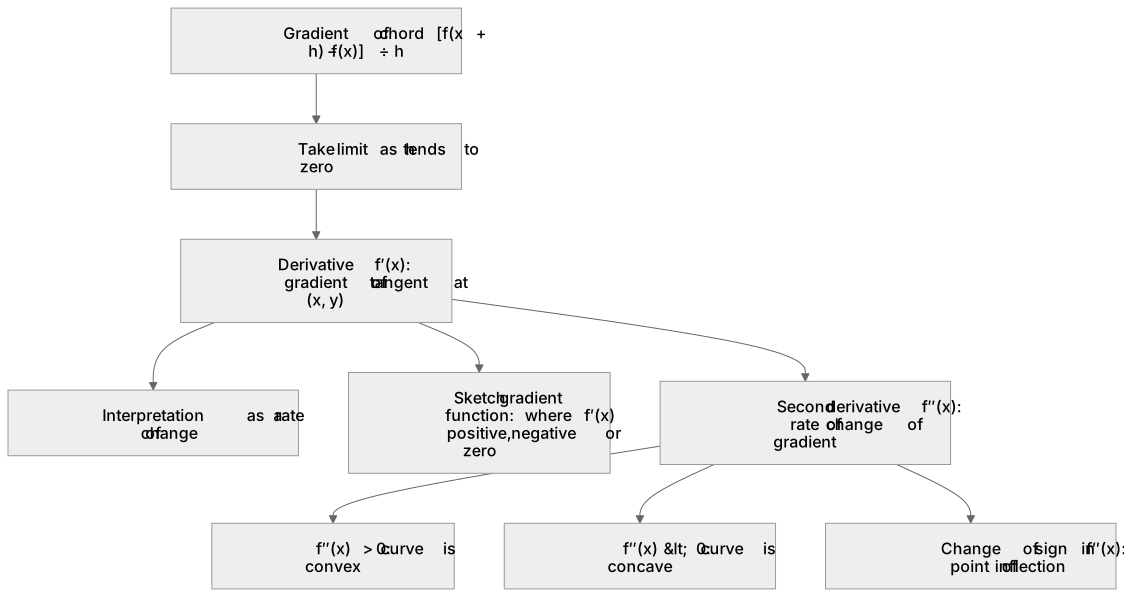
The derivative f′(x) gives the gradient of the tangent to y = f(x) at the general point (x, y). It is defined as the limit of [f(x + h) − f(x)] ÷ h as h tends to zero. This limit is the gradient of the chord as the two points merge. The derivative also represents a rate of change, such as velocity from displacement. Sketching the gradient function means plotting where f′(x) is positive, negative or zero, matching stationary points to axis crossings. Differentiating from first principles works for small positive integer powers of x and for sin x and cos x. The second derivative f″(x) is the rate of change of the gradient; where f″(x) > 0 the curve is convex, where f″(x) < 0 it is concave, and a change of sign indicates a point of inflection.
What earns the marks
- States the derivative as the limit of [f(x + h) − f(x)] ÷ h as h tends to zero.
- Interprets f′(x) as the gradient of the tangent at a general point and as an instantaneous rate of change.
- Sketches the gradient function by identifying where f′(x) is positive, negative and zero relative to the original curve.
- Differentiates small positive integer powers of x from first principles by expanding and taking the limit.
- Derives the derivatives of sin x and cos x from first principles using small-angle approximations or limit results.
- Uses the second derivative as the rate of change of gradient and links its sign to convex and concave sections and points of inflection.
Common mistakes and how to put them right
Treating the derivative as the gradient of a chord rather than the tangent.
Put it right by taking the limit as h tends to zero.
Assuming any point where f″(x) = 0 is a point of inflection.
Put it right by checking that the concavity changes sign.
Confusing convex and concave.
Put it right by testing a value on each side.
Exam tips
- Write the limit definition in full before simplifying, so the first-principles method is clear.
- When sketching a gradient function, mark axis crossings and turning points of the original curve first.
- Justify points of inflection by showing a sign change in f″(x), not just f″(x) = 0.
Try the lesson
The start of the Differentiation: 7.1 Understand and use the derivative of f(x) as the gradient of the tangent to the graph of y = f(x) at a general point (x, y); the gradient of the tangent as a limit; interpretation as a rate of change; sketching the gradient function for a given curve; second derivatives; differentiation from first principles for small positive integer powers of x and for sin x and cos x. Understand and use the second derivative as the rate of change of gradient; connection to convex and concave sections of curves and points of inflection. lesson, made from checked teaching notes for this specification point.
Have a go first
Find the gradient of the tangent to the curve y = x³ at the point where x = 2.
Listen
The derivative f′(x) gives the gradient of the tangent to y = f(x) at the general point (x, y). It is defined as the limit of [f(x + h) − f(x)] ÷ h as h tends to zero. This limit is the gradient of the chord as the two points merge. The derivative also represents a rate of change, such as velocity from displacement. Sketching the gradient function means plotting where f′(x) is positive, negative or zero, matching stationary points to axis crossings. Differentiating from first principles works for small positive integer powers of x and for sin x and cos x. The second derivative f″(x) is the rate of change of the gradient; where f″(x) > 0 the curve is convex, where f″(x) < 0 it is concave, and a change of sign indicates a point of inflection. A strong answer earns marks for these points. States the derivative as the limit of [f(x + h) − f(x)] ÷ h as h tends to zero. Interprets f′(x) as the gradient of the tangent at a general point and as an instantaneous rate of change. Sketches the gradient function by identifying where f′(x) is positive, negative and zero relative to the original curve. Differentiates small positive integer powers of x from first principles by expanding and taking the limit. A common slip: Treating the derivative as the gradient of a chord rather than the tangent. Instead, taking the limit as h tends to zero. Exam tip: Write the limit definition in full before simplifying, so the first-principles method is clear.
See it
Key words
Say what each word means before you turn the card.
Derivative
Try answering aloud or in your head before turning the card.
Differentiation from first principles
Try answering aloud or in your head before turning the card.
Second derivative
Try answering aloud or in your head before turning the card.
Point of inflection
Try answering aloud or in your head before turning the card.
See every definition
- Derivative
- The gradient of the tangent to the graph of y = f(x) at a general point (x, y), defined as a limit.
- Differentiation from first principles
- Taking the limit of [f(x + h) − f(x)] ÷ h as h tends to zero, for small positive integer powers of x and for sin x and cos x.
- Second derivative
- The rate of change of the gradient; where it is greater than zero the curve is convex, where less than zero it is concave.
- Point of inflection
- A point indicated by a change of sign in the second derivative.
Label the diagram
Some boxes have lost their names. Pick the right name for each number.
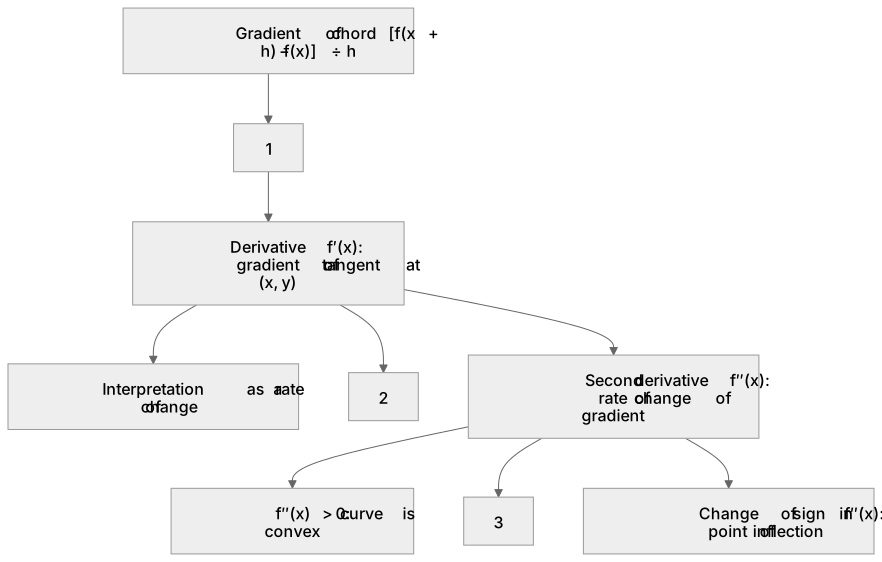
1Box 1
2Box 2
3Box 3
There is more to this lesson
The full lesson goes on to check your understanding and help you earn the marks. Create a free account to carry on, with your progress saved.
A week of Premium from your first lesson · Then the free plan continues · No card, no charge
Test your understanding of Differentiation: 7.1 Understand and use the derivative of f(x) as the gradient of the tangent to the graph of y = f(x) at a general point (x, y); the gradient of the tangent as a limit; interpretation as a rate of change; sketching the gradient function for a given curve; second derivatives; differentiation from first principles for small positive integer powers of x and for sin x and cos x. Understand and use the second derivative as the rate of change of gradient; connection to convex and concave sections of curves and points of inflection.
Active recall beats re-reading. Take an instant quiz now to test what you’ve learned and lock it into long-term memory.
A week of Premium from your first lesson · Then the free plan continues · No card, no charge