Pearson Edexcel · A-Level · Mathematics
Course version: 9MA0 · Version from Mar 2026
Differentiate xⁿ, for rational values of n, and related constant…
Full specification wording
Differentiation: 7.2 Differentiate xⁿ, for rational values of n, and related constant multiples, sums and differences. Differentiate e^(kx) and a^(kx), sin kx, cos kx, tan kx and related sums, differences and constant multiples. Understand and use the derivative of ln x as 1/x.
This section builds the core library of derivatives you apply throughout calculus.
Checked against the Pearson Edexcel 9MA0 specification (opens in a new tab) on .
- Point 2 of 6
- 3 key terms
Study notes
From the checked teaching notes for this specification point.
The idea
This section builds the core library of derivatives you apply throughout calculus. For a power xⁿ with rational n, the derivative is n x^(n−1); this works for positive, negative and fractional indices, so d/dx(x^(1/2)) = (1/2)x^(−1/2) and d/dx(x^(−2)) = −2x^(−3). Constant multiples, sums and differences differentiate term by term: if y = 5x³ − 2x^(1/2) + 7, then dy/dx = 15x² − x^(−1/2). For exponentials, d/dx(e^(kx)) = k e^(kx), and d/dx(a^(kx)) = k a^(kx) ln a, so d/dx(2^(3x)) = 3·2^(3x) ln 2. For trigonometric functions with argument kx, d/dx(sin kx) = k cos kx, d/dx(cos kx) = −k sin kx and d/dx(tan kx) = k sec² kx. The natural logarithm has d/dx(ln x) = 1/x for x > 0. Combine these rules with constant multiples and sums, for example d/dx(4 sin 3x − 2e^(5x)) = 12 cos 3x − 10e^(5x).
What earns the marks
- Applies the power rule n x^(n−1) correctly to rational indices, including negative and fractional powers such as x^(−3) and x^(2/3).
- Differentiates constant multiples, sums and differences term by term, preserving coefficients and signs.
- States and uses d/dx(e^(kx)) = k e^(kx) and d/dx(a^(kx)) = k a^(kx) ln a with the correct constant k and base factor.
- Differentiates sin kx, cos kx and tan kx as k cos kx, −k sin kx and k sec² kx respectively.
- Uses d/dx(ln x) = 1/x, including within sums and constant multiples such as 7 ln x.
Common mistakes and how to put them right
Forgetting to multiply by the inner constant k when differentiating e^(kx), sin kx or cos kx.
Put it right by writing the factor k explicitly before the function.
Subtracting one from the coefficient instead of the index when differentiating a power.
Put it right by reducing only the exponent, as in x⁵ becoming 5x⁴.
Treating ln x as differentiating to ln x or to x^(−1) written incorrectly.
Put it right by writing the derivative as 1/x, valid for x > 0.
Exam tips
- Rewrite roots and reciprocals as fractional or negative indices before differentiating, for example √x as x^(1/2).
- Check each term separately, then combine, so a sign error in one term does not spread through the whole expression.
- When a base is not e, such as 5^(2x), include ln 5 as a factor rather than leaving the derivative as a multiple of the original function alone.
Try the lesson
The start of the Differentiation: 7.2 Differentiate xⁿ, for rational values of n, and related constant multiples, sums and differences. Differentiate e^(kx) and a^(kx), sin kx, cos kx, tan kx and related sums, differences and constant multiples. Understand and use the derivative of ln x as 1/x. lesson, made from checked teaching notes for this specification point.
Have a go first
Differentiate y = x⁷ with respect to x.
Listen
This section builds the core library of derivatives you apply throughout calculus. For a power xⁿ with rational n, the derivative is n x^(n−1); this works for positive, negative and fractional indices, so d/dx(x^(1/2)) = (1/2)x^(−1/2) and d/dx(x^(−2)) = −2x^(−3). Constant multiples, sums and differences differentiate term by term: if y = 5x³ − 2x^(1/2) + 7, then dy/dx = 15x² − x^(−1/2). For exponentials, d/dx(e^(kx)) = k e^(kx), and d/dx(a^(kx)) = k a^(kx) ln a, so d/dx(2^(3x)) = 3·2^(3x) ln 2. For trigonometric functions with argument kx, d/dx(sin kx) = k cos kx, d/dx(cos kx) = −k sin kx and d/dx(tan kx) = k sec² kx. The natural logarithm has d/dx(ln x) = 1/x for x > 0. Combine these rules with constant multiples and sums, for example d/dx(4 sin 3x − 2e^(5x)) = 12 cos 3x − 10e^(5x). A strong answer earns marks for these points. Applies the power rule n x^(n−1) correctly to rational indices, including negative and fractional powers such as x^(−3) and x^(2/3). Differentiates constant multiples, sums and differences term by term, preserving coefficients and signs. States and uses d/dx(e^(kx)) = k e^(kx) and d/dx(a^(kx)) = k a^(kx) ln a with the correct constant k and base factor. Differentiates sin kx, cos kx and tan kx as k cos kx, −k sin kx and k sec² kx respectively. A common slip: Forgetting to multiply by the inner constant k when differentiating e^(kx), sin kx or cos kx. Instead, writing the factor k explicitly before the function. Exam tip: Rewrite roots and reciprocals as fractional or negative indices before differentiating, for example √x as x^(1/2).
See it

Key words
Say what each word means before you turn the card.
Power rule for rational indices
Try answering aloud or in your head before turning the card.
Exponential functions with base e and general base a
Try answering aloud or in your head before turning the card.
Trigonometric derivatives with argument kx
Try answering aloud or in your head before turning the card.
See every definition
- Power rule for rational indices
- For a power xⁿ with rational n, the derivative is n x^(n−1), which works for positive, negative and fractional indices.
- Exponential functions with base e and general base a
- The derivative of e^(kx) is k e^(kx), and the derivative of a^(kx) is k a^(kx) ln a.
- Trigonometric derivatives with argument kx
- The derivatives are k cos kx for sin kx, −k sin kx for cos kx, and k sec² kx for tan kx.
Label the diagram
Some boxes have lost their names. Pick the right name for each number.
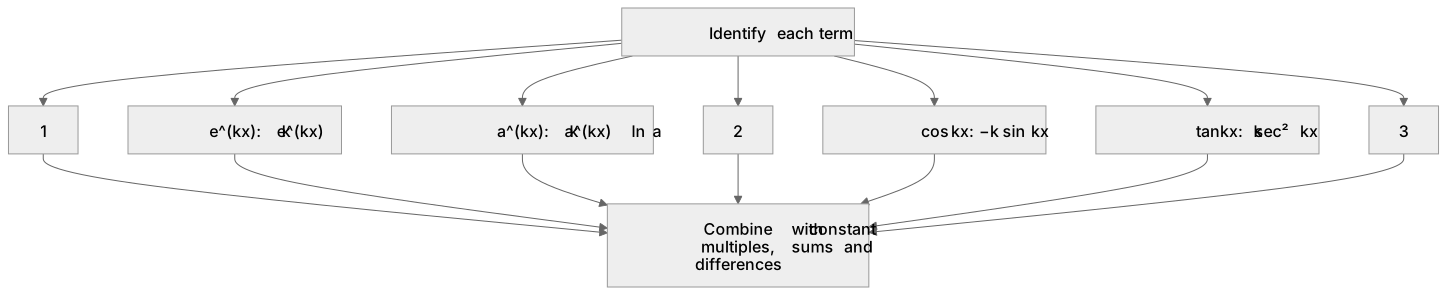
1Box 1
2Box 2
3Box 3
There is more to this lesson
The full lesson goes on to check your understanding and help you earn the marks. Create a free account to carry on, with your progress saved.
A week of Premium from your first lesson · Then the free plan continues · No card, no charge
Test your understanding of Differentiation: 7.2 Differentiate xⁿ, for rational values of n, and related constant multiples, sums and differences. Differentiate e^(kx) and a^(kx), sin kx, cos kx, tan kx and related sums, differences and constant multiples. Understand and use the derivative of ln x as 1/x.
Active recall beats re-reading. Take an instant quiz now to test what you’ve learned and lock it into long-term memory.
A week of Premium from your first lesson · Then the free plan continues · No card, no charge