Pearson Edexcel · A-Level · Mathematics
Course version: 9MA0 · Version from Mar 2026
Construct simple differential equations in pure mathematics and in context…
Full specification wording
Differentiation: 7.6 Construct simple differential equations in pure mathematics and in context (contexts may include kinematics, population growth and modelling the relationship between price and demand).
Constructing a differential equation means translating a written rate relationship into an equation containing a derivative.
Checked against the Pearson Edexcel 9MA0 specification (opens in a new tab) on .
- Point 6 of 6
- 3 key terms
Study notes
From the checked teaching notes for this specification point.
The idea
Constructing a differential equation means translating a written rate relationship into an equation containing a derivative. Identify the two quantities that change, choose symbols, then write the stated rate as a derivative: for example, if a population P grows at a rate proportional to its current size, write dP/dt = kP. In kinematics, acceleration is the rate of change of velocity, so a = dv/dt, and velocity is the rate of change of displacement, so v = ds/dt; a constant deceleration of 2 m s⁻² gives dv/dt = −2. For price and demand, if demand x falls at a rate proportional to its current value, dx/dt = −kx. Define every symbol, state whether each constant is positive, and keep units consistent.
What earns the marks
- Correctly identifies the dependent variable and the independent variable before differentiating, for example population P with respect to time t.
- Writes the given rate as a derivative with correct notation, such as dP/dt, dv/dt or dx/dt, rather than as a ratio of small changes.
- Translates proportional relationships using a constant of proportionality, for example dP/dt = kP, and states that k is a positive constant.
- Uses correct signs for increase or decrease, for example dv/dt = −2 for deceleration and dx/dt = −kx for falling demand.
- Defines all symbols and, where required, gives the units of the constant of proportionality so the equation is dimensionally consistent.
Common mistakes and how to put them right
Writing the rate as a plain fraction of changes instead of a derivative.
Put it right by using dP/dt or dv/dt notation.
Omitting the constant of proportionality in a proportional relationship.
Put it right by including k and stating its sign.
Using the wrong sign for a decreasing quantity.
Put it right by checking whether the context says increase or decrease and inserting a negative sign where needed.
Exam tips
- Underline the rate words in the question, such as rate of change, proportional to or per unit time, before writing anything.
- Define each symbol in a short sentence so the examiner can see your model clearly.
- Check the sign and units of your constant against the context before moving on.
Try the lesson
The start of the Differentiation: 7.6 Construct simple differential equations in pure mathematics and in context (contexts may include kinematics, population growth and modelling the relationship between price and demand). lesson, made from checked teaching notes for this specification point.
Have a go first
A colony of bacteria is being studied in a laboratory. The rate at which the population P grows is directly proportional to the size of the population at that instant. Write down a differential equation that models this situation, using k as the positive constant of proportionality.
Listen
Constructing a differential equation means translating a written rate relationship into an equation containing a derivative. Identify the two quantities that change, choose symbols, then write the stated rate as a derivative: for example, if a population P grows at a rate proportional to its current size, write dP/dt = kP. In kinematics, acceleration is the rate of change of velocity, so a = dv/dt, and velocity is the rate of change of displacement, so v = ds/dt; a constant deceleration of 2 m s⁻² gives dv/dt = −2. For price and demand, if demand x falls at a rate proportional to its current value, dx/dt = −kx. Define every symbol, state whether each constant is positive, and keep units consistent. A strong answer earns marks for these points. Correctly identifies the dependent variable and the independent variable before differentiating, for example population P with respect to time t. Writes the given rate as a derivative with correct notation, such as dP/dt, dv/dt or dx/dt, rather than as a ratio of small changes. Translates proportional relationships using a constant of proportionality, for example dP/dt = kP, and states that k is a positive constant. Uses correct signs for increase or decrease, for example dv/dt = −2 for deceleration and dx/dt = −kx for falling demand. A common slip: Writing the rate as a plain fraction of changes instead of a derivative. Instead, using dP/dt or dv/dt notation. Exam tip: Underline the rate words in the question, such as rate of change, proportional to or per unit time, before writing anything.
See it
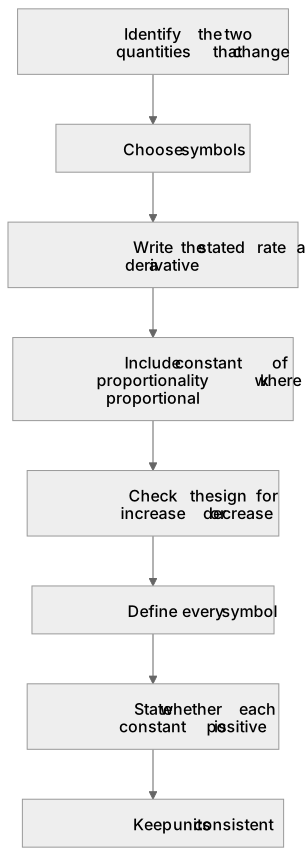
Put it in order
Put these steps in the order they happen.
- 1. Check the sign for increase or decrease
- 2. Keep units consistent
- 3. Define every symbol
- 4. Identify the two quantities that change
- 5. Choose symbols
- 6. State whether each constant is positive
- 7. Write the stated rate as a derivative
- 8. Include constant of proportionality k where proportional
Key words
Say what each word means before you turn the card.
Proportionality and constants of proportionality
Try answering aloud or in your head before turning the card.
Price and demand as related changing quantities
Try answering aloud or in your head before turning the card.
Modelling real situations with derivatives
Try answering aloud or in your head before turning the card.
See every definition
- Proportionality and constants of proportionality
- A rate relationship written with a constant of proportionality, such as dP/dt = kP, where k is stated to be a positive constant.
- Price and demand as related changing quantities
- If demand x falls at a rate proportional to its current value, the equation is dx/dt = −kx.
- Modelling real situations with derivatives
- Translating a written rate relationship into an equation containing a derivative, defining every symbol and keeping units consistent.
Label the diagram
Some boxes have lost their names. Pick the right name for each number.
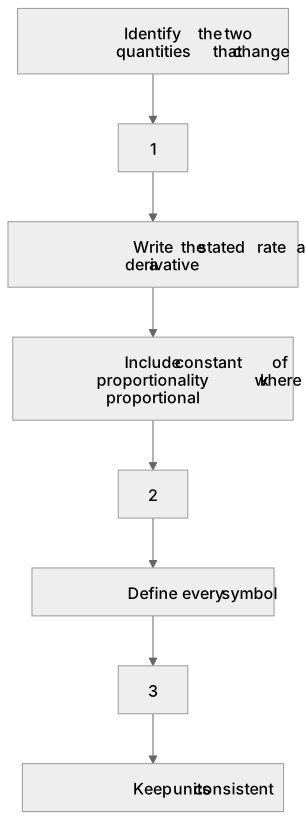
1Box 1
2Box 2
3Box 3
There is more to this lesson
The full lesson goes on to check your understanding and help you earn the marks. Create a free account to carry on, with your progress saved.
A week of Premium from your first lesson · Then the free plan continues · No card, no charge
Test your understanding of Differentiation: 7.6 Construct simple differential equations in pure mathematics and in context (contexts may include kinematics, population growth and modelling the relationship between price and demand).
Active recall beats re-reading. Take an instant quiz now to test what you’ve learned and lock it into long-term memory.
A week of Premium from your first lesson · Then the free plan continues · No card, no charge