Pearson Edexcel · A-Level · Mathematics
Course version: 9MA0 · Version from Mar 2026
Differentiate simple functions and relations defined implicitly or…
Full specification wording
Differentiation: 7.5 Differentiate simple functions and relations defined implicitly or parametrically, for first derivative only.
Some curves are easier to describe implicitly or parametrically.
Checked against the Pearson Edexcel 9MA0 specification (opens in a new tab) on .
- Point 5 of 6
- 3 key terms
Study notes
From the checked teaching notes for this specification point.
The idea
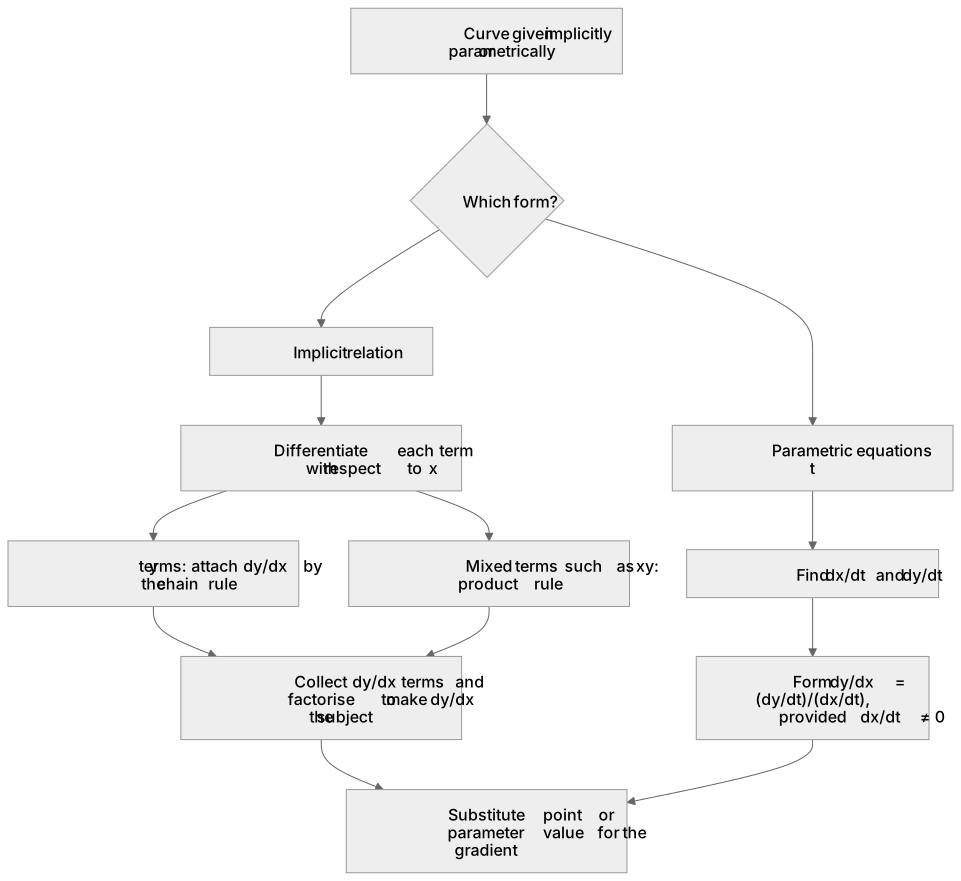
Some curves are easier to describe implicitly or parametrically. For implicit relations, differentiate each term with respect to x, remembering that y is a function of x, so d/dx(yⁿ) = n y^(n−1) dy/dx by the chain rule. For example, differentiating x² + y² = 25 gives 2x + 2y dy/dx = 0, so dy/dx = −x/y. Products such as xy require the product rule, giving x dy/dx + y. For parametric curves, x and y are given in terms of a parameter t; the first derivative is dy/dx = (dy/dt)/(dx/dt), provided dx/dt ≠ 0. For example, if x = t² and y = t³, then dy/dx = 3t²/(2t) = 3t/2. Only the first derivative is required here, so you do not need to find d²y/dx² for these implicit or parametric cases.
What earns the marks
- Differentiates implicit terms in y with respect to x, attaching dy/dx through the chain rule.
- Applies the product rule to mixed terms such as xy when differentiating implicitly.
- Rearranges the differentiated equation to make dy/dx the subject, factorising where necessary.
- Finds dx/dt and dy/dt for parametric equations and forms dy/dx as their quotient.
- Substitutes a given point or parameter value to obtain a numerical gradient where required.
Common mistakes and how to put them right
Differentiating y terms as if y were a constant.
Put it right by including dy/dx for every differentiated y term.
Forgetting the product rule on terms such as xy.
Put it right by writing x dy/dx + y.
Inverting the parametric quotient.
Put it right by dividing dy/dt by dx/dt, not the other way round.
Exam tips
- Collect all dy/dx terms on one side before factorising to isolate the derivative.
- For parametric questions, write dx/dt and dy/dt separately before forming the quotient.
- Substitute the given coordinates or parameter value only after obtaining the general expression for dy/dx.
Try the lesson
The start of the Differentiation: 7.5 Differentiate simple functions and relations defined implicitly or parametrically, for first derivative only. lesson, made from checked teaching notes for this specification point.
Have a go first
A curve is defined parametrically by x = t² and y = t³. Find the value of dy/dx at the point where t = 4.
Listen
Some curves are easier to describe implicitly or parametrically. For implicit relations, differentiate each term with respect to x, remembering that y is a function of x, so d/dx(yⁿ) = n y^(n−1) dy/dx by the chain rule. For example, differentiating x² + y² = 25 gives 2x + 2y dy/dx = 0, so dy/dx = −x/y. Products such as xy require the product rule, giving x dy/dx + y. For parametric curves, x and y are given in terms of a parameter t; the first derivative is dy/dx = (dy/dt)/(dx/dt), provided dx/dt ≠ 0. For example, if x = t² and y = t³, then dy/dx = 3t²/(2t) = 3t/2. Only the first derivative is required here, so you do not need to find d²y/dx² for these implicit or parametric cases. A strong answer earns marks for these points. Differentiates implicit terms in y with respect to x, attaching dy/dx through the chain rule. Applies the product rule to mixed terms such as xy when differentiating implicitly. Rearranges the differentiated equation to make dy/dx the subject, factorising where necessary. Finds dx/dt and dy/dt for parametric equations and forms dy/dx as their quotient. A common slip: Differentiating y terms as if y were a constant. Instead, including dy/dx for every differentiated y term. Exam tip: Collect all dy/dx terms on one side before factorising to isolate the derivative.
See it
Key words
Say what each word means before you turn the card.
Implicit differentiation
Try answering aloud or in your head before turning the card.
Chain rule applied to y terms
Try answering aloud or in your head before turning the card.
Parametric differentiation
Try answering aloud or in your head before turning the card.
See every definition
- Implicit differentiation
- Differentiating each term of an implicit relation with respect to x, remembering that y is a function of x.
- Chain rule applied to y terms
- Differentiating y terms with respect to x, attaching dy/dx, so d/dx(yⁿ) = n y^(n−1) dy/dx.
- Parametric differentiation
- For parametric curves, x and y are given in terms of a parameter t, and the first derivative is dy/dx = (dy/dt)/(dx/dt), provided dx/dt ≠ 0.
There is more to this lesson
The full lesson goes on to check your understanding and help you earn the marks. Create a free account to carry on, with your progress saved.
A week of Premium from your first lesson · Then the free plan continues · No card, no charge
Test your understanding of Differentiation: 7.5 Differentiate simple functions and relations defined implicitly or parametrically, for first derivative only.
Active recall beats re-reading. Take an instant quiz now to test what you’ve learned and lock it into long-term memory.
A week of Premium from your first lesson · Then the free plan continues · No card, no charge