Pearson Edexcel · A-Level · Mathematics
Course version: 9MA0 · Version from Mar 2026
Understand and use the laws of logarithms: log_a(x) + log_a(y) =…
Full specification wording
Exponentials and logarithms: 6.4 Understand and use the laws of logarithms: log_a(x) + log_a(y) = log_a(xy); log_a(x) − log_a(y) = log_a(x/y); k log_a(x) = log_a(x^k) (including, for example, k = −1 and k = −1/2).
The logarithm laws follow from the index laws because logs are exponents.
Checked against the Pearson Edexcel 9MA0 specification (opens in a new tab) on .
- Point 4 of 7
- 4 key terms
Study notes
From the checked teaching notes for this specification point.
The idea
The logarithm laws follow from the index laws because logs are exponents. Adding logs of the same base multiplies the arguments: log_a(x) + log_a(y) = log_a(xy). Subtracting logs divides the arguments: log_a(x) − log_a(y) = log_a(x/y). A coefficient becomes a power: k log_a(x) = log_a(x^k), which works for any real k, including k = −1 giving −log_a(x) = log_a(x^(−1)) = log_a(1/x), and k = −1/2 giving −(1/2)log_a(x) = log_a(x^(−1/2)) = log_a(1/√x). These laws let you combine or split logarithms, solve logarithmic equations by condensing to a single log, and change the subject in exponential models. They apply only when all logs share the same base and all arguments are positive.
What earns the marks
- States the product law log_a(x) + log_a(y) = log_a(xy) and applies it to combine two logarithms of the same base.
- States the quotient law log_a(x) − log_a(y) = log_a(x/y) and applies it to simplify differences of logarithms.
- States the power law k log_a(x) = log_a(x^k) and uses it to move coefficients into the exponent.
- Handles negative and fractional coefficients, showing −log_a(x) = log_a(1/x) and −(1/2)log_a(x) = log_a(1/√x).
- Uses the laws to solve equations, for example condensing log_a(x) + log_a(x − 3) into log_a(x(x − 3)) before removing the logarithm.
- Checks that all arguments remain positive and that every logarithm in a calculation has the same base.
Common mistakes and how to put them right
Applying the product law to a sum inside one logarithm, for example rewriting log_a(x + y) as log_a(x) + log_a(y).
Put it right by keeping log_a(x + y) unchanged.
Using the laws across different bases, such as combining log_2(x) with log_3(y).
Put it right by converting to a common base first.
Dropping the negative sign when k is negative, for example writing −log_a(x) as log_a(x); correct this by writing log_a(1/x).
Forgetting to reject solutions that make an argument zero or negative after solving.
Put it right by substituting back into the original equation.
Exam tips
- Write the base alongside every logarithm so you notice immediately if bases differ.
- Condense multiple logarithms into one before exponentiating both sides to solve an equation.
- When a coefficient is negative or fractional, convert it to a power of the argument rather than moving it incorrectly.
- Substitute your final answer back into the original equation to confirm every argument is positive.
Try the lesson
The start of the Exponentials and logarithms: 6.4 Understand and use the laws of logarithms: log_a(x) + log_a(y) = log_a(xy); log_a(x) − log_a(y) = log_a(x/y); k log_a(x) = log_a(x^k) (including, for example, k = −1 and k = −1/2). lesson, made from checked teaching notes for this specification point.
Have a go first
Write log₂ 5 + log₂ 3 as a single logarithm.
Listen
The logarithm laws follow from the index laws because logs are exponents. Adding logs of the same base multiplies the arguments: log_a(x) + log_a(y) = log_a(xy). Subtracting logs divides the arguments: log_a(x) − log_a(y) = log_a(x/y). A coefficient becomes a power: k log_a(x) = log_a(x^k), which works for any real k, including k = −1 giving −log_a(x) = log_a(x^(−1)) = log_a(1/x), and k = −1/2 giving −(1/2)log_a(x) = log_a(x^(−1/2)) = log_a(1/√x). These laws let you combine or split logarithms, solve logarithmic equations by condensing to a single log, and change the subject in exponential models. They apply only when all logs share the same base and all arguments are positive. A strong answer earns marks for these points. States the product law log_a(x) + log_a(y) = log_a(xy) and applies it to combine two logarithms of the same base. States the quotient law log_a(x) − log_a(y) = log_a(x/y) and applies it to simplify differences of logarithms. States the power law k log_a(x) = log_a(x^k) and uses it to move coefficients into the exponent. Handles negative and fractional coefficients, showing −log_a(x) = log_a(1/x) and −(1/2)log_a(x) = log_a(1/√x). A common slip: Applying the product law to a sum inside one logarithm, for example rewriting log_a(x + y) as log_a(x) + log_a(y). Instead, keeping log_a(x + y) unchanged. Exam tip: Write the base alongside every logarithm so you notice immediately if bases differ.
See it

Key words
Say what each word means before you turn the card.
Laws of logarithms
Try answering aloud or in your head before turning the card.
Links between index laws and log laws
Try answering aloud or in your head before turning the card.
Solving logarithmic and exponential equations
Try answering aloud or in your head before turning the card.
Domain restrictions on logarithms
Try answering aloud or in your head before turning the card.
See every definition
- Laws of logarithms
- Rules that let you combine or split logarithms of the same base: adding gives the log of the product, subtracting gives the log of the quotient, and a coefficient becomes a power.
- Links between index laws and log laws
- The logarithm laws follow from the index laws because logs are exponents.
- Solving logarithmic and exponential equations
- The laws let you solve logarithmic equations by condensing to a single log, and change the subject in exponential models.
- Domain restrictions on logarithms
- The laws apply only when all logs share the same base and all arguments are positive.
Label the diagram
Some boxes have lost their names. Pick the right name for each number.
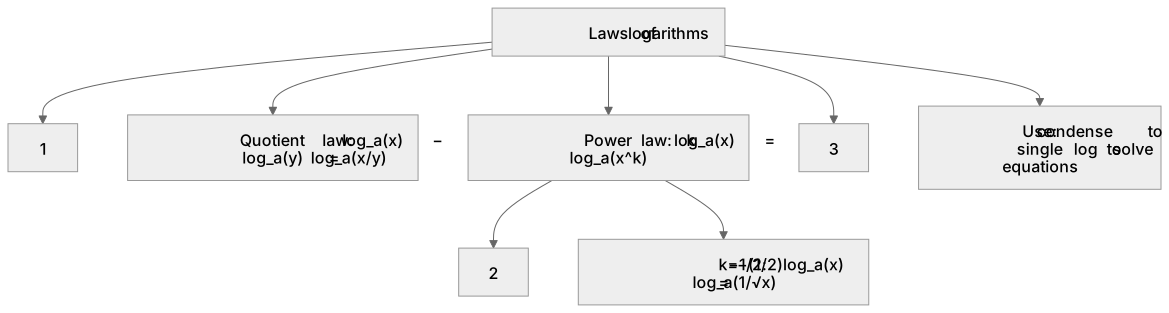
1Box 1
2Box 2
3Box 3
There is more to this lesson
The full lesson goes on to check your understanding and help you earn the marks. Create a free account to carry on, with your progress saved.
A week of Premium from your first lesson · Then the free plan continues · No card, no charge
Test your understanding of Exponentials and logarithms: 6.4 Understand and use the laws of logarithms: log_a(x) + log_a(y) = log_a(xy); log_a(x) − log_a(y) = log_a(x/y); k log_a(x) = log_a(x^k) (including, for example, k = −1 and k = −1/2).
Active recall beats re-reading. Take an instant quiz now to test what you’ve learned and lock it into long-term memory.
A week of Premium from your first lesson · Then the free plan continues · No card, no charge