Pearson Edexcel · A-Level · Mathematics
Course version: 9MA0 · Version from Mar 2026
Exponentials and logarithms: 6.5 Solve equations of the form a^x = b.
An equation aˣ = b has the unknown in the exponent, so ordinary rearrangement cannot isolate x.
Checked against the Pearson Edexcel 9MA0 specification (opens in a new tab) on .
- Point 5 of 7
Study notes
From the checked teaching notes for this specification point.
The idea
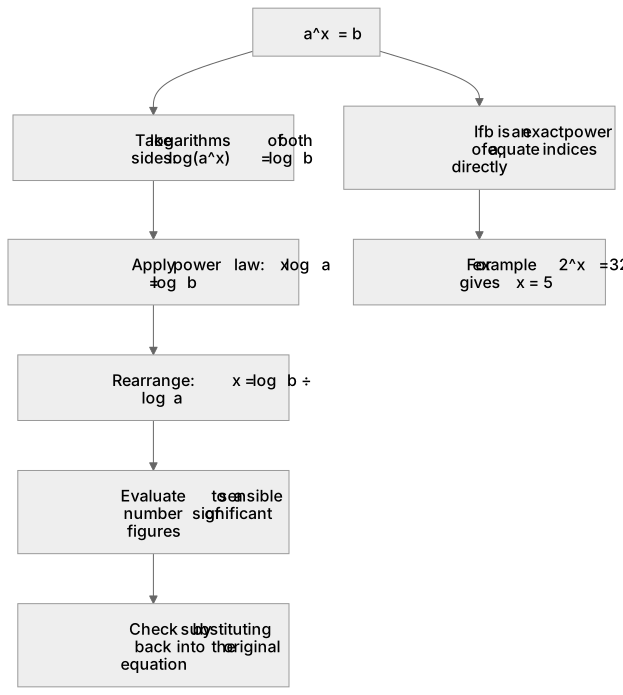
An equation aˣ = b has the unknown in the exponent, so ordinary rearrangement cannot isolate x. Take logarithms of both sides: log(aˣ) = log b, then use the power law to bring x down, giving x log a = log b and hence x = log b ÷ log a. Any consistent base works; choosing base 10 or base e suits most calculators. For example, 3ˣ = 20 gives x = log 20 ÷ log 3 ≈ 1.3010 ÷ 0.4771 ≈ 2.73. Check by substitution: 3^2.73 ≈ 20. If b is a recognisable power of a, equate indices directly, as with 2ˣ = 32 giving x = 5. Equations such as 5^(2x−1) = 40 are solved the same way, keeping the whole exponent intact before dividing.
What earns the marks
- Takes logarithms of both sides of aˣ = b using a consistent base, for example log₁₀ or ln.
- Applies the power law log(aˣ) = x log a to bring the exponent down as a product.
- Rearranges to x = log b ÷ log a and evaluates to a sensible number of significant figures.
- Recognises cases where b is an exact power of a and equates indices instead, for example 2ˣ = 32 giving x = 5.
- Handles a compound exponent such as 5^(2x−1) = 40 by keeping the exponent intact, then solving the resulting linear equation.
- Checks the solution by substituting back into the original equation and comparing values.
Common mistakes and how to put them right
Dividing b by a instead of taking logarithms.
Put it right by taking logs of both sides first.
Writing log b ÷ log a as log(b ÷ a).
Put it right by keeping the two logarithms separate.
Dropping the exponent when the base is a power of the other side.
Put it right by equating indices only when the bases match exactly.
Exam tips
- State the logarithm step explicitly before using the power law, so the method is visible.
- Give the final answer to three significant figures unless the question specifies otherwise.
- Substitute the answer back into the original equation as a quick numerical check.
Try the lesson
The start of the Exponentials and logarithms: 6.5 Solve equations of the form a^x = b. lesson, made from checked teaching notes for this specification point.
Have a go first
Solve the equation 3^x = 81.
Listen
An equation aˣ = b has the unknown in the exponent, so ordinary rearrangement cannot isolate x. Take logarithms of both sides: log(aˣ) = log b, then use the power law to bring x down, giving x log a = log b and hence x = log b ÷ log a. Any consistent base works; choosing base 10 or base e suits most calculators. For example, 3ˣ = 20 gives x = log 20 ÷ log 3 ≈ 1.3010 ÷ 0.4771 ≈ 2.73. Check by substitution: 3^2.73 ≈ 20. If b is a recognisable power of a, equate indices directly, as with 2ˣ = 32 giving x = 5. Equations such as 5^(2x−1) = 40 are solved the same way, keeping the whole exponent intact before dividing. A strong answer earns marks for these points. Takes logarithms of both sides of aˣ = b using a consistent base, for example log₁₀ or ln. Applies the power law log(aˣ) = x log a to bring the exponent down as a product. Rearranges to x = log b ÷ log a and evaluates to a sensible number of significant figures. Recognises cases where b is an exact power of a and equates indices instead, for example 2ˣ = 32 giving x = 5. A common slip: Dividing b by a instead of taking logarithms. Instead, taking logs of both sides first. Exam tip: State the logarithm step explicitly before using the power law, so the method is visible.
See it
Label the diagram
Some boxes have lost their names. Pick the right name for each number.
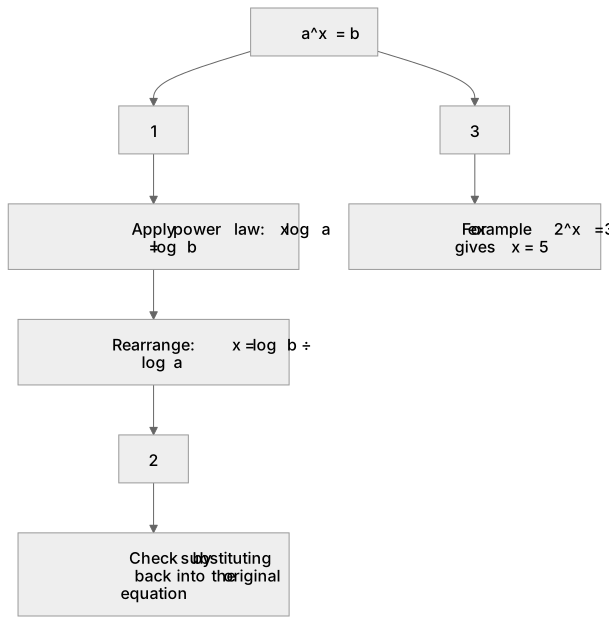
1Box 1
2Box 2
3Box 3
There is more to this lesson
The full lesson goes on to check your understanding and help you earn the marks. Create a free account to carry on, with your progress saved.
A week of Premium from your first lesson · Then the free plan continues · No card, no charge
Test your understanding of Exponentials and logarithms: 6.5 Solve equations of the form a^x = b.
Active recall beats re-reading. Take an instant quiz now to test what you’ve learned and lock it into long-term memory.
A week of Premium from your first lesson · Then the free plan continues · No card, no charge