Pearson Edexcel · A-Level · Mathematics
Course version: 9MA0 · Version from Mar 2026
Understand and use weight and motion in a straight line under gravity;…
Full specification wording
Forces and Newton’s laws: 8.3 Understand and use weight and motion in a straight line under gravity; gravitational acceleration, g, and its value in S.I. units to varying degrees of accuracy. (The inverse square law for gravitation is not required and g may be assumed to be constant, but students should be aware that g is not a universal constant but depends on location).
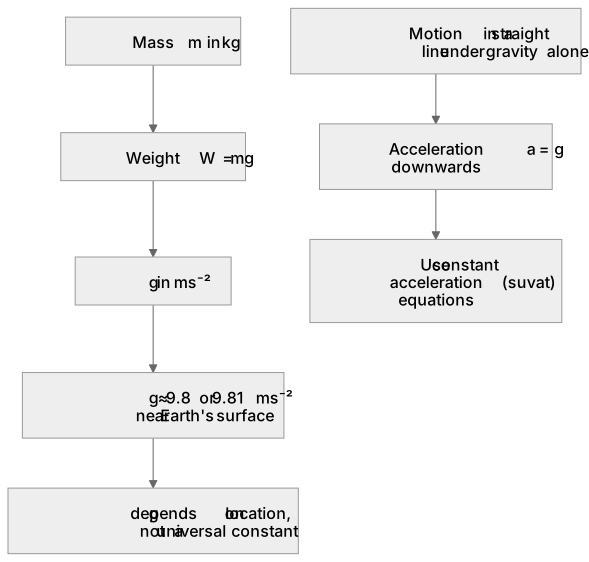
Weight is the gravitational force on a mass: W = mg, where m is mass in kg and g is gravitational acceleration in m s⁻².
Checked against the Pearson Edexcel 9MA0 specification (opens in a new tab) on .
- Point 3 of 6
- 4 key terms
Study notes
From the checked teaching notes for this specification point.
The idea
Weight is the gravitational force on a mass: W = mg, where m is mass in kg and g is gravitational acceleration in m s⁻². Near the Earth’s surface, g ≈ 9.8 m s⁻², often used as 9.81 m s⁻² or 9.8 m s⁻² depending on required accuracy. For motion in a straight line under gravity alone, a particle accelerates downwards at g, so equations of constant acceleration (suvat) apply with a = g. For example, a ball dropped from rest falls 4.9 m in 1 s because s = ½gt² = ½ × 9.8 × 1² = 4.9 m. g is not a universal constant: it varies slightly with location and altitude, being about 9.81 m s⁻² in the UK and about 9.78 m s⁻² at the equator. The inverse square law is not required, but you should recognise that g depends on distance from the Earth’s centre. Always use S.I. units: weight in N, mass in kg, g in m s⁻².
What earns the marks
- Calculate weight using W = mg, ensuring mass is in kg and g is in m s⁻².
- Use g = 9.8 m s⁻² or 9.81 m s⁻² as appropriate to the accuracy required, and state the value used.
- Apply the constant acceleration equations with a = g for vertical motion under gravity, taking downwards as positive or negative consistently.
- Recognise that g varies with location and is not a universal constant, though it may be treated as constant near the Earth’s surface.
- Convert between units where necessary, for example grams to kilograms, and keep S.I. units throughout.
Common mistakes and how to put them right
Using g = 10 m s⁻² when the question expects 9.8 m s⁻² or 9.81 m s⁻².
Put it right by reading the required accuracy and using the stated value.
Confusing mass and weight.
Put it right by remembering mass is in kg and weight is a force in N calculated as mg.
Mixing sign conventions in suvat equations.
Put it right by choosing a positive direction and applying it consistently to displacement, velocity and acceleration.
Exam tips
- Write down the value of g you are using at the start of your solution.
- List the suvat variables you know and the one you need before substituting into an equation.
- Check that your final answer has the correct unit and a sensible magnitude for the context.
Try the lesson
The start of the Forces and Newton’s laws: 8.3 Understand and use weight and motion in a straight line under gravity; gravitational acceleration, g, and its value in S.I. units to varying degrees of accuracy. (The inverse square law for gravitation is not required and g may be assumed to be constant, but students should be aware that g is not a universal constant but depends on location). lesson, made from checked teaching notes for this specification point.
Have a go first
An object of mass 8 kg is at rest on a table. Taking g = 9.8 m/s², calculate the weight of the object.
Listen
Weight is the gravitational force on a mass: W = mg, where m is mass in kg and g is gravitational acceleration in m s⁻². Near the Earth’s surface, g ≈ 9.8 m s⁻², often used as 9.81 m s⁻² or 9.8 m s⁻² depending on required accuracy. For motion in a straight line under gravity alone, a particle accelerates downwards at g, so equations of constant acceleration (suvat) apply with a = g. For example, a ball dropped from rest falls 4.9 m in 1 s because s = ½gt² = ½ × 9.8 × 1² = 4.9 m. g is not a universal constant: it varies slightly with location and altitude, being about 9.81 m s⁻² in the UK and about 9.78 m s⁻² at the equator. The inverse square law is not required, but you should recognise that g depends on distance from the Earth’s centre. Always use S.I. units: weight in N, mass in kg, g in m s⁻². A strong answer earns marks for these points. Calculate weight using W = mg, ensuring mass is in kg and g is in m s⁻². Use g = 9.8 m s⁻² or 9.81 m s⁻² as appropriate to the accuracy required, and state the value used. Apply the constant acceleration equations with a = g for vertical motion under gravity, taking downwards as positive or negative consistently. Recognise that g varies with location and is not a universal constant, though it may be treated as constant near the Earth’s surface. A common slip: Using g = 10 m s⁻² when the question expects 9.8 m s⁻² or 9.81 m s⁻². Instead, reading the required accuracy and using the stated value. Exam tip: Write down the value of g you are using at the start of your solution.
See it
Key words
Say what each word means before you turn the card.
Weight
Try answering aloud or in your head before turning the card.
Gravitational acceleration
Try answering aloud or in your head before turning the card.
Motion under gravity
Try answering aloud or in your head before turning the card.
S.I. units
Try answering aloud or in your head before turning the card.
See every definition
- Weight
- The gravitational force on a mass, given by W = mg, where m is mass in kg and g is gravitational acceleration in m s⁻².
- Gravitational acceleration
- The value g, in m s⁻², which near the Earth's surface is approximately 9.8 m s⁻², often used as 9.81 m s⁻² depending on required accuracy.
- Motion under gravity
- Motion in a straight line under gravity alone, where a particle accelerates downwards at g so equations of constant acceleration apply with a = g.
- S.I. units
- The units to always use: weight in N, mass in kg, and g in m s⁻².
Label the diagram
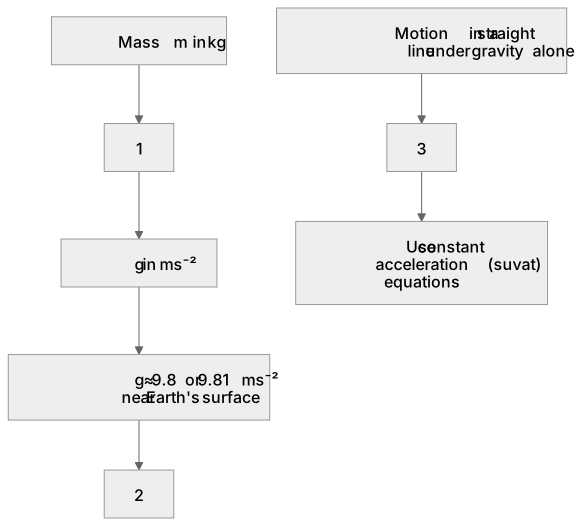
Some boxes have lost their names. Pick the right name for each number.
1Box 1
2Box 2
3Box 3
There is more to this lesson
The full lesson goes on to check your understanding and help you earn the marks. Create a free account to carry on, with your progress saved.
A week of Premium from your first lesson · Then the free plan continues · No card, no charge
Test your understanding of Forces and Newton’s laws: 8.3 Understand and use weight and motion in a straight line under gravity; gravitational acceleration, g, and its value in S.I. units to varying degrees of accuracy. (The inverse square law for gravitation is not required and g may be assumed to be constant, but students should be aware that g is not a universal constant but depends on location).
Active recall beats re-reading. Take an instant quiz now to test what you’ve learned and lock it into long-term memory.
A week of Premium from your first lesson · Then the free plan continues · No card, no charge