Pearson Edexcel · A-Level · Mathematics
Course version: 9MA0 · Version from Mar 2026
Understand and use the F ≤ μR model for friction; coefficient of friction;…
Full specification wording
Forces and Newton’s laws: 8.6 Understand and use the F ≤ μR model for friction; coefficient of friction; motion of a body on a rough surface; limiting friction and statics.
Friction opposes relative motion or tendency to move.
Checked against the Pearson Edexcel 9MA0 specification (opens in a new tab) on .
- Point 6 of 6
- 4 key terms
Study notes
From the checked teaching notes for this specification point.
The idea
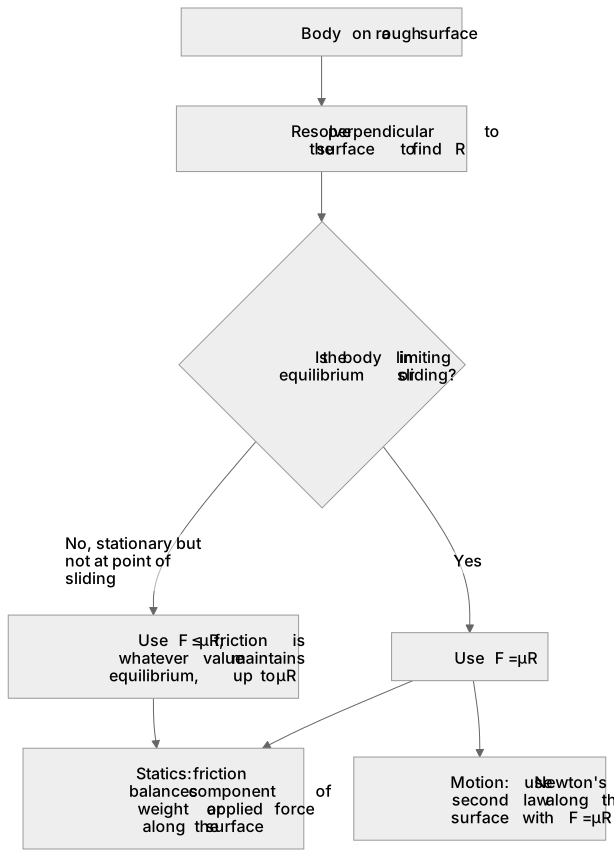
Friction opposes relative motion or tendency to move. The model F ≤ μR relates friction F to normal reaction R and coefficient μ. When a body is in limiting equilibrium, F = μR; otherwise F < μR. For a body on a rough surface, resolve perpendicular to the surface to find R, then apply F = μR at limiting equilibrium or F ≤ μR when stationary. In statics, friction balances the component of weight or applied force along the surface. For motion, use Newton’s second law along the surface with F = μR if sliding. Example: a block of mass 5 kg on a rough horizontal plane with μ = 0.3 has R = 5g N, so limiting friction is 0.3 × 5g = 1.5g N. If the applied horizontal force is 10 N and g = 9.8 m s⁻², then 1.5g = 14.7 N, so the block remains stationary and friction is 10 N.
What earns the marks
- State that friction acts parallel to the contact surface and opposes relative motion or the tendency to move.
- Define the coefficient of friction μ as the constant in the relationship F = μR at limiting equilibrium, and note that μ is dimensionless.
- Resolve forces perpendicular to the rough surface to determine the normal reaction R, including cases where an applied force has a component perpendicular to the surface.
- Apply F = μR when the body is in limiting equilibrium or sliding, and apply F ≤ μR when the body is stationary but not at the point of sliding.
- For statics on a rough inclined plane, resolve parallel and perpendicular to the plane and use F = μR at the point of impending motion.
- For motion on a rough surface, use Newton’s second law along the direction of motion with friction F = μR, and include acceleration or deceleration as appropriate.
Common mistakes and how to put them right
Assuming friction always equals μR.
Put it right: Use F = μR only at limiting equilibrium or when sliding; otherwise friction is whatever value is needed to maintain equilibrium, up to μR.
Using R = mg without resolving perpendicular to the surface.
Put it right: Resolve perpendicular to the surface; on an inclined plane R = mg cos θ for a body with no other perpendicular forces.
Treating μ as having units.
Put it right: μ is dimensionless because it is the ratio of two forces.
Forgetting that friction can act up or down an inclined plane depending on the direction of impending motion.
Put it right: Determine the direction of relative motion or tendency to move before assigning the direction of friction.
Exam tips
- Draw a clear force diagram showing weight, normal reaction, friction and any applied forces, with friction opposing the direction of motion or impending motion.
- State whether the body is in limiting equilibrium, stationary but not limiting, or moving before choosing F = μR or F ≤ μR.
- Show the resolution perpendicular to the surface to find R, then substitute into F = μR if appropriate; keep g as a symbol until the final numerical evaluation unless a numerical value is required.
- Check the direction of friction on an inclined plane by considering which way the body would slide if friction were absent.
Try the lesson
The start of the Forces and Newton’s laws: 8.6 Understand and use the F ≤ μR model for friction; coefficient of friction; motion of a body on a rough surface; limiting friction and statics. lesson, made from checked teaching notes for this specification point.
Have a go first
A block of mass 4 kg rests on a rough horizontal floor. The coefficient of friction between the block and the floor is 0.3. Taking g = 9.8 m/s², calculate the magnitude of the limiting friction force acting on the block.
Listen
Friction opposes relative motion or tendency to move. The model F ≤ μR relates friction F to normal reaction R and coefficient μ. When a body is in limiting equilibrium, F = μR; otherwise F < μR. For a body on a rough surface, resolve perpendicular to the surface to find R, then apply F = μR at limiting equilibrium or F ≤ μR when stationary. In statics, friction balances the component of weight or applied force along the surface. For motion, use Newton’s second law along the surface with F = μR if sliding. Example: a block of mass 5 kg on a rough horizontal plane with μ = 0.3 has R = 5g N, so limiting friction is 0.3 × 5g = 1.5g N. If the applied horizontal force is 10 N and g = 9.8 m s⁻², then 1.5g = 14.7 N, so the block remains stationary and friction is 10 N. A strong answer earns marks for these points. State that friction acts parallel to the contact surface and opposes relative motion or the tendency to move. Define the coefficient of friction μ as the constant in the relationship F = μR at limiting equilibrium, and note that μ is dimensionless. Resolve forces perpendicular to the rough surface to determine the normal reaction R, including cases where an applied force has a component perpendicular to the surface. Apply F = μR when the body is in limiting equilibrium or sliding, and apply F ≤ μR when the body is stationary but not at the point of sliding. A common slip: Assuming friction always equals μR. Instead, use F = μR only at limiting equilibrium or when sliding; otherwise friction is whatever value is needed to maintain equilibrium, up to μR. Exam tip: Draw a clear force diagram showing weight, normal reaction, friction and any applied forces, with friction opposing the direction of motion or impending motion.
See it
Key words
Say what each word means before you turn the card.
Friction
Try answering aloud or in your head before turning the card.
Coefficient of friction
Try answering aloud or in your head before turning the card.
Limiting equilibrium
Try answering aloud or in your head before turning the card.
Normal reaction
Try answering aloud or in your head before turning the card.
See every definition
- Friction
- A contact force that acts parallel to the contact surface and opposes relative motion or the tendency to move.
- Coefficient of friction
- The dimensionless constant μ in the relationship F = μR at limiting equilibrium.
- Limiting equilibrium
- The state in which a body is at the point of sliding, so that F = μR rather than F < μR.
- Normal reaction
- The force found by resolving perpendicular to the rough surface, used with μ in the friction model.
Label the diagram
Some boxes have lost their names. Pick the right name for each number.
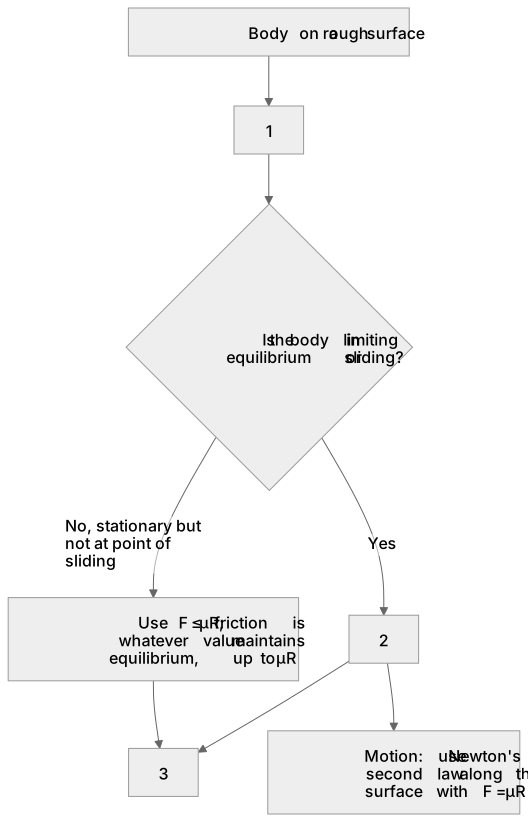
1Box 1
2Box 2
3Box 3
There is more to this lesson
The full lesson goes on to check your understanding and help you earn the marks. Create a free account to carry on, with your progress saved.
A week of Premium from your first lesson · Then the free plan continues · No card, no charge
Test your understanding of Forces and Newton’s laws: 8.6 Understand and use the F ≤ μR model for friction; coefficient of friction; motion of a body on a rough surface; limiting friction and statics.
Active recall beats re-reading. Take an instant quiz now to test what you’ve learned and lock it into long-term memory.
A week of Premium from your first lesson · Then the free plan continues · No card, no charge